Whales and the Secret Languages of the Sea of Cortez
By Bryan Jauregui
You are floating in 80 feet of clear blue water off Baja California Sur, and the ocean is talking. You feel it before you hear it — a low, resonant pulse that enters your chest like a bass note from some cosmic instrument. Then it becomes sound: deep, rhythmic clicks, rising and falling in a pattern that is startlingly, unmistakably conversational. Somewhere in the blue dark below, a sperm whale is speaking.
The Sea of Cortez — what Jacques Cousteau called “the world’s aquarium” — is one of the most biodiverse marine environments on the planet. It is also one of the most talkative. At any given moment, the cetaceans that call these waters home or highway are communicating, strategizing, teaching their children, and calling out the names of their friends. They are, in short, doing things we have long considered exclusively human. Language. Culture. Family.
The science is in, and the news is humbling: we are not the only creatures on Earth who talk.
The Sperm Whale: A Language in the Dark
Of all the conversationalists in the Sea of Cortez, none has seized the scientific imagination more fiercely than the sperm whale — a 60-foot deep diver with the largest brain of any animal that has ever lived. And it turns out, that brain has a lot to say.
Sperm whales communicate using patterns of clicks called “codas” — short, rhythmic bursts that, to the human ear, sound like Morse code tapped on a pipe. In his 2020 book Becoming Wild, naturalist Carl Safina spent time with researcher Shane Gero’s Dominica Sperm Whale Project, watching specific families of sperm whales whose individual members Gero has known for years. What Safina witnessed was extraordinary: multigenerational matriarchies — grandmothers, mothers, daughters, calves — using their shared coda repertoire to stay in contact during deep dives, announce their return to the surface, and participate in boisterous group socializing sessions he describes as family reunions in which whales clustered together, rolling and rubbing, clicking furiously back and forth.
In 2024, MIT’s CSAIL lab and Project CETI published research in Nature Communications analyzing nearly 9,000 codas collected from Eastern Caribbean sperm whale families over a decade, identifying a “sperm whale phonetic alphabet” of stunning complexity — including rhythm, tempo, rubato, and ornamentation, where whales make sub-second adjustments mid-conversation to match one another. UC Berkeley linguist Gašper Beguš found that when codas are sped up to match the tempo of human speech, they contain vowel-like sounds and diphthongs. The clicking is not merely communication. It is kinship, transmitted acoustically.
“Despite their dramatically divergent evolutionary lineage, sperm whales have aspects within their communication system typically reserved for humans,” said Dr. Shane Gero, founder of the Dominica Sperm Whale Project.
The Gray Whale: Lullabies in the Lagoon
Every winter some lucky humans make the pilgrimage to Baja’s protected lagoons to meet the gray whales that have been coming to these warm shallows for millennia to mate, give birth and nurse their calves. What most visitors don’t realize is that they’re eavesdropping on a constant conversation.
Dr. Aaron Thode of Scripps Institution of Oceanography has been recording the underwater soundscape of Baja’s lagoons since 2005, documenting a rich vocabulary of at least six distinct call types: low-frequency “conga” knocks, moaning growls, bubble blasts, and a mysterious croaking “S4” call that reminds everyone who hears it of a very large frog. Most poignant is what researchers call a potential “motherese” — a special vocal register mothers may use only with their newborns. A UNAM graduate student, Anaid López Urbán, was the first to formally describe this gentle low-frequency call, the “Ronroneo,” recorded from groups of whales in the lagoon. The idea that gray whale mothers whisper to their calves in a voice reserved just for them, just as human mothers soften their voice for infants, feels less like a surprise and more like recognition. For those of us who have been lucky enough to have a gray whale mother push her calf toward our panga so the little one can be scratched — an experience that will rearrange your understanding of wildness for the rest of your life — the idea that she is also murmuring to it in whale is deeply satisfying.
The Humpback: The Ocean’s Pop Stars
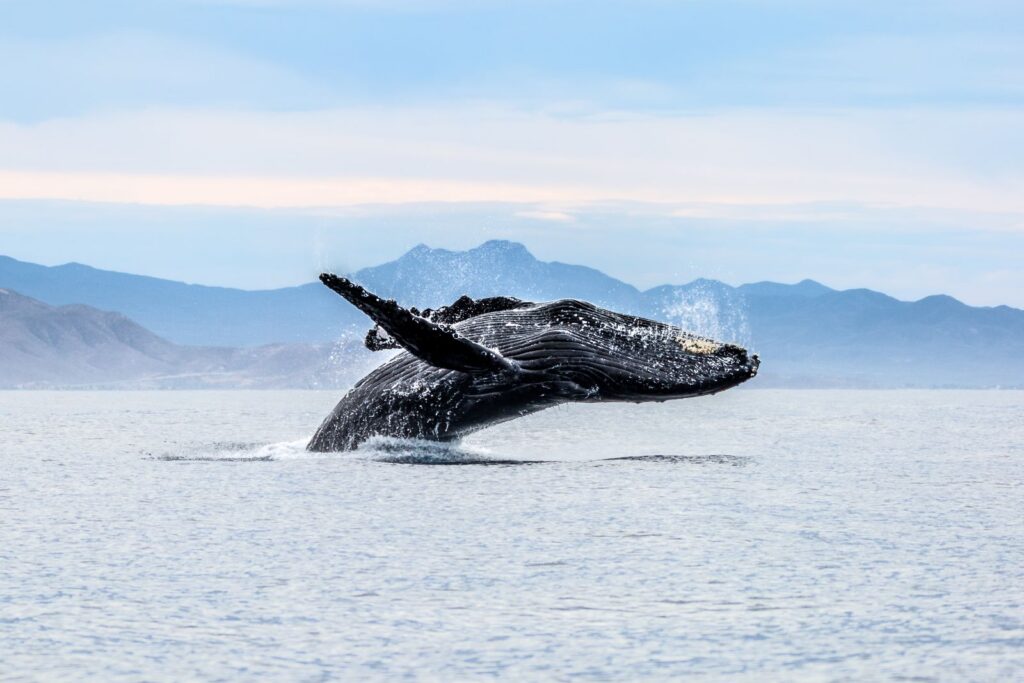
If sperm whales are cryptic scholars and gray whales devoted mothers, humpbacks are the rock stars. From January through March, male humpbacks fill the Sea of Cortez with songs of such length and complexity that marine biologist Philip Clapham called them “probably the most complex in the animal kingdom.” Roger Payne’s discovery of humpback song in 1971 changed conservation history — his recordings, released as a bestselling album, helped launch the Save the Whales movement.
The research has only deepened since. A 2025 paper in Science showed that humpback songs follow the same statistical efficiency laws as human language — a pattern called Zipf’s law that makes complex systems easier to learn, suggesting it emerges in any communication system transmitted culturally rather than genetically. And transmitted it is: researchers have documented “song revolutions” sweeping the South Pacific, entirely new songs spreading eastward from Australia to New Caledonia to French Polynesia — cultural waves of music carried whale to whale across thousands of miles. The humpbacks wintering in the Sea of Cortez are part of this same vast acoustic culture. Meanwhile, mothers and calves exchange a softer repertoire of 30 or more social call types — low grunts and high whistles passed between them in their warm nursery waters. The singing male performs for rivals and mates. The whispering mother keeps her family alive.
Blue Whales, Fin Whales, and the Voices That Cross Oceans
The blue whale — the largest animal to ever exist — communicates at up to 189 decibels in frequencies so low we feel rather than hear them. The Sea of Cortez is among the most important blue whale feeding grounds in the North Pacific, with hundreds of individuals gathering to feast on the extraordinary upwellings of krill. And while they feed, they talk. Stanford researchers have identified a specific acoustic signal that marks the moment when individual blues shift from feeding to migration mode, a change in song that may broadcast “time to move” across hundreds of miles of open water. Since the 1960s, blue whale songs worldwide have been deepening in pitch — a global mystery that nobody has yet explained, a conversation we cannot fully hear, let alone understand.
The fin whale, the second-largest animal on Earth, speaks in 20 Hz pulses so powerful that U.S. Navy hydrophones monitoring for Soviet submarines during the Cold War picked them up and worried when they couldn’t identify them. They were picking up whales. Fin whale calls travel hundreds of kilometers underwater; researchers tracked one vocalizing fin whale crossing 14 kilometers of an active LNG shipping lane while emitting steady calls the whole way — a vocal trail stitched through the deep, connecting one end of a shipping channel to the other.
The Orca: The Family That Never Parts
No cetacean demonstrates the bond between language and family more dramatically than the orca. Resident orcas live in stable matrilines from which neither males nor females ever emigrate. A son stays with his mother for his entire life. The family is not just a social unit — it is permanent and absolute. And the family speaks in its own language.
Each pod maintains a dialect of 7 to 17 distinct call types, unique to that pod and passed down through the matriline the way a surname passes through generations. Calves begin vocalizing within days of birth and learn their family’s calls from their mothers — and research has shown that family-specific calls actually increase following the birth of a calf, as if the whole pod leans in to make sure the newest member learns who they are. In the Sea of Cortez, orca pods coordinate cooperative hunts through real-time acoustic signals, directing family members to surround prey and share the kill. They hunt together, eat together, and apparently talk the whole thing through.
The Dolphin: Everyone Has a Name
And then there are the dolphins — acrobatic, sociable, endlessly present — bow-riding the pangas and assembling in superpods of hundreds that silver the surface with their backs. They are engaging in something that startles even seasoned researchers: they call each other by name.
Bottlenose dolphins develop a unique “signature whistle” within the first few months of life — a high-pitched call they invent themselves and use for the rest of their lives to announce who they are. No two are alike. More remarkable still, dolphins copy each other’s whistles to address one another directly — the equivalent of saying someone’s name. “Raul” — “Yeah, I’m here.” Research has shown dolphins can recognize signature whistles of individuals not encountered in more than 20 years, a feat of social memory that rivals our own. Scientists have also identified non-signature whistles that appear to carry specific meanings: one seems to function as an alarm, another as a query. In a delightful field experiment, researchers played the whistles of two bonded males back to them while they swam together — and heard what the scientists on the boat laughingly called the “WTF whistle” in return. The dolphins were confused. They were together. Why was someone calling their names?
What the Whales Have Always Known
The old question of what separates humans from other animals has always had a short answer: language. We talk, they don’t. The cetaceans of the Sea of Cortez are quietly dismantling that story.
Sperm whales have a phonetic alphabet and family-specific dialects passed down through matrilines. Humpback songs follow the statistical laws of human language and sweep across ocean basins like cultural revolutions. Gray whale mothers whisper to their newborns in a voice reserved only for them. Orcas never leave their families and speak in accents unique to their pod. Dolphins invent names for themselves, remember their friends across decades, and may even talk about individuals who aren’t in the room.
These are not metaphors or projections. These are documented, peer-reviewed behaviors. They point toward something both exhilarating and sobering: the Sea of Cortez is not simply a beautiful place to swim. It is a world of ongoing conversation — of love and strategy and identity expressed through sound, across generations of animals that are, in ways we are only beginning to understand, kin to us.
Project CETI is applying machine learning, robotics, and AI to the codas of the Dominica sperm whale families, hoping to translate what they’re actually saying. When that answer comes, it will not merely be a scientific discovery. It will be a first contact.