by Bryan Jáuregui | Adventure, Culture, Travel Industry
In 1996 Janice Kinne moved to Todos Santos with her most precious possession in the world, her baby daughter. And not much else. Mexicans call Baja the Last Frontier, and Janice was the embodiment of pioneering spirit. She had been working 60-70 hours a week as Director of Information Systems for a large ad agency in the Twin Cities area, and – while she liked the work – decided that there had to be a better lifestyle for her somewhere. Maybe somewhere with less snow and more sun, maybe somewhere with less people and more palms, maybe somewhere with less mania and more magic, maybe, in short, somewhere like Todos Santos.
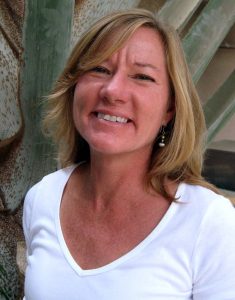
Yoga Instructor Janice Kinne
So she quit her job, sold her house, grabbed her daughter and came down to Todos Santos, where she moved into her house even though they were still constructing it around her, and bought a horse even though she hadn’t ridden much before. She looked around and found herself in a great community of artists who were giving gallery tours and organizing talks, and decided that a regular calendar of events was exactly what the community needed. Janice now lives in a beautiful house, is an expert horsewoman and her magazine – El Calendario de Todos Santos – is in its 13th year of production, has doubled in format size, and attracts advertisers from across Baja California Sur. Amazing what a little dreaming can do.
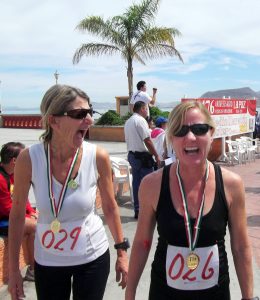
Janice (right) and Buddy Celia at La Paz Half Marathon
Back in her college days in Minnesota Janice worked as a health instructor and weight lifter in one of the local spas. Health spas being in short supply in Todos Santos, Janice turned to other channels for inspiration, namely the Yoga Zone TV channel. Each morning she would get her daughter up, then do her yoga class with the Yoga Zone. She got hooked. She sought out yoga masters and studios and practiced. She bought tapes and books and practiced. She trained for marathons and saw what yoga could do to help her. She hung out with surfers in Todos Santos and saw what yoga could do to help them. She took instructor classes and started teaching. She worked out a yoga program for equestrians and started offering it to Kaia – another Todos Santos Saint – and her students. Janice has applied yoga across several sports disciplines and is now the yoga instructor for Todos Santos Eco Adventures’ Baja Surf Camp for Women.
“My style of yoga is Hatha flow. I appreciate yoga in a cross training program as I am an equestrian and runner. I’ve seen that yoga can aid all sports by increasing body awareness, proper breathing, flexibility and balance. Surfers of all levels of experience benefit from these attributes of yoga. Also, every discipline strengthens some areas more than others and causes an over-development of some muscles that needs to be countered. Specifically, surfers tend to really work their backs and arms, but this repetitive motion shortens the back and shoulder muscles. They need more work on forward bends, arm stretches and core muscles to counter this. In the morning yoga classes at the Baja Surf Camp for Women, we focus on loosening up/stretching out all the muscles for the surfing lesson ahead, then getting the mind and body focused on the balance and flexibility it will need for surfing. I like to send my students off to their surfing lesson feeling rejuvenated, relaxed and ready to master the waves! Of course, the place where we hold the yoga classes helps on the inspiration front – we look out over a palm oasis and 70 miles of undeveloped beach. Definitely beats most yoga studios!”
Janice couldn’t have chosen a better location for the lifestyle she was seeking. “I love the beautiful outdoors in Baja, and am very focused on the balanced lifestyle that I was able to create in Todos Santos – work, recreation, relaxation and nutrition. All come together so naturally for me here.”
Janice’s 1996 check list reviewed in 2011:
- More sun? Check!
- More palms? Check!
- More magic? Triple check!
And that baby daughter? Thriving in high school, completely bilingual, and looking forward to college. Check!
© Copyright Sergio and Bryan Jauregui, Casa Payaso S de RL de CV, 2011
by Bryan Jáuregui | Culture, Food
Would it make you feel any better about vacationing in Mexico if you had a federal agent serving you all your meals? Then come on down to Todos Santos because Café Brown has the solution for you! Owner/Chef Iker Algorri worked as a federal agent for the state of Baja California Sur for 12 years before hanging up his badge and picking up a spatula to turn out some of the best home-cooked Mexican food you can find anywhere.
It was the agent’s instinct for survival that led him to cooking in the first place. “My mother hated to cook, so at our house we had the eternal picnic. Sandwiches, tuna salad, peanut butter. So I started cooking just to have something besides picnic food. The more sandwiches she made the more I applied myself in the kitchen. Seeing how serious I was, she finally relented and hired a cook. But not just any cook. She hired a Tlaxcaltecan woman – someone with absolutely no Spanish blood in her – who really knew how to make the great traditional dishes of Mexico. I learned an incredible amount from her, then later got the confidence to modify and create and really make things my own. It’s this blend of traditional Mexico and experimentation that I love to serve our guests at Café Brown.”
Iker grew up in Mexico City and moved to Baja in 1983 to start a career that took him all over the peninsula. In addition to his 12 years as a federal agent, Iker also worked as a translator for the court (like many Mexico City kids, he was fluent in English by the time he graduated from high school), an official with the Registry of Motor Vehicles, a Mexican ATF agent, and as a Customs officer. He even got a law degree and worked as a lawyer. In short, Iker served as all those people that you love to hate, which makes it all the more amazing that Iker and Café Brown together are two of the most-loved institutions in town.
While Iker’s mother indirectly got him interested in cooking, his father directly got him invested in Café Brown. When visiting Iker in La Paz in 2000, his dad took a side trip to Todos Santos and promptly announced, “Now I know where I’m going to die.” (Todos Santos often has that effect – ask all the residents who now have extended family living here!) Iker finished up 20 years with the government, took early retirement, and opened Café Brown with his dad in 2003. It was one of the first arts-oriented cafes in town, and has always featured live music/great recorded music, works by local artists, drumming circles, Spanish-language movies, lots of dancing and of course, cooking classes and the Cooking Adventures Week with Todos Santos Eco Adventures. That there is fabulous food is a given. Iker’s motto is “Happiness is only real when it’s shared” and sharing happiness is what the Café Brown experience is all about. And of course, it’s all perfectly safe with Federal Agent/Chef Iker running the show!

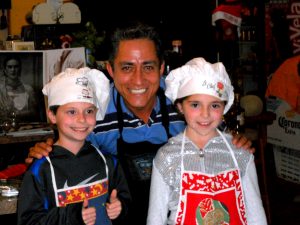
Chef Iker Algorri with Portrait at Cafe Brown
© Copyright Sergio and Bryan Jauregui, Casa Payaso S de RL de CV, 2011
by Bryan Jáuregui | Culture, Travel Industry
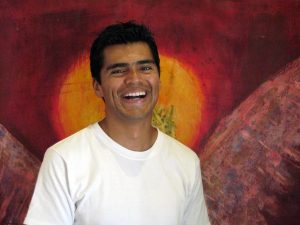
Erick in front of Yandi Monardo’s “Angeles Protectores”
by Todos Santos Eco Adventures
This is the story about the son of a carpenter who goes on to become a teacher and inspire those around him. The one born in Mexico City.
At age 21 Erick Ochoa found himself working in his father’s carpentry shop in Todos Santos, wondering what the heck he was doing there. By his own standards he wasn’t a very good carpenter. Trouble was, he didn’t know if he was good at anything else either. He’d studied engineering and architecture in college, but had dropped out when the courses failed to excite him. Erick was a young man seeking inspiration and, as Mick Jagger would say, sometimes you find you get what you need.
Which, with respect to Mick, is sometimes exactly what you want. One day a man named Jack Hall walked into the carpentry shop, and couldn’t help but notice that Erick seemed underwhelmed by his current circumstances. He asked Erick if he had any interest in art. As it happened, college had not inspired Erick but the local art museums certainly had. Jack therefore made the introductions and soon enough Erick found himself working for renowned artist and sculptor, Michael Cope, helping Michael and his wife Pat run Galería de Todos Santos. At that point Erick understood a fair bit of English, but spoke relatively little. This was the first of Erick’s skill sets that was to undergo a drastic transformation with the Copes.
The second skill set emerged shortly thereafter, when Michael (sometime in 2000) asked Erick to help him prepare some clay for sculpting. In lieu of payment, Erick asked Michael to teach him how to draw. He had no idea what he was in for. Michael demanded dedication and hard work, and Erick found himself spending hour upon hour sketching and drawing, drawing and sketching. It was a year before he was allowed to move on to colors and oils. Michael wanted Erick to prove – to both himself and Michael – that he truly wanted to learn, and that he had the talent to succeed. Neither of them was disappointed. In the process of finding his path in life, Erick also discovered the incredible power of a mentor and a teacher to change your life. He learned what it meant to have someone invest significant time, energy and talent in you. More than just another skill set, the Copes had helped him discover passion and purpose. This was something he wanted to pass on to others.
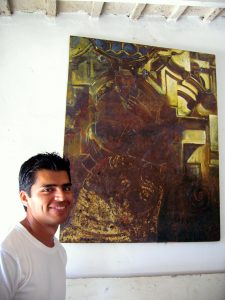
Erick and his painting, “Icono del tiempo”
Like many families, the Ochoas like to get together around the dinner table and solve the problems of the world. Just as Erick was contemplating how he might turn some of that talk into action, Donna Viglione came knocking on his door. Donna was the president of the Palapa Society, a non-profit whose mandate is to improve the lives of local Todos Santos children. She had built up the Bridge-to-English program (an after-school English-language class for local kids) and wanted to offer art classes in English to kids who excelled in the program. Erick – now fluent in English and an established artist in this artist’s colony town – was a natural choice for the job. His third skill set inspired by the Copes soon emerged: teaching, mentoring, passing it on. It’s been a great success for everyone involved. “We now have up to 20 kids between the ages of 4 and 12 in any given art class, and 8 of those are quite serious. Some of them have real potential, and one has already told me that he wants to be an artist. This is so exciting to me and I’m so happy to have this wonderful opportunity to pass on what Michael taught me.” Erick is perpetuating a great cycle. The Palapa Society now has 8 scholarship students who will graduate from university next year, and – inspired by Erick, Donna and other Palapa Society volunteers – they all want to return to Todos Santos as teachers themselves.
Erick is now the president of the Palapa Society – a job which pays him very well in satisfaction – and spends a great deal of time on the program during the school year, not only teaching but going to the local schools to work with the Palapa Society scholarship kids and their teachers. He only has time to paint two to three hours a day when school is in session. “But in the summertime I paint all day. Everything in Todos Santos inspires me. The days are beautiful, with light so unbelievably crisp and clear. Todos Santos is always a study in contrasts with the desert and ocean. But in the summertime it gets even wilder – we’ll often have a huge thundercloud formation over the mountains, at the same time that we have an incredible sunset over the ocean.” Same carpenter’s son, same home town, a different world entirely. The magic of our pueblo magico revealed.
© Copyright Sergio and Bryan Jauregui, Casa Payaso S de RL de CV, 2011
by Bryan Jáuregui | Culture, Food
by Todos Santos Eco Adventures
Todos Santos has a well-deserved reputation as a food lover’s paradise, with our many fabulous restaurants, cafés and wine bars. But what you may not know is that Todos Santos also has some pretty darn good taco stands. In fact, our official, self-appointed, Mexico City taco snob has reviewed the taco scene in Todos Santos and has pronounced our town’s taquerias to be right up there with the big-city greats. We interviewed 4 taco stands in town to find out about the people behind the tacos and to answer that burning question: what makes a great taco, a great taco?
El Pastorcito
- Best for: tacos al pastor and carne asada
- Hours: 7:00 AM to 1:00 AM daily. Except maybe some days in summer.
The 2 Lucias who run El Pastorcito have been offered significant sums of money to reveal the secrets of their tacos al pastor, but they’re not selling or telling. “We get the pork in from Cabo San Lucas then do all the preparation here. It’s a secret recipe of the owner. But we do use the traditional pineapple on the top and bottom of the meat, or sometimes an onion on the bottom. That’s all we can tell you!” When asked what makes a great taco a great taco, they said it’s all in the preparation of the meat and the salsas. “Salsas must be prepared fresh everyday with fresh ingredients. We buy all local Todos Santos produce for the salsas and it makes a nice difference.” For vegetarians El Pastorcito also serves papas rellenos and quesadillas. Beer, soft drinks and water for sale. El Pastorcito was started 3 years ago by Alejandro Fuerte, a 20-year resident of Todos Santos who moved here from Michoacan.
Taco George’s
- Best for: fish tacos
- Hours: 9:00 AM to 3:00 PM every day but Thursday
Taco George’s
This taco cart on the side of the road is a celebration of Baja California Sur’s great contribution to Mexican cuisine – the fish taco! Started 10 years ago by the original “George” Jorge Ramirez Rodriguez of La Paz, it is now run by George Jr. who moved to Todos Santos 2 years ago to take over management of the stand from his father. He’s done pretty well by the old man – in high season he moves 300 to 400 tacos a day from his cart. George buys his fish from the local fishermen at Punta Lobos and is proud to be serving a Todos Santos-sourced meal. When asked what makes a great taco a great taco he plays his cards close to the chest. ‘Oh, nothing special. That I can tell you about.” Soft drinks available for sale.
Barajas Tacos
- Best for: carnitas con cuero and chicharron
- Hours: 8:00 AM to Midnight, every day but Tuesday
Ruben at Barajas Tacos
Started by La Paz resident Jorge Barajas in 1995, Barajas is a long-time favorite with residents and visitors alike. When asked what makes a great taco, Esmeralda and Ruben – both of whom have worked at Barajas for 11 years – said it all comes down to the people who prepare the pork for the carnitas. As it happened, the new carnita supplier for Barajas was there during our meal (the old supplier went on vacation and never came back) and he explained “It’s all about the correct combination of time and heat, and knowing how to get this right takes years of practice. We cook the meat with onion, garlic and orange – and maybe a few other things too.” Vegetarians in the crowd? Barajas also serves papas rellenos (stuffed potatoes) an assortment of quesadillas, and fish/shrimp tacos. Only soft drinks and water available for drinks, but you can bring your own beer or wine.
El Tacos y Mariscos Sinaloense
- Best for: smoked marlin and shrimp tacos
- Hours: 7:00 AM to 2:00 AM every day except Monday. Tacos during the day and mariscos (seafood) at night.
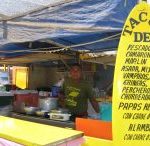
Jose Luis at El Sinaloense
Looking for a more peaceful environment, Jose Luis Ibarra Grimaldi, his wife Maria and their children moved to Todos Santos from Mazatlan four years ago. But they retain their Sinaloa ties and buy their shrimp and smoked marlin from there (Jose Luis reminds us it’s all the Sea of Cortez!). When asked what makes a great taco a great taco, Jose Luis doesn’t hesitate. “There are really 3 main factors: 1. The product – what you put into it. We only buy the best. 2. Spices and salsas. We take great pride in our salsa bar. 3. Service.” El Sinaloense also serves a variety of meat tacos, papas rellenos and quesadillas. Soft drinks, orchata and water available.
This list is just representative of some of the taco joys you can find in our pueblo magico. Got your own favorite taco joint in Todos Santos? Tell us all about it!
© Copyright Sergio and Bryan Jauregui, Casa Payaso S de RL de CV, 2011
by Bryan Jáuregui | Adventure, Culture
by Todos Santos Eco Adventures
This article on Hollywood horse champion Kaia Thomson is the third in our series, The Saints of Todos Santos, which profiles some of the people who help put that spark of magic into our pueblo magico.
Queens may come and go, but queen-makers are a special force to be reckoned with, and Kaia Thomson has made 14 queens…so far. In 2005 Kaia was running a 55-acre ranch with 60 horses where she had trained 12 Gymkhana champions and 14 rodeo queens, including Brandy De Jongh, Miss Rodeo America 2000. She was at the top of her game in the horse world with students, horses in training and competing. Then she decided to move to Todos Santos. “It was my 50th birthday and I decided that I just had to move to Mexico with my horses. All my friends thought I was crazy, but I wanted to do something radical. I just had to do it.” So she did. She finished out the year on her ranch and arrived in Todos Santos in December 2005 with 3 horses and the remains of her worldly possessions. It’s now hard to imagine what the town would be like without Kaia and her incredible skills as a teacher, rider, trainer, naturalist and photographer.
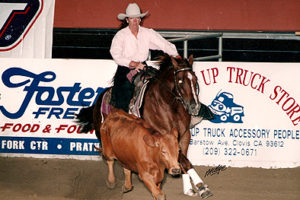
Kaia Demonstrating Her Skill at a Reined Cow Horse Competition
Kaia is one of the most down-to-earth people you’re likely to meet in this life. A characteristic that is not explained by the fact that Kaia is a true Hollywood gal who grew up under the Hollywood sign, spent a lot of time on Hollywood Boulevard and had her first horseback riding lesson at the age of 4 at Sunset Ranch Hollywood Stables. She went to Hollywood High School with many (now famous) stars and worked at a tack shop where she regularly rubbed shoulders with the likes of Sylvester Stallone, Sam Shephard, Richard Farnsworth, and Juice Newton. She worked for Glen Randall who trained Roy Rogers’ horse Trigger (“he said Trigger was the smartest horse he ever met – he could recognize over 100 words and cues”) as well as with Glen’s protégés Rex Peterson and Bobby Lovegren who trained horses for movies such as Black Beauty, Hidalgo, Zorro, and The Horse Whisperer. She ponied horses for Laz Barrera, renowned trainer of Affirmed (the last horse to win the Triple Crown) and worked alongside many champions on race days at Santa Anita, Hollywood Park and Del Mar racetracks. She rode a horse named Madrid, a grandson of Bold Ruler – Secretariat’s sire – and trained, competed and won in dressage, jumping and showmanship. She traded a saddle for a mule in the Sierra Nevada’s and competed on mules for over 16 years. She saw a Reined Cowhorse Show in Las Vegas in 1989, and soon became a regular on the National Reined Cow Horse Association circuit. She trained with Teddy Robinson, the world’s greatest Reined Cow Horse champion, and acquired the exceptional horse skills required to rein, cut and work cattle in competition. Kaia thrived on the perfect complement of sportsmanship, connection and discipline that horse competition in all its variety demanded. Then she fell in love.
Silver Drift, a dorsal-striped dun charmer affectionately known as Fourteen, was Kaia’s equine soul mate, the greatest horse she ever owned. She got him in 1996, and loved to gather cattle and team rope with him. “Roping on 14 was like riding on mashed potatoes with extra butter…everyone wanted me to head for them!” They had a great partnership and he helped her train some of those rodeo queens on her ranch. “Then on a Friday the 13th in 1999, he was just playing in his paddock and broke his leg. We had to put him down. I was devastated. It almost made me quit horses altogether. To distract me, some friends took me to Catalina Island to go scuba diving, and I was completely hooked. I went all the way through instructor and about 20 specialty courses, mainly because I loved being able to engage in one of my great passions – photography – under water. This is what led me to Baja because in 2000 I came to La Paz for my birthday to go scuba diving in the Sea of Cortez – which I even did once in my birthday suit! I absolutely loved it and started coming back 2 to 3 times every year to dive. On one of these trips it was too windy to dive so a friend suggested that we check out this little town called Todos Santos. When I got here I realized that I’d seen all this lush greenness in the desert several times from the air. I loved it.”

Kaia Jumping
While it seemed like a wild decision to walk away from the incredible life that she’d built in the horse world in the U.S., Mexico was a natural fit. “Mexico is founded on ranchero culture – horses, mules, burros – all used for transport and working the ranch. Mexicans are very proud of their horse heritage. The Criollos, the local horses, can all trace their lineage back to the horses that Hernán Cortés brought to Mexico over 500 years ago and turned loose before heading back to Spain. Mexico now even has its own official breed of horse, the Española, a cross between Andalusians and quarter horses. This mixture is meant to create the ultimate caballo de charro or rodeo horses, and they’ve been pretty successful with this.”
“The horse community here has been so welcoming to me. My horse buddies and I are always invited to ride in the cabalgatas (horse parades or trail rides) and these are an enormous amount of fun. These are often 2 days and 1 night, and will have over 200 riders on horses, burros and mules. There are around 30 cabalgatas a year in the little towns around southern Baja, and the one we participate in the most ends in an extravaganza at the stadium in Todos Santos where the Escaramuza ladies put on a great show. These are young women who ride in a drill team style formation at a full gallop to emulate the women of the revolution who would put on their colorful adelitas – pretty dresses with full flowing skirts – and head out on horseback to attract the men of the enemy. When the men got into firing range the escaramuzas would sling the hidden rifles off their shoulders and aid the rest of the army with the task at hand. Lots of the local cowboys also do horse dancing and trick riding. We also get invited to a lot of the horse races on straight tracks that are held in all the different towns. After the “fancy” horses run, sometimes my students will ride one of my horses in the races – we’ve actually won 6 out of 7!”
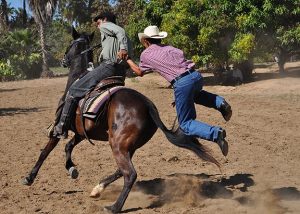
Heri and Javier at an Internado Competition
One of the reasons the local horse community is so fond of Kaia is because of her work with the Internado, the boarding house for ranch kids who come to Todos Santos to go to school. Each year the Internado has an Annual Open House to raise funds, and Kaia trains the Internado students for 2 months to prepare them for the competition that they put on as part of the fundraiser. Past events have included simulating ranch tasks like catching a chicken, roping a cow, and “killing” a bandito with a machete, all from the back of a galloping horse (chicken/cow/bandito dummies used), as well as barrel racing and cavalry-style carousels. Throughout the rest of the year Kaia sponsors the Internado kids to come to her place once a week to go riding and work the horses with her.
The Internado students are not the only ones who benefit from Kaia’s generosity with her talents. For each edition of the town’s local magazine, El Calendario, Kaia – a “self-appointed naturalist” – donates two pages of her amazing photographs which document the wild beauty of the flora and fauna of Baja. She also usually contributes an article or two on local businesses, people of note, or natural history. “I always completely embrace wherever I am. I’ve been fewer places than some people, but I know a great deal about many aspects of those few places and I love sharing that knowledge.”
Luckily for the people of Todos Santos, residents and visitors alike, Todos Santos is one of those few places where Kaia has chosen to shine her light and share her knowledge. She has a really fun place where you can train in dressage, jumping and gymkhana. Or you can just go on a Todos Santos Eco Adventures sunset ride with Kaia, and ask her about endemic bird species…or the life spans of local cactus… or Mexican charro rodeo regulations…or whale shark feeding habits in the Sea of Cortez….or the beauty secrets of rodeo queens…or what it really feels like to be an American cowgirl living in a magic Mexican village.
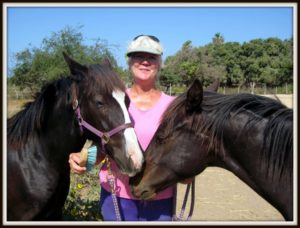
Kaia with Friends in Todos Santos
© Copyright Sergio and Bryan Jauregui, Casa Payaso S de RL de CV, 2011