by Bryan Jáuregui | Adventure, Blog, Culture, Travel Industry
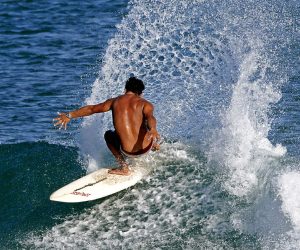
Photo by Jocelyn Mathe for the Journal del Pacifico article, Surfing Santeños
When you head out to the surf breaks of Todos Santos you don’t see many people who can trace their ancestry back through five generations of Todos Santeños, but 23-year old Dany Torres can. While many Mexican residents of Todos Santos prefer to leave the water well enough alone, Dany’s grandfather used to go body surfing at La Poza (please don’t try this at home!) and his father met his Canadian mother while working as a dive instructor in Cabo. It’s a family that clearly loves the water, but it was an American who gave him his first surf board at the age of 12 and, like his surfing American neighbors, it completely changed his life. Now a budding architect in Todos Santos with several projects underway, Dany says “Surfing defines my days. I surf early in the morning during the week because of work commitments, but on the weekend I’ll often surf all day long.” As a dual Mexican-Canadian citizen he has plenty of options for places to launch his career. But for Dany, there’s no place like home. “I’ve surfed all over mainland Mexico, California and Canada and I really love surfing at home the best. Not only are the waves great, but there is no territoriality. I’m actually one of the youngest surfers around which is great because the older surfers are very laid back and really happy to share the waves. That relaxed atmosphere just adds to the magic of this place.”
This profile is part of our article, Surfing Santeños, published in the Summer 2012 issue of Janice Kinne’s Journal del Pacifico.
by Bryan Jáuregui | Adventure, Blog, Culture, Travel Industry
Mario’s guide to surfing the cape is part of our article, Surfing Santeños, published in the Summer 2012 issue of Janice Kinne’s Journal del Pacifico.
Las Palmas (San Pedrito)
Drive 5 km south from Todos Santos on Highway 19. Look for the Campo Experimental building on your left, and turn off the highway onto one of the dirt roads that winds toward the beach. Las Palmas is a beautiful beach with a lot of palm trees, and has a fast, heavy beach break.
• Best for: Intermediate to advanced surfers
San Pedrito
South of Las Palmas you will find San Pedrito. Also known as Pescadero Beach, it’s about 8 km south of Todos Santos. It’s a point break with a rocky bottom and breaks best with a north swell. • Best for: Advanced surfers
Los Cerritos
This is one of the best beaches in Mexico for learning to surf. Los Cerritos is a beach break with a sandy bottom and has one of the most consistent waves in Baja. It is also one of the few swimmable beaches in the area. From Todos Santos, look for the Cerritos signs at km 66. Lodging and restaurants are located nearby.
• Best for: Beginner to advanced surfers
La Curva
La Curva, also known as KM 93, has a long, right point break that only breaks with north swells and mostly in the winter. Watch for three large rocks you can only see at low tide.
• Best for: Intermediate to advanced surfers
Monuments
Five minutes from Cabo San Lucas on the way to San Jose del Cabo, this is a left point break that is best with a south swell, although it also breaks with north swells. Take the road to Misiones Hotel and park on the road. Be aware of sea urchins at low tides.
• Best for: Advanced surfers
Old Man’s
Also known as Acapulquito, this is one of three close breaks on the Costa Azul Beach. It is east of the Palmilla sign, on the right below the view point off the highway to San Jose del Cabo. It breaks with a south swell and there is a long, right point break, especially good for long boards. The waves are mushy and easy to read. Watch for rocks at low tide. Surf lessons and rentals are available here, and many restaurants are located nearby.
• Best for: Beginner to intermediate surfers
The Rock
Another break that needs a south swell, The Rock is located on the Costa Azul Beach, east of Old Man’s. It is named for the rocks that are visible from the viewpoint. It is a long, right point break, a little faster than Old Man’s.
• Best for: Intermediate to advanced surfers
Zippers
Last of the three Costa Azul breaks, Zippers is a shorter, faster, right point break. This break is popular with the locals who may seem a little territorial. Only breaks with a south swell.
• Best for: Advanced surfers
Shipwrecks
Shipwrecks offers a fast, right point break. Be aware of rocks. It is located on the East Cape. To get there travel past downtown San Jose del Cabo on the bridge over the estuary then drive approximately 20 minutes east.
• Best for: Advanced surfers
Nine Palms
Drive another 20 minutes east of Shipwrecks, and look for the palms at the little rancho, where you may find donkeys and cows resting in the shade. This is a mushy, long point break, good for long boards.
• Best for: Beginner surfers
by Bryan Jáuregui | Adventure, Blog, Culture, Travel Industry
In the age of jet-setting surfers pursuing monster waves across the globe for fame and money; of California surf breaks so crowded it is not uncommon to see 100 boards or more in the water; of jet skis towing surfers to catch waves that the human body could never conquer on its own, it is wonderful to hear Todos Santos resident Steve Merrill recall the age in which he first saw a surfer. “It was 1956 and I was six years old. My parents were driving the car along Pleasure Point in Santa Cruz, California, and I saw a guy standing on a giant wooden board gliding across the waves, completely alone on the water. It is impossible to describe the impact that vision had on me. I knew then and there that surfing was what I had to do.” Steve’s immediate enthrallment with surfing is echoed in the voice of the young narrator in Australian writer Tim Winton’s surfer-coming-of-age novel Breath, “How strange it was to see men do something beautiful. Something pointless and elegant, as though nobody saw or cared…as if dancing on water was the best and bravest thing a man could do.” Back in the day, Winton tells us, surfing was the closest a man could get to poetry.
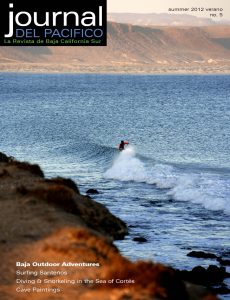
If surfing is akin to poetry then Todos Santos today is the City Lights Bookstore and the Beatniks are having a poetry slam. “We’re living the bonus years here in Todos Santos” says surfing resident Billy Girvan. Like many expats in the Todos Santos surfing community, Billy grew up in California just as surfing culture was taking root. “In 1959 I was 12 years old and saw these guys surfing in Santa Barbara. All I wanted was to be like them. It wasn’t just the surfing, it was the life style that was so appealing, the beach life, the freedom. They were so different from everyone else. I traded my go-cart for a surfboard and never looked back.” Todos Santos surfer Jim McRoberts knows just how he feels. “In 1962 I was 15 and living in Sierra Madre, California. My uncle was a founding member of the San Onofre Surf Club and took me with him to the beach one day. That first time riding a wave, the sensation was simply amazing. It took hold of me immediately and I couldn’t think of doing anything else. My passion has never lessened from that day to this.” Like Billy, Jim was just as in love with the surfing culture as with the surfing itself. “Everything important was happening at the beach.”
Billy, Jim, Steve and countless other expat surfers living in Todos Santos went from being “grommets”, or “gremmies” – slang for young surfers – to embracing the full surfing life as older teens and adults. A lot of school was missed, a lot of pretty girls chased, a lot non-food items ingested and a whole lot of waves caught. Poetry? Absolutely. “Poetry is not only dream and vision” says poet Audre Lorde, “It is the skeleton architecture of our lives. It [is] a bridge across our fears of what has never been before.” For these boys surfing was the bridge to embracing nature in a most intimate, thrilling and terrifying way. Surfing was the bridge out of an ordinary life into something sublime. Surfing was the bridge to salvation. “Going to the ocean is like going to church for me.” says Jim who went on to get a Masters in English and is currently writing a novel about surfing. “If it wasn’t for surfing I would have been a drug addict or alcoholic like a lot of my friends. You have to stay physically fit to surf. It saved me.” Billy, who went on to become a founding member and bass player for the hard rock band NoXit, agrees. “I was in the midst of living this rock star’s life and surfing is definitely what kept me healthy, what kept me alive.”
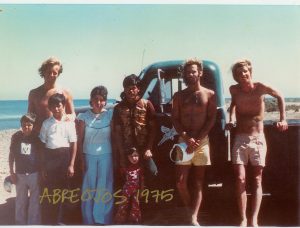
Steve Meisinger and Friends in Baja in 1975
As countless movies and songs throughout the 1960’s and ‘70s glamorized surfing culture, the surf breaks in California inevitably became more crowded and surfers became more territorial and protective of their breaks, often resulting in a tense and aggressive atmosphere. Some surfers, like Steve Meisenger, or “Meisy”, started looking elsewhere and in 1973 at the age of 18 the Morro Bay, California board shaper started coming to Baja to enjoy the peninsula’s stark beauty and uncrowded breaks. “I was getting a degree in Ornamental Horticulture at Cal Poly and would save all the money I made shaping boards during the year to come to Baja in the summer. We would live in the van and camp on the beach. We never went out to eat, we never stayed in a hotel. All of our money went to surfing and survival.” Meisy started a successful, 30-year career as a housing contractor but continued to come to Baja at least once a year. He stumbled upon Todos Santos in 1981 while looking for a mechanic. He was captivated. He found himself returning to surf the breaks here every year, and by 1990 had bought property and started building his house. “The environment in most of Baja is so harsh, but in Todos Santos we get the great waves as well as this lush environment, great weather and wonderful creature comforts.”
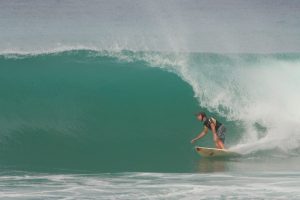
Steve Merrill Surfing in Todos Santos. Photo by Sam Belling.
The magic of Todos Santos surfing has a powerful pull. By the time Billy first visited Todos Santos in 1994 it had been 14 years since he’d last been on a surf board. But much to his joy he found that he could still ride the waves. Much to the consternation of his wife he also found that he really wanted to surf all the time, once again. “But luckily that beautiful woman really loves me so when I said I wanted to move to Todos Santos to surf she backed me 100%. We sold all of our property and here we are.” Jim knows just what he means. When he and his wife married in 1989 they moved to the mountains of Oregon so they could pursue her love of horses. “But I thought about surfing every single day, and even carved a sculpture of a wave to put over the mantel.” A 3-year road trip throughout the North American continent brought them to Todos Santos in 2009. It had been 20 years since Jim was last on a surf board, but the magic returned immediately. “Every good wave that you ride is like a gift. It is this energy that is there for you personally, energy that has come 2,000 miles for you to merge with and take to the Todos Santos shore.” Jim and his wife sold their Oregon property and have been in Todos Santos ever since.
No matter whether they surfed every day for the past 5 decades or abandoned the waves for years, surfing still provides the “skeleton architecture” of these men’s lives as they move through their 60s. And one of the key reasons they love surfing Todos Santos is, as Steve says, “This is as nice a surfing community as anyone could ever hope to find. There is hardly any localism and everyone on the waves is respectful and supportive of each other in the water.” While they may not have the stamina and moves of youth, the men don’t seem to mind (much). “Let’s face it” says Billy, “the best surfer out there is the one having the most fun. And that’s usually me!” Coming from a guy with 2 titanium bars, 4 screws and 3 vertical spacers holding his back together, that’s no mean feat. Billy already has days on the water when his back prevents him from getting up on the board, and he can see a time coming when he won’t be physically able to surf any more. “But I’m just not that worried” says Billy. “There is always mind surfing!” Poetry? Oh yes indeed.
This article by Bryan Jáuregui of Todos Santos Eco Adventures and Mario Becerril of Mario Surf School was published in the Summer 2012 issue of Janice Kinne’s Journal del Pacifico.
by Bryan Jáuregui | Adventure, Blog, Travel Industry, Wildlife
This article by Todos Santos Eco Adventures was published in the Spring 2012 issue of Janice Kinne’s Journal del Pacifico.
If you sift back through the catalog of parental admonitions that were meant to ensure you a long and happy life – you know, “don’t stick your tongue on frozen metal”, “don’t eat yellow snow”, “don’t drink your father’s last bottle of beer” – somewhere buried in there your mother must surely have added “and oh yes dear, don’t swim with sharks”.
Very sound advice to be sure but swimming with sharks – whale sharks that is – in the Sea of Cortez is truly one of life’s great (and, sadly for you danger junkies, very safe) adventures. While whale sharks have thousands of teeth in hundreds of rows in their enormous mouths (imagine armed shark mouths 4 to 5 feet wide), they can neither bite nor chew. That’s right, they are happy to forego all human body parts in favor of plankton, krill and small fish. Go figure!
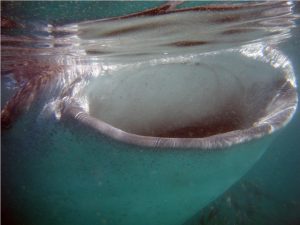
Whale Shark Mouth! Photo by Deni Ramirez
So now you feel safe but even if you were on the varsity swim team you’re probably wondering how you could actually keep pace with a shark in the water. Well, the whale shark got its moniker because it is the only fish that is literally as big as a whale; mature adults can reach 60 feet in length and 50 tons in weight. Reaching these proportions requires an immense amount of energy, which the whale shark gets by consuming huge volumes of plankton-rich water, then straining it out through its gills. In fact, to get the food it needs it is not unusual for a whale shark to filter 400,000 gallons of water an hour. To conserve this hard-won strength – and continue eating – whale sharks tend to do a lot of hanging about in the water, or, if moving, doing so at a very slow pace. This lollygagging is what makes it possible for non-bait types like humans to jump in and swim alongside them for a bit. Of course, when they want to put on the speed they certainly can so when a whale shark tires of your company all you will see is a swishing tail receding into the distance.
Now you’d think it’d be a relatively simple matter to learn about a mammoth fish the size of a school bus dawdling through the water eating up everything in its path. But the fact is that scientists still know relatively little about the whale shark, and La Paz resident Dení Ramirez of Whale Shark Mexico is trying to change all that. Originally from Mexico City, Dení has been studying whale sharks in La Paz since 2001, and completed her Ph.D. in marine biology last year. The whale shark’s skin is covered in a pattern of pale yellow spots and stripes that is unique to each animal, a type of fingerprint if you will, so Dení has been able to track some of the inhabitants of La Paz Bay. In fact, she has been tracking the young sharks Flavio, Tikki Tikki and Tango for almost a decade now, and has determined that they are true Baja residents. While whale sharks have been spotted across the globe from Australia to Djibouti, from the Philippines to Mozambique, Dení’s juveniles appear to travel only in the Sea of Cortez, from the Bay of La Paz to Bahia de Los Angeles – roughly 600 miles. We asked Dení why we seem to be seeing the whale sharks around La Paz so much more over the last couple of years than we ever did before.
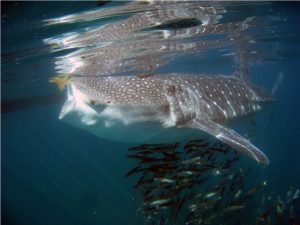
Whale Shark Feeding in the Sea of Cortez: Photo by Deni Ramirez
“It’s really just a question of food. Over the last two to three years the conditions in the Bay of La Paz have been just right to produce an enormous amount of plankton for the whale sharks to feed on. The wind, currents, mangrove conditions – all these have combined to create an excellent environment for plankton growth that we just didn’t have for such extended periods in earlier years. Also, in the Bay of La Paz the plankton is rich in the coastal waters, and these relatively shallow waters give the young sharks in my group a certain amount of protection.” Dení is happy to take visitors with her on her research trips and share some of her extensive knowledge of whale sharks and research methodology.
Dení is currently doing a lot of work with the pregnant females who inhabit the deeper waters around Espiritu Santo Island and have found that they have much larger migrations than the young sharks due to their different needs as mothers, mothers who surely will work to ensure the long life and happiness of their offspring by admonishing “and dear, don’t try to eat the humans. They’ll just clog up your gills.”
TOSEA guest Mary Winzig recounts her whale shark adventure:
“Swimming with whales sharks is the most amazing thing I have ever done in my life. They are such magnificent animals and I felt so lucky to be in their presence. I was scared—to see something so large and to know you are jumping in the water with them made me pause for a moment. My heart seemed to be almost leaping through my wetsuit – I asked the guide to make sure they were whale sharks because their dorsal fins were so huge! But after watching them and seeing their polka dots, I realized I had to swim with them. You can’t be afraid of anything with polka dots! Jumping in and seeing them through the snorkel was magical. Once I was in the water, I wasn’t afraid. I have no idea how long I was in the water with them, 2 minutes? 15 minutes? I was transfixed. Their mouths look like the grill of a ‘57 Chevy. I have never felt so small or insignificant, but also so powerful. I have decided I have to do everything in my power to help save these magnificent creatures. Thank you Todos Santos Eco Adventures for this wonderful opportunity. I look forward to swimming with the sharks again!”
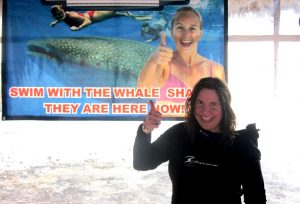
Mary Winzig After Swimming with Whale Sharks
© Copyright Sergio and Bryan Jauregui, Casa Payaso S de RL de CV, 2012
by Bryan Jáuregui | Adventure, Culture, Travel Industry
In 1996 Janice Kinne moved to Todos Santos with her most precious possession in the world, her baby daughter. And not much else. Mexicans call Baja the Last Frontier, and Janice was the embodiment of pioneering spirit. She had been working 60-70 hours a week as Director of Information Systems for a large ad agency in the Twin Cities area, and – while she liked the work – decided that there had to be a better lifestyle for her somewhere. Maybe somewhere with less snow and more sun, maybe somewhere with less people and more palms, maybe somewhere with less mania and more magic, maybe, in short, somewhere like Todos Santos.
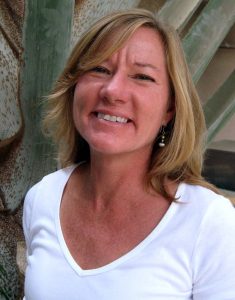
Yoga Instructor Janice Kinne
So she quit her job, sold her house, grabbed her daughter and came down to Todos Santos, where she moved into her house even though they were still constructing it around her, and bought a horse even though she hadn’t ridden much before. She looked around and found herself in a great community of artists who were giving gallery tours and organizing talks, and decided that a regular calendar of events was exactly what the community needed. Janice now lives in a beautiful house, is an expert horsewoman and her magazine – El Calendario de Todos Santos – is in its 13th year of production, has doubled in format size, and attracts advertisers from across Baja California Sur. Amazing what a little dreaming can do.
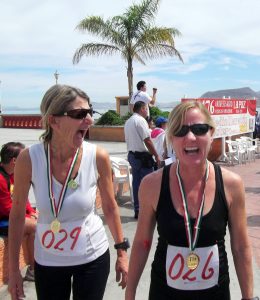
Janice (right) and Buddy Celia at La Paz Half Marathon
Back in her college days in Minnesota Janice worked as a health instructor and weight lifter in one of the local spas. Health spas being in short supply in Todos Santos, Janice turned to other channels for inspiration, namely the Yoga Zone TV channel. Each morning she would get her daughter up, then do her yoga class with the Yoga Zone. She got hooked. She sought out yoga masters and studios and practiced. She bought tapes and books and practiced. She trained for marathons and saw what yoga could do to help her. She hung out with surfers in Todos Santos and saw what yoga could do to help them. She took instructor classes and started teaching. She worked out a yoga program for equestrians and started offering it to Kaia – another Todos Santos Saint – and her students. Janice has applied yoga across several sports disciplines and is now the yoga instructor for Todos Santos Eco Adventures’ Baja Surf Camp for Women.
“My style of yoga is Hatha flow. I appreciate yoga in a cross training program as I am an equestrian and runner. I’ve seen that yoga can aid all sports by increasing body awareness, proper breathing, flexibility and balance. Surfers of all levels of experience benefit from these attributes of yoga. Also, every discipline strengthens some areas more than others and causes an over-development of some muscles that needs to be countered. Specifically, surfers tend to really work their backs and arms, but this repetitive motion shortens the back and shoulder muscles. They need more work on forward bends, arm stretches and core muscles to counter this. In the morning yoga classes at the Baja Surf Camp for Women, we focus on loosening up/stretching out all the muscles for the surfing lesson ahead, then getting the mind and body focused on the balance and flexibility it will need for surfing. I like to send my students off to their surfing lesson feeling rejuvenated, relaxed and ready to master the waves! Of course, the place where we hold the yoga classes helps on the inspiration front – we look out over a palm oasis and 70 miles of undeveloped beach. Definitely beats most yoga studios!”
Janice couldn’t have chosen a better location for the lifestyle she was seeking. “I love the beautiful outdoors in Baja, and am very focused on the balanced lifestyle that I was able to create in Todos Santos – work, recreation, relaxation and nutrition. All come together so naturally for me here.”
Janice’s 1996 check list reviewed in 2011:
- More sun? Check!
- More palms? Check!
- More magic? Triple check!
And that baby daughter? Thriving in high school, completely bilingual, and looking forward to college. Check!
© Copyright Sergio and Bryan Jauregui, Casa Payaso S de RL de CV, 2011
by Bryan Jáuregui | Adventure, Culture
by Todos Santos Eco Adventures
This article on Hollywood horse champion Kaia Thomson is the third in our series, The Saints of Todos Santos, which profiles some of the people who help put that spark of magic into our pueblo magico.
Queens may come and go, but queen-makers are a special force to be reckoned with, and Kaia Thomson has made 14 queens…so far. In 2005 Kaia was running a 55-acre ranch with 60 horses where she had trained 12 Gymkhana champions and 14 rodeo queens, including Brandy De Jongh, Miss Rodeo America 2000. She was at the top of her game in the horse world with students, horses in training and competing. Then she decided to move to Todos Santos. “It was my 50th birthday and I decided that I just had to move to Mexico with my horses. All my friends thought I was crazy, but I wanted to do something radical. I just had to do it.” So she did. She finished out the year on her ranch and arrived in Todos Santos in December 2005 with 3 horses and the remains of her worldly possessions. It’s now hard to imagine what the town would be like without Kaia and her incredible skills as a teacher, rider, trainer, naturalist and photographer.
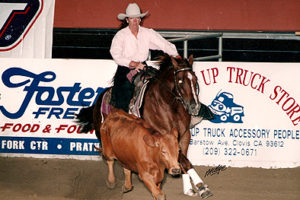
Kaia Demonstrating Her Skill at a Reined Cow Horse Competition
Kaia is one of the most down-to-earth people you’re likely to meet in this life. A characteristic that is not explained by the fact that Kaia is a true Hollywood gal who grew up under the Hollywood sign, spent a lot of time on Hollywood Boulevard and had her first horseback riding lesson at the age of 4 at Sunset Ranch Hollywood Stables. She went to Hollywood High School with many (now famous) stars and worked at a tack shop where she regularly rubbed shoulders with the likes of Sylvester Stallone, Sam Shephard, Richard Farnsworth, and Juice Newton. She worked for Glen Randall who trained Roy Rogers’ horse Trigger (“he said Trigger was the smartest horse he ever met – he could recognize over 100 words and cues”) as well as with Glen’s protégés Rex Peterson and Bobby Lovegren who trained horses for movies such as Black Beauty, Hidalgo, Zorro, and The Horse Whisperer. She ponied horses for Laz Barrera, renowned trainer of Affirmed (the last horse to win the Triple Crown) and worked alongside many champions on race days at Santa Anita, Hollywood Park and Del Mar racetracks. She rode a horse named Madrid, a grandson of Bold Ruler – Secretariat’s sire – and trained, competed and won in dressage, jumping and showmanship. She traded a saddle for a mule in the Sierra Nevada’s and competed on mules for over 16 years. She saw a Reined Cowhorse Show in Las Vegas in 1989, and soon became a regular on the National Reined Cow Horse Association circuit. She trained with Teddy Robinson, the world’s greatest Reined Cow Horse champion, and acquired the exceptional horse skills required to rein, cut and work cattle in competition. Kaia thrived on the perfect complement of sportsmanship, connection and discipline that horse competition in all its variety demanded. Then she fell in love.
Silver Drift, a dorsal-striped dun charmer affectionately known as Fourteen, was Kaia’s equine soul mate, the greatest horse she ever owned. She got him in 1996, and loved to gather cattle and team rope with him. “Roping on 14 was like riding on mashed potatoes with extra butter…everyone wanted me to head for them!” They had a great partnership and he helped her train some of those rodeo queens on her ranch. “Then on a Friday the 13th in 1999, he was just playing in his paddock and broke his leg. We had to put him down. I was devastated. It almost made me quit horses altogether. To distract me, some friends took me to Catalina Island to go scuba diving, and I was completely hooked. I went all the way through instructor and about 20 specialty courses, mainly because I loved being able to engage in one of my great passions – photography – under water. This is what led me to Baja because in 2000 I came to La Paz for my birthday to go scuba diving in the Sea of Cortez – which I even did once in my birthday suit! I absolutely loved it and started coming back 2 to 3 times every year to dive. On one of these trips it was too windy to dive so a friend suggested that we check out this little town called Todos Santos. When I got here I realized that I’d seen all this lush greenness in the desert several times from the air. I loved it.”
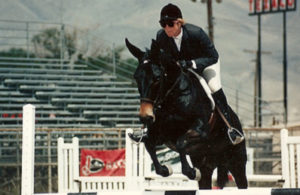
Kaia Jumping
While it seemed like a wild decision to walk away from the incredible life that she’d built in the horse world in the U.S., Mexico was a natural fit. “Mexico is founded on ranchero culture – horses, mules, burros – all used for transport and working the ranch. Mexicans are very proud of their horse heritage. The Criollos, the local horses, can all trace their lineage back to the horses that Hernán Cortés brought to Mexico over 500 years ago and turned loose before heading back to Spain. Mexico now even has its own official breed of horse, the Española, a cross between Andalusians and quarter horses. This mixture is meant to create the ultimate caballo de charro or rodeo horses, and they’ve been pretty successful with this.”
“The horse community here has been so welcoming to me. My horse buddies and I are always invited to ride in the cabalgatas (horse parades or trail rides) and these are an enormous amount of fun. These are often 2 days and 1 night, and will have over 200 riders on horses, burros and mules. There are around 30 cabalgatas a year in the little towns around southern Baja, and the one we participate in the most ends in an extravaganza at the stadium in Todos Santos where the Escaramuza ladies put on a great show. These are young women who ride in a drill team style formation at a full gallop to emulate the women of the revolution who would put on their colorful adelitas – pretty dresses with full flowing skirts – and head out on horseback to attract the men of the enemy. When the men got into firing range the escaramuzas would sling the hidden rifles off their shoulders and aid the rest of the army with the task at hand. Lots of the local cowboys also do horse dancing and trick riding. We also get invited to a lot of the horse races on straight tracks that are held in all the different towns. After the “fancy” horses run, sometimes my students will ride one of my horses in the races – we’ve actually won 6 out of 7!”
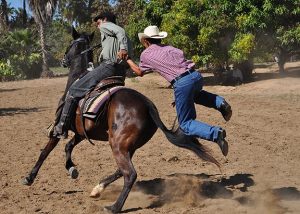
Heri and Javier at an Internado Competition
One of the reasons the local horse community is so fond of Kaia is because of her work with the Internado, the boarding house for ranch kids who come to Todos Santos to go to school. Each year the Internado has an Annual Open House to raise funds, and Kaia trains the Internado students for 2 months to prepare them for the competition that they put on as part of the fundraiser. Past events have included simulating ranch tasks like catching a chicken, roping a cow, and “killing” a bandito with a machete, all from the back of a galloping horse (chicken/cow/bandito dummies used), as well as barrel racing and cavalry-style carousels. Throughout the rest of the year Kaia sponsors the Internado kids to come to her place once a week to go riding and work the horses with her.
The Internado students are not the only ones who benefit from Kaia’s generosity with her talents. For each edition of the town’s local magazine, El Calendario, Kaia – a “self-appointed naturalist” – donates two pages of her amazing photographs which document the wild beauty of the flora and fauna of Baja. She also usually contributes an article or two on local businesses, people of note, or natural history. “I always completely embrace wherever I am. I’ve been fewer places than some people, but I know a great deal about many aspects of those few places and I love sharing that knowledge.”
Luckily for the people of Todos Santos, residents and visitors alike, Todos Santos is one of those few places where Kaia has chosen to shine her light and share her knowledge. She has a really fun place where you can train in dressage, jumping and gymkhana. Or you can just go on a Todos Santos Eco Adventures sunset ride with Kaia, and ask her about endemic bird species…or the life spans of local cactus… or Mexican charro rodeo regulations…or whale shark feeding habits in the Sea of Cortez….or the beauty secrets of rodeo queens…or what it really feels like to be an American cowgirl living in a magic Mexican village.
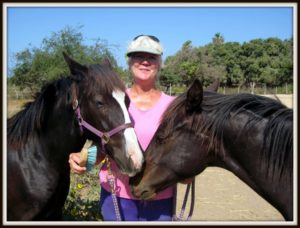
Kaia with Friends in Todos Santos
© Copyright Sergio and Bryan Jauregui, Casa Payaso S de RL de CV, 2011