by Bryan Jáuregui | Adventure, Blog, Travel Industry, Wildlife
This memoir by Blair Batson was first published in Janice Kinne’s Journal del Pacifico
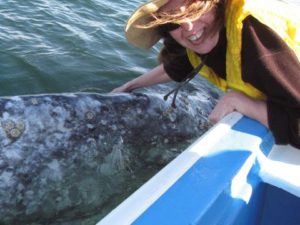
Blair and Pinky
I came down to Baja one February to escape the cold grey of Oregon and hang out with my family. My sister Bryan – who owns and operates Todos Santos Eco Adventures with her husband Sergio — was excited she had arranged for us to come at the perfect time to see the grey whales in Magdalena Bay. I was excited we had yet another entertaining way to spend a day in paradise while waiting for Sergio’s killer margaritas to appear at dusk.
I had been whale watching in Oregon before, and found it hard to recommend: Go out in a large boat with a bunch of strangers in the rain, get mildly seasick, look for whales for about 2 hours, finally catch a glimpse of one swimming 50 yards off, pursue it until it disappears, then call it a day. Oh yeah, and get totally drenched and freeze to death. I was glad I could look forward to better weather.
On the appointed day, my family goes out onto Mag Bay in a 40-foot open boat. We putter along for a while admiring the smooth open water and arid landscape. After about an hour, the panga driver starts turning the boat around. Sergio, who can always spot wildlife a mile away, gets an intense look on his face.
“Ballena!” We all turn in the direction Sergio is pointing. And there is the unmistakable shape of a grey whale fluke disappearing into the bay – about 50 yards away. I’m thrilled. We’re all thrilled. It’s like a Sierra Club calendar cover shot. We hoot and holler and jump up and down as best we can without tipping the boat. I am completely satisfied with the trip, as I have never seen that classic image in real life – and so close. Awesome. And I’m still dry and warm. I’m thinking Todos Santos Eco Adventures might want to expand their business to Oregon.
The panga driver cuts the motor back and we start sort of drifting around in the middle of the Bay. I’m thinking a margarita might be nice to celebrate our sighting. Then I hear again: “Ballena!” On the right side of the boat about 10 yards off, we see a whale flipper sticking out of the water, turning – as if the whale is flopping onto its back for a rest. Sergio says it’s a juvenile – probably 40 feet long – the size of our boat. Gulp. Where’s Mom?
The next thing I know Bryan and Sergio are diving towards one side of the boat where we can see the juvenile just five feet under the surface a few feet away from us. Holy smokes, he’s big! The panga driver starts banging the boat and Bryan and Sergio are singing and calling out like they’re calling their cats: “Hey Ballena; here ballena. Come to mama; come to papa. Here ballena.”
Well, I think, crazy’s what I’m good at, so what the hell? I throw myself along the edge of the boat, leaning out as far as I can over the water: “Here Ballena. Hey baby. Come here, cutie.” A moment later, I am gobsmacked when the little sweetheart lifts his huge head out of the water — right under my outstretched hand! I almost dive in the water to embrace him, but somebody’s got a firm hold on my jeans from behind.

Blair and Pinky in Magdalena Bay
I pet and scratch his head and back and coo and laugh. As Bryan points out, he really likes it when you scratch his chin and barnacley parts. She calls him Pinky. So I keep petting and scratching and cooing, wishing the moment would never end. My baby stays with me a good long while and then, finally, turns and looks me straight in the eye with a sweet smile to say thank you and farewell.
At that moment, gazing into that beautiful eye, I know. You may think that angels have wings. But I’m here to tell you they have fins and flukes and are covered with barnacles. I have never had such a feeling of peace and connectedness with any of the many sentient beings I’ve encountered on this planet. That sweet young whale radiated total kindness, beneficence and fun. Anthropomorphizing? I don’t think so. Ask my family. Pinky was generous. He let everyone love him and pet him and feel that amazing connection, the grace of encounter.
This is all by way of saying that if anyone suggests you spend a day or two whale watching with Todos Santos Eco Adventures – as opposed to say, another day of walking on the beach, eating at all the fabulous Todos Santos restaurants, or drinking mas margaritas with your pals – you might want to seriously consider it. It’s not Oregon. Just sayin’.
by Bryan Jáuregui | Blog, Culture, Food, Plants
“Can you make a margarita with that?”
by Todos Santos Eco Adventures
These days it seem like the world has gone just plain crazy for Baja cuisine. The New York Times, The Washington Post, National Public Radio – these are but a few from the 4th estate that have lined up to gush over chefs and restaurants that are giving Baja – heretofore best known to outsiders as a totally rad surf scene dude – a bona fide “food scene”. So while it was the surfers who first made the terms “firing” and “shredding” famous in Baja (all surfspeak for surfing really well) it’s the chefs who are breathing new life into the terms in the culinary revolution that is sweeping the peninsula.
But what exactly is it that the chefs are firing and shredding? Of course there’s the bounty from the two seas, and all that great produce from the organic farms that populate the region. But most of Baja is desert and when you look out at it, it can seem kind of desolate, maybe a little forbidding, definitely thorny. What’s there to eat? Turns out, quite a bit (if you don’t mind getting your fingers pricked)!
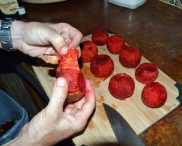
Sergio preparing pitaya at home
Take the pitaya. The Baja peninsula is covered in this cactus and Chef Dany of Santo Vino/Hotel California likens the fruit of this plant to a red kiwi. He loves to cook it up with ginger and butter to make sauce for his Cabrilla (sea bass), and he’s also found that it makes a zingy vinaigrette for his salads. Our local ice cream stores in Todos Santos and La Paz report that pitaya ice cream is a perennial best-seller, notwithstanding the fact that the pitaya fruit is disgustingly healthy, packed with cancer-fighting antioxidants and Vitamin C. In fact, Juice Generation, a chain of smoothie bars in New York City, is promoting the pitaya as “the next big superfruit”, following in the footsteps of pomegranates, mangosteens and acai.
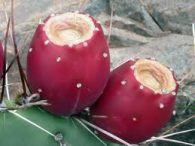
Prickly Pear
The tuna, or prickly pear, is the fruit of the nopal cactus, another ubiquitous Baja dweller. While Chef Dany likes to use the prickly pear for his dynamite fish salsas, and others like to pair it with tequila for a zingy barbeque sauce, Chef Rick Bayless likes to make Fresh Prickly Pear Ice as a refreshing dessert, and many folks in Baja share this enthusiasm for sweets made from tunas and regularly cook up prickly pear jelly, prickly pear syrup and prickly pear candy. Like the pitaya though, the tuna is ridiculously healthy, being high in magnesium, taurine, Vitamin C, calcium, potassium and antioxidants.
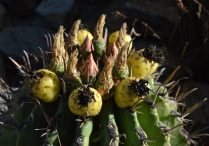
Biznaga
The leaves or paddles of the nopal are another great staple of Baja cuisine. Sergio Jáuregui (yes, our very own Sergio of Todos Santos Eco Adventures) likes to make what he calls nopal “quesadillas”. He cleans the paddle, grills it on both sides, then melts his favorite cooking cheese onto it – usually Oaxaca or Manchego – and fries it up. Delicious! (In that deep-fat fryer / comfort food kind of way.) Chef Dany’s favorite way to eat nopal paddles is equally tasty (and far more healthy): he puts it raw in salads with cubes of onion, tomatoes, local fresh cheese (queso fresco), parsley and cilantro – magnifique!
There are many more cactus plants from the Baja desert that make great eating, including the biznaga – which many chefs include in their chiles en nogada – and yucca, whose lovely white flowers make a great stir fry in Chef Dany’s wok.
But the real test of any Baja food is: can you make a margarita with it? And for all of our featured cacti here – the prickly pear, the pitaya, the biznaga and yucca – the answer is a resounding YES! Just swing by Santo Vino or the Hotel California some evening and prepare yourself for a most delicious treat (and don’t be afraid to try it at home either!)
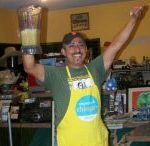
Brown-Garitas for Everyone!
Chef Iker Algorri of Café Brown likes to use a plant local to Todos Santos – damiana – to make his world-famous Brown-Garitas, a sure crowd pleaser:
-
-
- 1 shot of of tequila
- 1 shot of controy or triple sec
- 3/5th shot of damiana
- Splash of lime juice
- Splash of fresh orange juice
Blend it up, serve with love and enjoy! Oh, and damiana is widely considered a potent aphrodisiac so best to enjoy your Brown-Garitas with friends!
If you’d like to learn more about cooking with Baja foods please contact us about our Cooking Adventures Week here in Todos Santos. It features fun, informative classes with both Chef Dany and Chef Iker, as well as lots of time in the glorious nature of Baja, checking out the bounty of the ocean and desert.
Thanks to Janine Wall for her help with this article.
© Copyright Sergio and Bryan Jauregui, Casa Payaso S de RL de CV, 2012
by Bryan Jáuregui | Adventure, Blog, Culture, Travel Industry
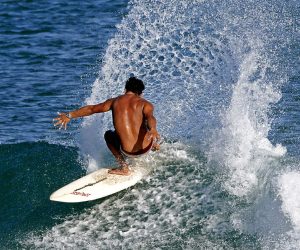
Photo by Jocelyn Mathe for the Journal del Pacifico article, Surfing Santeños
When you head out to the surf breaks of Todos Santos you don’t see many people who can trace their ancestry back through five generations of Todos Santeños, but 23-year old Dany Torres can. While many Mexican residents of Todos Santos prefer to leave the water well enough alone, Dany’s grandfather used to go body surfing at La Poza (please don’t try this at home!) and his father met his Canadian mother while working as a dive instructor in Cabo. It’s a family that clearly loves the water, but it was an American who gave him his first surf board at the age of 12 and, like his surfing American neighbors, it completely changed his life. Now a budding architect in Todos Santos with several projects underway, Dany says “Surfing defines my days. I surf early in the morning during the week because of work commitments, but on the weekend I’ll often surf all day long.” As a dual Mexican-Canadian citizen he has plenty of options for places to launch his career. But for Dany, there’s no place like home. “I’ve surfed all over mainland Mexico, California and Canada and I really love surfing at home the best. Not only are the waves great, but there is no territoriality. I’m actually one of the youngest surfers around which is great because the older surfers are very laid back and really happy to share the waves. That relaxed atmosphere just adds to the magic of this place.”
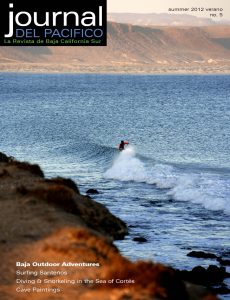
This profile is part of our article, Surfing Santeños, published in the Summer 2012 issue of Janice Kinne’s Journal del Pacifico.
by Bryan Jáuregui | Adventure, Blog, Culture, Travel Industry
Mario’s guide to surfing the cape is part of our article, Surfing Santeños, published in the Summer 2012 issue of Janice Kinne’s Journal del Pacifico.
Las Palmas (San Pedrito)
Drive 5 km south from Todos Santos on Highway 19. Look for the Campo Experimental building on your left, and turn off the highway onto one of the dirt roads that winds toward the beach. Las Palmas is a beautiful beach with a lot of palm trees, and has a fast, heavy beach break.
• Best for: Intermediate to advanced surfers
San Pedrito
South of Las Palmas you will find San Pedrito. Also known as Pescadero Beach, it’s about 8 km south of Todos Santos. It’s a point break with a rocky bottom and breaks best with a north swell. • Best for: Advanced surfers
Los Cerritos
This is one of the best beaches in Mexico for learning to surf. Los Cerritos is a beach break with a sandy bottom and has one of the most consistent waves in Baja. It is also one of the few swimmable beaches in the area. From Todos Santos, look for the Cerritos signs at km 66. Lodging and restaurants are located nearby.
• Best for: Beginner to advanced surfers
La Curva
La Curva, also known as KM 93, has a long, right point break that only breaks with north swells and mostly in the winter. Watch for three large rocks you can only see at low tide.
• Best for: Intermediate to advanced surfers
Monuments
Five minutes from Cabo San Lucas on the way to San Jose del Cabo, this is a left point break that is best with a south swell, although it also breaks with north swells. Take the road to Misiones Hotel and park on the road. Be aware of sea urchins at low tides.
• Best for: Advanced surfers
Old Man’s
Also known as Acapulquito, this is one of three close breaks on the Costa Azul Beach. It is east of the Palmilla sign, on the right below the view point off the highway to San Jose del Cabo. It breaks with a south swell and there is a long, right point break, especially good for long boards. The waves are mushy and easy to read. Watch for rocks at low tide. Surf lessons and rentals are available here, and many restaurants are located nearby.
• Best for: Beginner to intermediate surfers
The Rock
Another break that needs a south swell, The Rock is located on the Costa Azul Beach, east of Old Man’s. It is named for the rocks that are visible from the viewpoint. It is a long, right point break, a little faster than Old Man’s.
• Best for: Intermediate to advanced surfers
Zippers
Last of the three Costa Azul breaks, Zippers is a shorter, faster, right point break. This break is popular with the locals who may seem a little territorial. Only breaks with a south swell.
• Best for: Advanced surfers
Shipwrecks
Shipwrecks offers a fast, right point break. Be aware of rocks. It is located on the East Cape. To get there travel past downtown San Jose del Cabo on the bridge over the estuary then drive approximately 20 minutes east.
• Best for: Advanced surfers
Nine Palms
Drive another 20 minutes east of Shipwrecks, and look for the palms at the little rancho, where you may find donkeys and cows resting in the shade. This is a mushy, long point break, good for long boards.
• Best for: Beginner surfers
by Bryan Jáuregui | Adventure, Blog, Culture, Travel Industry
In the age of jet-setting surfers pursuing monster waves across the globe for fame and money; of California surf breaks so crowded it is not uncommon to see 100 boards or more in the water; of jet skis towing surfers to catch waves that the human body could never conquer on its own, it is wonderful to hear Todos Santos resident Steve Merrill recall the age in which he first saw a surfer. “It was 1956 and I was six years old. My parents were driving the car along Pleasure Point in Santa Cruz, California, and I saw a guy standing on a giant wooden board gliding across the waves, completely alone on the water. It is impossible to describe the impact that vision had on me. I knew then and there that surfing was what I had to do.” Steve’s immediate enthrallment with surfing is echoed in the voice of the young narrator in Australian writer Tim Winton’s surfer-coming-of-age novel Breath, “How strange it was to see men do something beautiful. Something pointless and elegant, as though nobody saw or cared…as if dancing on water was the best and bravest thing a man could do.” Back in the day, Winton tells us, surfing was the closest a man could get to poetry.
If surfing is akin to poetry then Todos Santos today is the City Lights Bookstore and the Beatniks are having a poetry slam. “We’re living the bonus years here in Todos Santos” says surfing resident Billy Girvan. Like many expats in the Todos Santos surfing community, Billy grew up in California just as surfing culture was taking root. “In 1959 I was 12 years old and saw these guys surfing in Santa Barbara. All I wanted was to be like them. It wasn’t just the surfing, it was the life style that was so appealing, the beach life, the freedom. They were so different from everyone else. I traded my go-cart for a surfboard and never looked back.” Todos Santos surfer Jim McRoberts knows just how he feels. “In 1962 I was 15 and living in Sierra Madre, California. My uncle was a founding member of the San Onofre Surf Club and took me with him to the beach one day. That first time riding a wave, the sensation was simply amazing. It took hold of me immediately and I couldn’t think of doing anything else. My passion has never lessened from that day to this.” Like Billy, Jim was just as in love with the surfing culture as with the surfing itself. “Everything important was happening at the beach.”
Billy, Jim, Steve and countless other expat surfers living in Todos Santos went from being “grommets”, or “gremmies” – slang for young surfers – to embracing the full surfing life as older teens and adults. A lot of school was missed, a lot of pretty girls chased, a lot non-food items ingested and a whole lot of waves caught. Poetry? Absolutely. “Poetry is not only dream and vision” says poet Audre Lorde, “It is the skeleton architecture of our lives. It [is] a bridge across our fears of what has never been before.” For these boys surfing was the bridge to embracing nature in a most intimate, thrilling and terrifying way. Surfing was the bridge out of an ordinary life into something sublime. Surfing was the bridge to salvation. “Going to the ocean is like going to church for me.” says Jim who went on to get a Masters in English and is currently writing a novel about surfing. “If it wasn’t for surfing I would have been a drug addict or alcoholic like a lot of my friends. You have to stay physically fit to surf. It saved me.” Billy, who went on to become a founding member and bass player for the hard rock band NoXit, agrees. “I was in the midst of living this rock star’s life and surfing is definitely what kept me healthy, what kept me alive.”
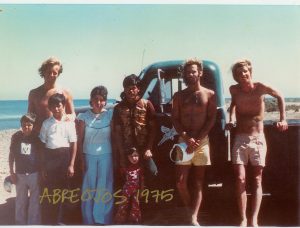
Steve Meisinger and Friends in Baja in 1975
As countless movies and songs throughout the 1960’s and ‘70s glamorized surfing culture, the surf breaks in California inevitably became more crowded and surfers became more territorial and protective of their breaks, often resulting in a tense and aggressive atmosphere. Some surfers, like Steve Meisenger, or “Meisy”, started looking elsewhere and in 1973 at the age of 18 the Morro Bay, California board shaper started coming to Baja to enjoy the peninsula’s stark beauty and uncrowded breaks. “I was getting a degree in Ornamental Horticulture at Cal Poly and would save all the money I made shaping boards during the year to come to Baja in the summer. We would live in the van and camp on the beach. We never went out to eat, we never stayed in a hotel. All of our money went to surfing and survival.” Meisy started a successful, 30-year career as a housing contractor but continued to come to Baja at least once a year. He stumbled upon Todos Santos in 1981 while looking for a mechanic. He was captivated. He found himself returning to surf the breaks here every year, and by 1990 had bought property and started building his house. “The environment in most of Baja is so harsh, but in Todos Santos we get the great waves as well as this lush environment, great weather and wonderful creature comforts.”
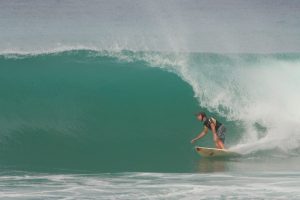
Steve Merrill Surfing in Todos Santos. Photo by Sam Belling.
The magic of Todos Santos surfing has a powerful pull. By the time Billy first visited Todos Santos in 1994 it had been 14 years since he’d last been on a surf board. But much to his joy he found that he could still ride the waves. Much to the consternation of his wife he also found that he really wanted to surf all the time, once again. “But luckily that beautiful woman really loves me so when I said I wanted to move to Todos Santos to surf she backed me 100%. We sold all of our property and here we are.” Jim knows just what he means. When he and his wife married in 1989 they moved to the mountains of Oregon so they could pursue her love of horses. “But I thought about surfing every single day, and even carved a sculpture of a wave to put over the mantel.” A 3-year road trip throughout the North American continent brought them to Todos Santos in 2009. It had been 20 years since Jim was last on a surf board, but the magic returned immediately. “Every good wave that you ride is like a gift. It is this energy that is there for you personally, energy that has come 2,000 miles for you to merge with and take to the Todos Santos shore.” Jim and his wife sold their Oregon property and have been in Todos Santos ever since.
No matter whether they surfed every day for the past 5 decades or abandoned the waves for years, surfing still provides the “skeleton architecture” of these men’s lives as they move through their 60s. And one of the key reasons they love surfing Todos Santos is, as Steve says, “This is as nice a surfing community as anyone could ever hope to find. There is hardly any localism and everyone on the waves is respectful and supportive of each other in the water.” While they may not have the stamina and moves of youth, the men don’t seem to mind (much). “Let’s face it” says Billy, “the best surfer out there is the one having the most fun. And that’s usually me!” Coming from a guy with 2 titanium bars, 4 screws and 3 vertical spacers holding his back together, that’s no mean feat. Billy already has days on the water when his back prevents him from getting up on the board, and he can see a time coming when he won’t be physically able to surf any more. “But I’m just not that worried” says Billy. “There is always mind surfing!” Poetry? Oh yes indeed.
This article by Bryan Jáuregui of Todos Santos Eco Adventures and Mario Becerril of Mario Surf School was published in the Summer 2012 issue of Janice Kinne’s Journal del Pacifico.
by Bryan Jáuregui | Adventure, Blog, Travel Industry, Wildlife
This article by Todos Santos Eco Adventures was published in the Spring 2012 issue of Janice Kinne’s Journal del Pacifico.
If you sift back through the catalog of parental admonitions that were meant to ensure you a long and happy life – you know, “don’t stick your tongue on frozen metal”, “don’t eat yellow snow”, “don’t drink your father’s last bottle of beer” – somewhere buried in there your mother must surely have added “and oh yes dear, don’t swim with sharks”.
Very sound advice to be sure but swimming with sharks – whale sharks that is – in the Sea of Cortez is truly one of life’s great (and, sadly for you danger junkies, very safe) adventures. While whale sharks have thousands of teeth in hundreds of rows in their enormous mouths (imagine armed shark mouths 4 to 5 feet wide), they can neither bite nor chew. That’s right, they are happy to forego all human body parts in favor of plankton, krill and small fish. Go figure!
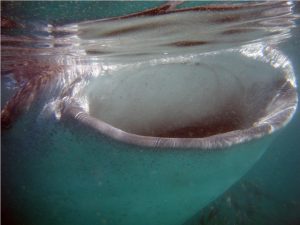
Whale Shark Mouth! Photo by Deni Ramirez
So now you feel safe but even if you were on the varsity swim team you’re probably wondering how you could actually keep pace with a shark in the water. Well, the whale shark got its moniker because it is the only fish that is literally as big as a whale; mature adults can reach 60 feet in length and 50 tons in weight. Reaching these proportions requires an immense amount of energy, which the whale shark gets by consuming huge volumes of plankton-rich water, then straining it out through its gills. In fact, to get the food it needs it is not unusual for a whale shark to filter 400,000 gallons of water an hour. To conserve this hard-won strength – and continue eating – whale sharks tend to do a lot of hanging about in the water, or, if moving, doing so at a very slow pace. This lollygagging is what makes it possible for non-bait types like humans to jump in and swim alongside them for a bit. Of course, when they want to put on the speed they certainly can so when a whale shark tires of your company all you will see is a swishing tail receding into the distance.
Now you’d think it’d be a relatively simple matter to learn about a mammoth fish the size of a school bus dawdling through the water eating up everything in its path. But the fact is that scientists still know relatively little about the whale shark, and La Paz resident Dení Ramirez of Whale Shark Mexico is trying to change all that. Originally from Mexico City, Dení has been studying whale sharks in La Paz since 2001, and completed her Ph.D. in marine biology last year. The whale shark’s skin is covered in a pattern of pale yellow spots and stripes that is unique to each animal, a type of fingerprint if you will, so Dení has been able to track some of the inhabitants of La Paz Bay. In fact, she has been tracking the young sharks Flavio, Tikki Tikki and Tango for almost a decade now, and has determined that they are true Baja residents. While whale sharks have been spotted across the globe from Australia to Djibouti, from the Philippines to Mozambique, Dení’s juveniles appear to travel only in the Sea of Cortez, from the Bay of La Paz to Bahia de Los Angeles – roughly 600 miles. We asked Dení why we seem to be seeing the whale sharks around La Paz so much more over the last couple of years than we ever did before.
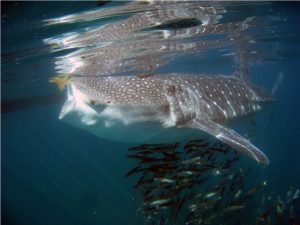
Whale Shark Feeding in the Sea of Cortez: Photo by Deni Ramirez
“It’s really just a question of food. Over the last two to three years the conditions in the Bay of La Paz have been just right to produce an enormous amount of plankton for the whale sharks to feed on. The wind, currents, mangrove conditions – all these have combined to create an excellent environment for plankton growth that we just didn’t have for such extended periods in earlier years. Also, in the Bay of La Paz the plankton is rich in the coastal waters, and these relatively shallow waters give the young sharks in my group a certain amount of protection.” Dení is happy to take visitors with her on her research trips and share some of her extensive knowledge of whale sharks and research methodology.
Dení is currently doing a lot of work with the pregnant females who inhabit the deeper waters around Espiritu Santo Island and have found that they have much larger migrations than the young sharks due to their different needs as mothers, mothers who surely will work to ensure the long life and happiness of their offspring by admonishing “and dear, don’t try to eat the humans. They’ll just clog up your gills.”
TOSEA guest Mary Winzig recounts her whale shark adventure:
“Swimming with whales sharks is the most amazing thing I have ever done in my life. They are such magnificent animals and I felt so lucky to be in their presence. I was scared—to see something so large and to know you are jumping in the water with them made me pause for a moment. My heart seemed to be almost leaping through my wetsuit – I asked the guide to make sure they were whale sharks because their dorsal fins were so huge! But after watching them and seeing their polka dots, I realized I had to swim with them. You can’t be afraid of anything with polka dots! Jumping in and seeing them through the snorkel was magical. Once I was in the water, I wasn’t afraid. I have no idea how long I was in the water with them, 2 minutes? 15 minutes? I was transfixed. Their mouths look like the grill of a ‘57 Chevy. I have never felt so small or insignificant, but also so powerful. I have decided I have to do everything in my power to help save these magnificent creatures. Thank you Todos Santos Eco Adventures for this wonderful opportunity. I look forward to swimming with the sharks again!”
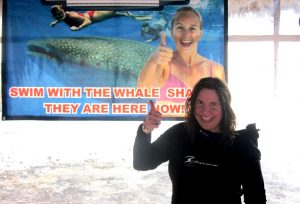
Mary Winzig After Swimming with Whale Sharks
© Copyright Sergio and Bryan Jauregui, Casa Payaso S de RL de CV, 2012