by Sonya Bradley | Blog
45 Men and a Flag: William Walker’s Invasion of Baja California
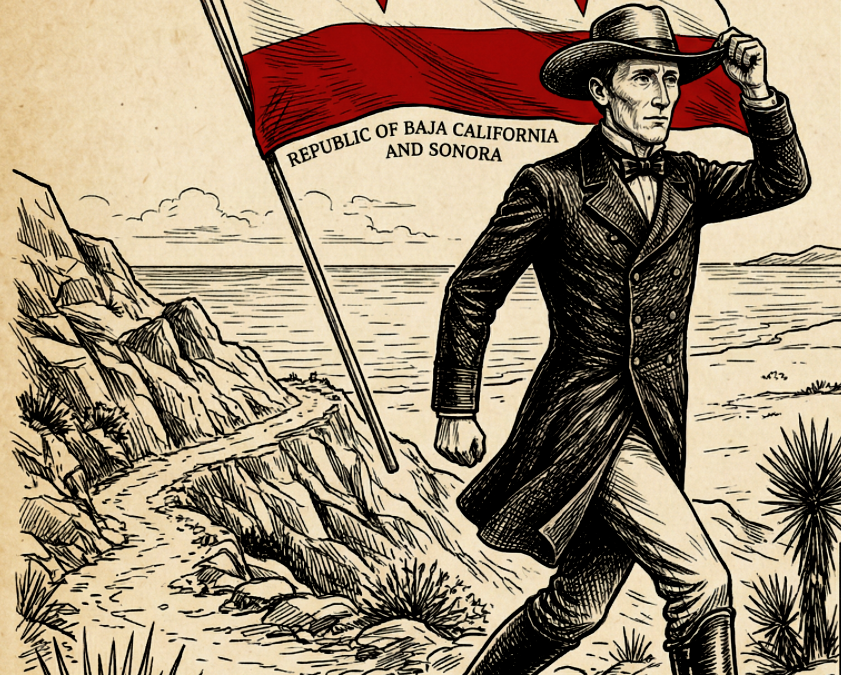
On the night of October 16, 1853, a 29-year-old American lawyer named William Walker slipped out of San Francisco harbor under cover of darkness on the schooner Caroline. He had 45 men with him. He had no maps of the territory he was about to invade. He had neglected to bring sufficient food. He had no military experience. He did have, however, an extraordinary sense of personal destiny and a flag he’d designed himself for the country he was about to create. The country was Baja, or Lower California. Never mind that Baja California was part of Mexico, the plan was to conquer it, declare it an independent republic governed by the laws of Louisiana – which meant slavery was legal – and eventually petition for annexation by the United States. The plan was insane. It nearly worked.
William Walker is one of the most remarkable yet most forgotten figures in American history, a testimony to the stories we choose to forget. He was born in Tennessee in 1824, the son of a non-slave owning family, and grew up to become a physician, then a lawyer, then a newspaper editor, graduating from all three professions with the particular confidence of a man who has been told repeatedly that he is brilliant. He stood five feet, two inches tall. He had pale gray eyes described by contemporaries as unsettling, the kind of eyes that don’t blink quite often enough. He had been shot in at least two duels and survived both. He had, somewhere in the course of all this doctoring and lawyering and newspaper editing, become absolutely convinced that the destiny of the United States required the expansion of white, slaveholder civilization into Latin America. He was not alone in this belief. The 1850s were the high noon of what Americans called Manifest Destiny, the quasi-religious conviction that the United States was ordained by God to expand across the continent and perhaps beyond it. The Mexican-American War had just ended in 1848, delivering to the U.S. more than half of Mexico’s territory: Texas, California, Arizona, New Mexico, Nevada, Utah, Colorado. The appetite had not been satisfied. Men like Walker – called “filibusters” after the Spanish filibustero, or pirate – raised their own private armies and invaded sovereign nations, not on behalf of the U.S. government but in the spirit of it, testing boundaries, claiming territory, daring Mexico to fight back. Walker decided to start with Baja California and Sonora. He had actually traveled to Guaymas in the summer of 1853 to ask the Mexican government for a land grant in Sonora. Mexico said no.
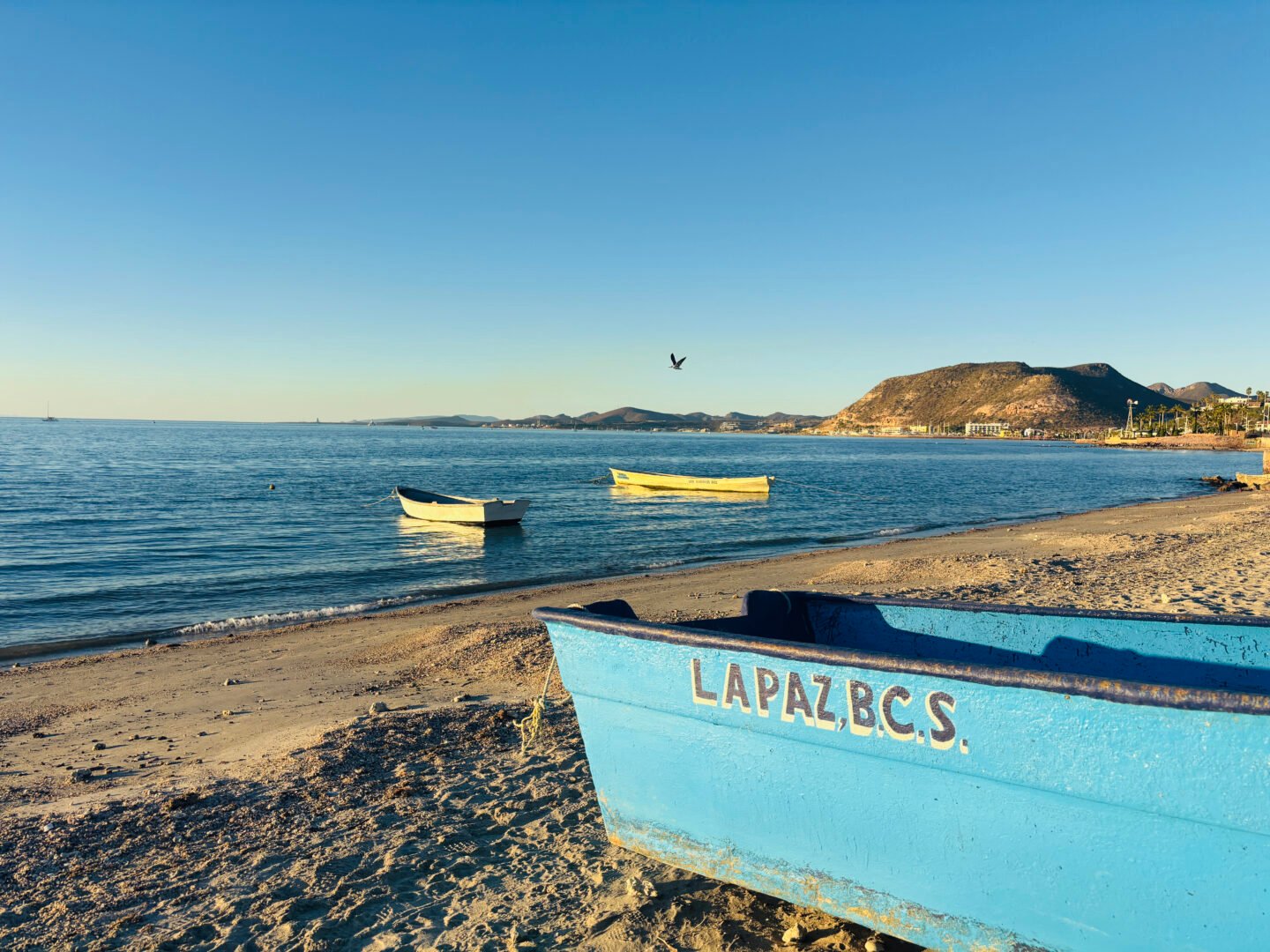
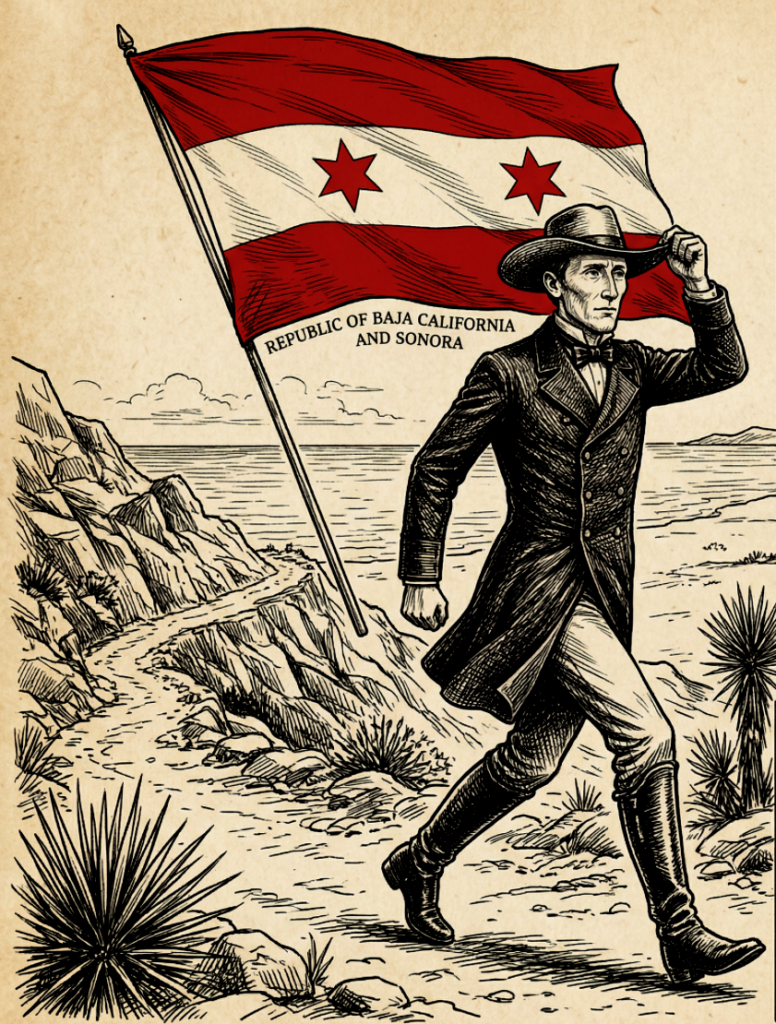
He went back to San Francisco, recruited 45 men – many of them Gold Rush veterans who had missed the fortune they came for and were looking for the next opportunity – and stole a second ship when the U.S. Army seized the first one. Walker’s schooner, the Caroline, arrived at Cabo San Lucas on October 28, 1853, paused for water, then sailed up the Gulf to La Paz. He arrived on November 3 flying the Mexican flag, a deception that gave him the element of surprise in a town of approximately 1,000 people who had no reason to expect an American invasion before breakfast. It took thirty minutes. Walker’s men captured the governor, Colonel Rafael Espinosa, at gunpoint. They hauled down the Mexican flag and ran up Walker’s own: three horizontal stripes, red and white, with a single star. Walker stepped off the boat, looked around the small, sun-bleached capital of one of Mexico’s most remote territories, and declared himself president. “The Republic of Lower California” he announced in a proclamation immediately dispatched to California newspapers, “is hereby declared Free, Sovereign, and Independent, and all allegiance to the Republic of Mexico is forever renounced.” He decreed free trade with the world. He decreed that the laws of the state of Louisiana would govern his new nation. Louisiana’s laws included slavery. Walker had just introduced the institution to a country that had abolished it 25 years earlier.
In San Francisco, the news landed like a firework. A local paper hailed the filibusters for “releasing Lower California from the tyrannous yoke of declining Mexico.” A recruiting office opened; within hours, hundreds of men had signed up. The era of Manifest Destiny was such that a private citizen could invade a foreign country with 45 men, declare himself its president, and be celebrated as a patriot in the American press. Walker’s problem was not public relations. His problem was logistics. Walker had no maps and no food, and Baja California in 1853 had no roads and very few people willing to help him. Within three days of his glorious proclamation, he abandoned La Paz – partly from fear of Mexican counterattack, partly because there was nothing useful there – and retreated to Cabo San Lucas. Three weeks later he moved again to Ensenada, 1,600 kilometers to the north, dragging prisoners with him in a wagon across terrain he did not understand toward a border he could barely locate. The promised supply ships from California were late. When reinforcements finally arrived – around 230 additional volunteers – they brought almost no provisions and less knowledge of how to survive the Baja desert. Walker’s men were living off livestock seized from local ranches, for which Walker issued IOUs that no one would ever collect.
On January 10, 1854, apparently feeling that conquering one non-existent country was insufficient, Walker issued a new decree: Baja California was now annexed to the Republic of Sonora. He had not set foot on the Mexican mainland, but he was now president of two countries. He began marching north toward the border, hoping to find a passage east into Sonora. His men were deserting in substantial numbers. Those who stayed were dying of dysentery and dehydration. The local population – the rancheros and farmers and fishermen of the Baja peninsula – were actively hostile, refusing to sell him food and in several cases taking
up arms against him under a Mexican officer named Antonio Meléndrez, who harassed Walker’s retreating column relentlessly through the thorny, waterless mountains of northern Baja.
By May of 1854, Walker had fewer than 35 men left. He tried to reach San Vicente – the administrative seat of Baja California about 90 miles south of the US border – but found Mexican troops had taken it. He tried to cross into the United States but found Mexican soldiers blocking his path and American soldiers waiting on the other side. In the end, the Mexican fighters stepped aside and let him cross and he surrendered on May 8, 1854. His invasion of Baja California and Sonora had lasted eight months, cost the lives of unknown numbers of men on both sides, and accomplished absolutely nothing. Back in San Francisco, Walker was tried for violating the Neutrality Act, which prohibited American citizens from waging private war against nations at peace with the United States. The jury deliberated for eight minutes and acquitted him. The era of Manifest Destiny was such that it only took eight minutes for twelve people to conclude that invading Mexico was fine. Walker, characteristically, took the acquittal as an endorsement. He immediately began planning his next invasion. In 1855 he went to Nicaragua with 60 men, exploited a civil war to seize control of the country, declared himself president, reinstated slavery (which Nicaragua had abolished), and made English an official language. U.S. President Franklin Pierce formally recognized his government. Walker ruled Nicaragua for almost a year. A coalition of Central American armies drove him out in 1857. He tried twice more to return. In 1860, the British Navy captured him in Honduras and handed him to local authorities. He was executed by firing squad on September 12, 1860, at age 36. He died, witnesses reported, without flinching.
Walker’s adventure had consequences for Baja California that echoed for decades. The invasion accelerated Mexican determination to populate and militarize the peninsula. Over a third of Baja’s already sparse population reportedly left the territory during and after the invasion, fleeing the chaos. The Mexican government responded by pushing settlers in from the mainland and establishing garrisons at key points along the peninsula. The modern effort to make Baja actually Mexican, rather than just technically Mexican, began in part as a direct response to Walker. In Mexico, Walker appears in third-grade history primers. In the United States, he is largely forgotten, a minor footnote in the history of Manifest Destiny, which itself has been largely laundered out of the national memory. William Walker, president of two republics that never existed, is dust.
by Bryan Jáuregui | Blog, Culture, Education, Food, Wildlife
By Bryan Jáuregui, Todos Santo Eco Adventures
This article first appeared in Janice Kinne’s Journal del Pacfico.
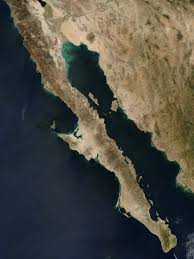
Google Earth Image of the Baja Peninsula
If SmartFish founder Hoyt Peckham has his way, diners in the high-end restaurants of Los Cabos will soon be guaranteed something that may have eluded them for some time–fish caught sustainably in the waters of Baja California Sur.
It seems hard to imagine that restaurants located on a spit of land between two vibrant oceans would have to import fish, but that is exactly what has been happening. Says Drew Deckman, founder and chef of restaurants in Los Cabos and Valle de Guadalupe, “It’s not that there aren’t fantastic fish in the local waters–some of the best seafood in the world is here. The issue is that some methods for catching and processing fish can destroy quality, so sometimes I have to go out with local fishermen myself to ensure that we’re providing our customers with the high quality, sustainably caught fish they deserve. It’s a shame.
Hoyt Peckham describes the problem faced by fishing cooperatives throughout the Baja peninsula. “Many of our local fishing cooperatives are caught in a vicious cycle. They are very good at fishing, but they don’t have the capital or the capacity to bring their fish to market, which puts them at the mercy of aggressive buyers. They end up receiving very poor prices for their fish, so every time they fish they have to make up for the low prices with higher quantities. For example, fishermen at Magdalena Bay sell some of their fish for between 5 and 8 pesos per kilo. By comparison, dirty plastic bottles fetch 9 or 10 pesos per kilo. This means that these fishermen are literally selling their fish for less than garbage, and to break even at that rate they need to catch and sell 800 kilos per day. To make money they need to do 1,000 kilos per day, and there is no way for a small boat to maintain quality at those volumes. This is the reverse alchemy that plagues Baja fishermen: they catch something that could be worth gold, but they’re selling it for less than garbage.”
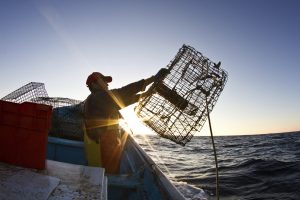
Fishermen baits and sets a trap for sand bass. Photo © Carlos Aguilar – SmartFish
The mission of SmartFish is to reverse that equation and the overfishing that it fuels. Fishing is at the heart of communities throughout Baja, and SmartFish aims to empower local fishermen and their families to rescue the value of their product, while avoiding the predicted extinction of key target species. Says Hoyt, “Here we are on one of the most pristine coasts in North America, fishing every day in the “Aquarium of the World,” but distinguishing customers are importing their fish. We have to reverse that trend.” Otherwise, fears Hoyt, these communities will continue to be marginalized, with a good swath of the social fabric of Baja destroyed in the process.
The current quality problems stem from three main factors: how the fish is caught, how it is stored, and how it is processed.
- How it is caught: Many fishermen use gillnets or traps to catch the volumes they need. These processes produce stress in the fish, which leads to a dramatic increase in blood flow, as well as the excretion of hormones and enzymes. These factors lead to an accelerated degradation of the fish’s flesh when it dies, meaning a much poorer quality of fish reaches the shore. In addition, fish often suffocate in the traps and gillnets, which means they are dead by the time they are brought on board the boat; they have literally started to rot.
- How it is stored: The small fishing pangas of some fishermen have no refrigeration to speak of, so these large volumes of fish are simply dumped in the bottom of the boat where they cook in the hot sun all day. Needless to say, this seriously degrades the quality of the meat. Further, when they reach the shore, in many cases these mounds of fish are just shoveled onto the ground where they continue to cook in the hot sun during processing.
- How it is processed. In some places, the fishermen’s families process the fish at the beach on wooden tables in the sun, and with a large catch, processing can take quite a long while.
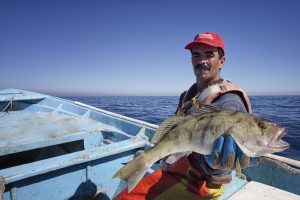
Porfirio Zuñiga displaying a hand-caught sand bass, which he will despatch, bleed and put directly on ice to ensure its freshness Photo © Carlos Aguilar – SmartFish
The SmartFish Difference. Hoyt and his team set out to address these problems by forming a social venture with five fishing cooperatives in Magdalena Bay. The fishermen quickly grasped Hoyt’s vision of higher profitability and sustainability, and Hoyt helped them gain access to funding for the equipment and training they needed to make the vision a reality. The fishermen successfully switched from their high volume, high bycatch gillnetting and trapping techniques to much smaller volume / no bycatch hook and line fishing and eco-traps that have escape hatches for smaller fish and barriers to larger fish. All fish are brought in alive by hand, quickly dispatched and bled, then immediately put into ice water, maintained below 4C.
“This process generates fish that is dramatically different in quality, and the high-end chefs have really been blown away.” Says Drew Deckman “Not only are we willing to pay a premium for the superb quality of fish coming out of SmartFish, we’re willing to pay a premium for the sustainability that is inherent to this process. This is a major win for both the fishermen and the restaurants they serve in Baja.” One of Smartfish’s first customers was El Bismarkcito, a much-loved seafood restaurant in La Paz. The owner, who has been selling seafood under the same trees along the Malecón for decades, at first refused to believe that the fish was one of the species she had bought for years. When finally convinced, the only question she had was, “Can you get me more?”
For SmartFish the challenge now is not demand but supply. The success of the pilot cooperatives is generating considerable interest, but not even all the boats in the those cooperatives have been converted; it takes at least one year to get a fleet up to the SmartFish standard. With a relatively small number of boats in the program, Hoyt currently can personally guarantee that the fish bought by El Bismarkcito or Drew has been caught responsibly. But soon that will change as the number of fisherman in the system increases. To address this issue SmartFish is launching a process of traceability using the technology and techniques of ShellCatch (www.shellcatch.com) in which consumers can track a fish from the fisherman’s hook to their own plates.
Hoyt characterizes all this as SmartFish’s “Value Rescue formula” and is excited that it is yielding “impressive triple-bottom-line outcomes”: 1. Economic
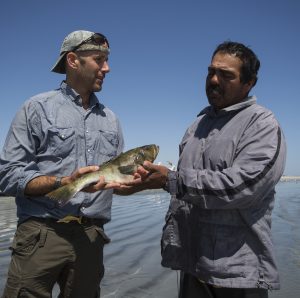
Fisherman Francisco Rodríguez Romero details with pride the quality of his sand bass to Hoyt Peckham Photo © Carlos Aguilar – SmartFish
outcome: fishermen are realizing important price increases, usually exceeding 100%; 2. Power outcomes: Fishermen and their families are taking control of their economic destinies as price setters, and chefs and other retailers are able to offer sustainable and high quality seafood; and 3. Environmental outcomes: there is a 40-60% lower catch volume than the status quo for target species; there are minimum and in some cases maximum size limits; there is decreased fish bycatch and zero megafauna bycatch (no turtles, dolphins etc. killed in gillnets); and a switch to more resilient target populations, i.e. away from grouper and shark towards sand bass and yellowtail.
Drew Deckman is sold. “I’m the governor of Slow Food for the entire Baja peninsula and the vertical integration that Hoyt is seeking in the fishing cooperatives is exactly what I look for in every new location in which I establish operations. Before I was a chef I was a commercial fisherman and a master diver, so for me the SmartFish solution is ideal; it is the logical conclusion of all my efforts. It’s fantastic to work with Hoyt and the cooperatives, and we’re all excited about the change this will bring to the lives of fishermen in Baja.” SmartFish, smart choice.
For more information on SmartFish you can visit their website at http://smartfish.mx/
It’s Not all Dire Straits in BCS
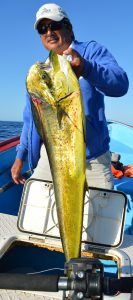
Todos Santos Fisherman Agustin Agundez
Of course not all fishing cooperatives in Baja are subject to the same forces Hoyt describes. Many receive good prices for their fish and have catching and processing techniques that deliver a high quality product to consumers. In Todos Santos, for example, fishermen Agustin Agundez reports that they receive 60 pesos per kilo for desirable fish like cabrilla and huachinango. While some Todos Santos fishermen do use gillnetting, they also fish with hook and line to ensure that local restaurants have the great quality fish for which they are rightfully famous. Chef Dany Lamote of Santo Vino has a great working relationship with the local fishermen. “The fishing cooperatives in Todos Santos know the quality that Santo Vino demands and we are very pleased with the fish we get here. We often buy the fish right off the boat and it is still very cool and very fresh.”