by Bryan Jáuregui | Adventure, Culture, Travel Industry
by Todos Santos Eco Adventures
Entrepreneurial Surfer Mario Becerril is the focus of this second installment in our series The Saints of Todos Santos, a fun look at some of the Todos Santos residents who really put the magic into our Pueblo Magico.
Sometimes mother really does know best. Mario’s mother moved the family from Mexico City to La Paz when Mario was 12 years old, and she quickly prioritized her educational goals for Mario in their new ecotourism-centered home town on the ocean. “My mother insisted that I learn to speak English and that I learn how to swim.” Luckily for folks who come to Todos Santos for surf instruction, he learned to do both extremely well! Mario is now widely considered the best surf instructor in the area and has built up a successful surfing school that is unmatched in terms of equipment, instructor talent, student success and – let’s face it – sheer fun. But it took some hard work to get here.
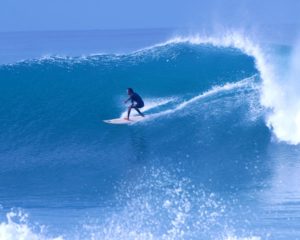
Mario Surfing at Los Cerritos. Photo by Kaia Thomson
Mario went to a high school in La Paz that specializes in preparing kids for a career in Baja California Sur tourism. As part of their coursework students are required to participate in all the main tourist activities in the area, including sport fishing, kayaking, scuba diving, sailing and so forth. So at the age of 16 Mario came to Los Cerritos Beach in Todos Santos to learn how to surf, the same beach where he teaches his own surf students these days. “After I caught that first wave at Los Cerritos I was completely hooked. For the rest of high school and all of college I came to Todos Santos every single weekend I could to surf. The incredible joy of surfing, the magic of Todos Santos, all combined to make Todos Santos the only real place for me to live once I graduated from college.”
Once he completed his degree in foreign business at the University of BCS in La Paz, Mario headed straight to Los Cerritos and hasn’t looked back since. He started working as a surf instructor for a small surf business at the beach, and soon realized that he had a natural gift for transmitting knowledge. His goal became to make the sheer exuberance of surfing accessible to everyone, so over the next 3 years he developed Mario’s Infallible Surfing Technique (MIST), the teaching tool that he uses at Todos Santos Eco Adventures’ Baja Surf Camp for Women. He’s serious about this. “If you don’t get up on the board during your first surf lesson I’ll give you your money back. We have a 3-step technique for people who come to us with better balance and strength, and a 4-step technique for those who need a little more work in these areas. But they all get up – and have fun doing it.” Mario notes that Los Cerritos is a particularly perfect beach for learning how to surf. “It doesn’t really matter what the weather is like or how big the surf is. The Cerritos magic is that we can always find a safe area for beginners to learn. The smooth and sandy bottom is a big plus as well.” And unlike some well-known surf spots there is no pollution in the ocean at Todos Santos.
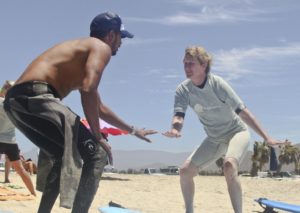
Imparting Mario’s Infallible Surfing Technique
To get the money he needed to build up his own surfing school Mario taught surfing 7 days a week at the beach and tended bar 6 nights a week in town. He even built his first 10 surf boards himself. Now, 12 years after moving to Todos Santos fulltime, Mario simply is surfing in Todos Santos. Even the big surf outfits out of Cabo and elsewhere on the Cape admit that Mario’s got the best equipment around, as well as the best-trained, most effective instructors. “We have such a great group of instructors. They are all Mexicans and they’re all from around this area. And of course they are all masters of the Infallible Technique!

Surfer Mario at Mario’s Bar
In addition to his surfing school Mario also runs Mario’s Bar at The Hotelito on Thursday, Friday and Saturday nights. His mother now lives in Todos Santos too!
© Copyright Sergio and Bryan Jauregui, Casa Payaso S de RL de CV, 2011
by Bryan Jáuregui | Culture, Food
by Todos Santos Eco Adventures
This piece on Chef Dany is the first in our series The Saints of Todos Santos, which focuses on those residents of Todos Santos (All Saints) who help give the town its most magical, mystical and memorable qualities – and whom you’d be most likely to meet on one of your adventures with us.
Chef Dany Lamote moved to Todos Santos from Canada, where he had been very much involved in the slow food movement, a practitioner of “think global, eat local”. When he was operating the Latin-fusion restaurant Mescalero in Calgary, this philosophy put such eclectic fare as elk burritos and salmon ceviche on the menu. Now that he is living between two oceans here in Todos Santos, Dany’s eat-local focus brings out fabulous seafood dishes, complemented by a wonderful variety of fruit. “Here in Todos Santos we have fresh, tree-ripened star fruit, tree-ripened mangos and lichees, and vine-ripened passion fruit. There simply is no equivalent in Canada. These fresh-off-the-plant fruits are great for making salsas for the fish, and of course we also use them to make drinks, margaritas and desserts.”
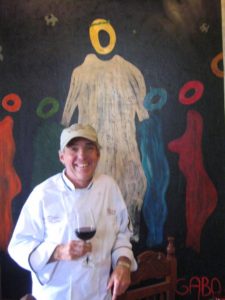
Chef Dany at Santo Vino
Dany moved to Todos Santos in 2002 as the Executive Chef of the Hotel California, a job which he still holds. He also has his own restaurant now – Santo Vino – which is dedicated to showcasing food and drink produced in Baja. “Baja’s wine country in Valle de Guadalupe is in full swing now, it is very dynamic. Most of the people making wine in Baja are very small producers, and we showcase a lot of these wines here at Santo Vino.” Having Dany pair Baja wines with his Baja dishes is one of the great joys of a meal at Santo Vino. Dany also features Baja-brewed beer!
In the cooking classes that he runs as part of Todos Santos Eco Adventures’ Cooking Adventures Week in Todos Santos, Dany focuses on sharing what he has learned through almost a decade of deep immersion in Mexican food culture. “When people come to my cooking class in Todos Santos I try to give them the opportunity to work with ingredients they’ve never used before – or maybe never even heard of before. I want them to leave with the satisfaction that they’ve gained a much deeper understanding of the culture than they ever could have gained from eating in restaurants only.”
Dany is a graduate of the CERIA Culinary Institute in Brussels, Belgium. He immigrated to Canada in 1979 where he eventually settled in Calgary. He was a partner in many successful restaurants and an inventive influence in the movement that put Calgary on the international culinary stage during the 1988 Winter Olympics. After moving to Todos Santos in 2002 Dany published the colorful The Hotel California Tequila Cookbook which reflects his love of discovering a beautiful new place to live.
© Copyright Sergio and Bryan Jauregui, Casa Payaso S de RL de CV, 2011
by Bryan Jáuregui | Culture
As most of you know, the name of our home town – Todos Santos – means “All Saints”. Most of you also know that Todos Santos has been designated as one of 36 Pueblo Magicos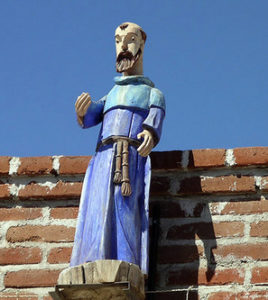 , or Magic Villages in Mexico. So what is it that draws all these spiritual, mystical and magical designations to the place? Well of course there is the incredible juxtaposition of the desert and ocean, the inspiring rise of the Sierra de la Laguna Mountains, the lush fields of strawberries, chiles, palms and mango trees, that wondrous air quality of a true desert oasis. All of these make Todos Santos a truly amazing place.
But more than that it is most likely the people who are drawn to these elements that really give the town its most magical, ethereal qualities. In years past we had the builders and traders like Tobasco Wang who built the Hotel California, Antonio Cota who built the hacienda that became the Todos Santos Inn, Don Pepe Santana who owned a sugar mill and lived in the building that is now the Cafe Santa Fe, and Ramon Wong, who built two stores and a cantina in town and married the daughter of a revolutionary hero. All these people came to Todos Santos to pursue their dreams and revel in the natural beauty.
Today the Saints of Todos Santos are both descendents of the town’s early settlers, and those who’ve followed since the artist Charles Stewart moved to Todos Santos in the early 1980s. Todos Santos is now home to a vast array of talented Mexicans and expatriots who enrich the town with their skills as chefs, artists, farmers, fishermen, photographers, craftsmen, writers, poets, surfers, architects, naturalists, teachers, environmentalists, storekeepers, adventurers, massage therapists, spiritual leaders, yoga practitioners…and more! We’ll be creating profiles of some of these “saints” of Todos Santos – those who help give the town its most special qualities – and whom you’d be most likely to meet on one of your adventures with us. Stay tuned to meet the Saints of Todos Santos!
by Bryan Jáuregui | Travel Industry
Having just spent a couple of weeks in the US we almost felt afraid to go back to Mexico ourselves! But a recent article in the Huffington Post sent to us by Sheila Wall reminded us that there are many in the media who have taken the time to a) see that Todos Santos is the same sleepy, safe, wonderful place it has always been (almost 1,000 miles from any of the drug-related problems that are troubling a select few locations in Mexico) and b) it is a great place for a nice, laid-back vacation away from the hordes in Cabo. Please enjoy this sampling of media coverage from the last 12 months that shows what a wonderful holiday destination Todos Santos remains:
The Sweetness of Todos Santos, Huffington Post, May 12, 2011
Top 8 Places to Now Safely Visit in Mexico, Lonely Planet, May 5, 2011
5 Safest Places in Mexico for Travelers, April 20, 2011
Relishing the Waves, Not the Crowds, in Mexico, The New York TImes, April 6, 2010
Todos Santos: All you want — and less — in a Baja getaway, The Los Angeles Times, March 7, 2010
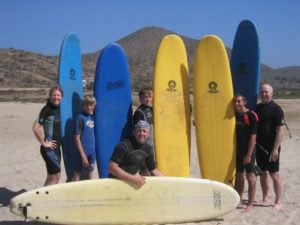
Family Surfing in Todos Santos
by Bryan Jáuregui | Wildlife
by Todos Santos Eco Adventures
What do scorpions have in common with humans? Unlike most of their fellow arachnids and invertebrates but very much like humans, scorpions are viviparous, i.e., they give birth to live young one by one. The scorpion babies look like miniature adults, except that they are very light in color (adults are dark) and cannot sting. This lack of stinging ability may help promote family harmony as almost immediately after birth baby scorpions climb onto their mother’s back, a perch they enjoy for several days until their first molt (longer for some species). The mother scorpion does not feed her babies, but she does carry and protect them until they are able to hunt for themselves. Unless, of course, she gets too hungry in which case she no longer recognizes the small arachnids are her babies and eats them! Some time after the first molt young scorpions leave the (relative) safety of their mother’s back to establish their own territories.
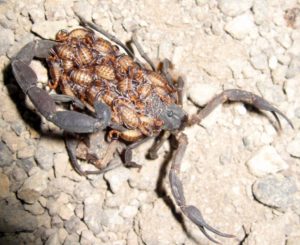
Mama Scorpion with Babies on Her Back
The body of a scorpion is divided into two parts: the cephalothorax (also called the prosoma) and the abdomen (opisthosoma). The cephalothorax is the scorpion’s “head”, comprising the carapace, eyes, chelicerae (mouth parts), pedipalps (claws) and four pairs of walking legs. The scorpion’s exoskeleton is thick and durable, providing good protection from predators. Scorpions have two eyes on the top of the head, and usually two to five pairs of eyes along the front corners of the head. In the summers in Baja scorpions can be seen raising their bodies off the ground to cool their undersides.
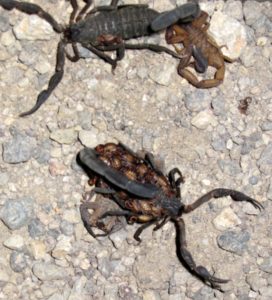
Scorpion Family Photo
Scorpions play an important role in the ecosystem of Baja by helping to keep the insect population under control. They also like to eat spiders, small mice and lizards. But they don’t eat every day; in fact scorpions have been known to go without food for up to 12 months if they have sufficient water. Typically though scorpions will have a meal at least once every 2 to 3 weeks. They are quite resourceful in going after these meals. Some stalk their prey and some will even dig a trap in the sand for their prey to fall into.
Others take a more relaxed approach and just wait by their burrow with their pincers open and stingers raised until unsuspecting prey wanders by. Once prey is within reach the scorpion grabs it and crushes it with their pincers. Scorpions try not to use their venomous sting unless absolutely necessary as it takes a great deal of body energy to produce more venom. Younger and smaller scorpions tend to use their stingers more often than larger and older ones. Scorpions have very small mouths and can only take in liquid, so captured prey is crushed and injected with enzymes that dissolve the insides. Scorpions are remarkable survivors. If necessary, they can slow their metabolism to as little as one-third the typical rate for arthropods. In this way the scorpion greatly reduces its intake of oxygen and can live on as little as a single insect per year. But unlike most hibernating species, even with lowered metabolism the scorpion has the ability to spring quickly to the hunt when the opportunity presents itself.
© Copyright Sergio and Bryan Jauregui, Casa Payaso S de RL de CV, 2012