By Bryan Jauregui
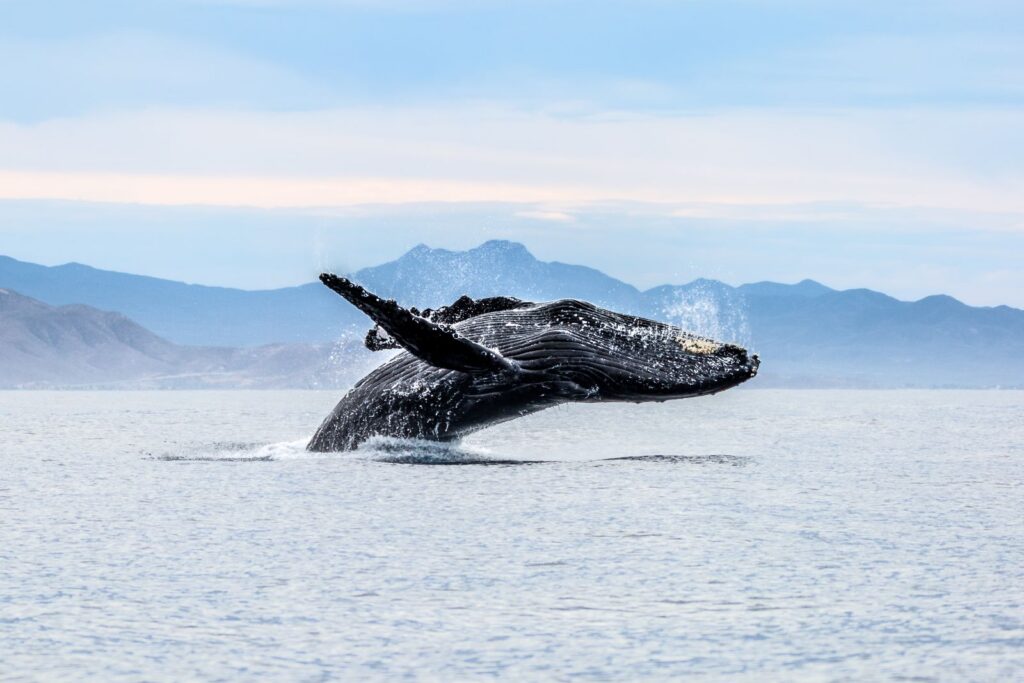
It was a terrible, anguished sound. Guide Citlali Aguilar, her clients, and local fishing captain Agustin Agundez were off the coast of Todos Santos when they heard it. Agustin steered his boat slowly towards the distressing noise and they passed an orca; it was alone, alert, silent, and still. It filled them with dread. A few hundred meters on a fierce battle exploded on the waves. “A second orca was trying to attack a baby humpback whale that was protected by two adult humpbacks” recalls Citlali. “The adults had the baby inside a circle of their bodies to protect it and keep it afloat, and the orca was jumping and jumping trying to make it into the center of the circle to drown the baby.” The sound she was hearing was the humpbacks screaming. Not underwater, but into the air. “You could tell they were calling for help” says Citlali. “They were thrashing
their tails, smashing them near the orca, and calling, calling for help.” The current was carrying the four mammals straight to the other orca that Citlali and Agustin had originally encountered which continued to wait silently, patiently. Notes Citlali, “The orcas definitely had a strategy.”
“It was agonizing to watch” recalls Citlali. The adult humpbacks were working so hard to defend the baby but they were trapped in a deadly dilemma: to protect the baby at the surface they couldn’t dive to gain the momentum needed to overpower the relentlessly attacking orca. “So they kept circling,” recalls Citlali, “thrashing with their tails and screaming. But the orca was tiring them out. It was so distressing that my clients started crying.”
Then an amazing thing happened. Two other adult humpback whales arrived to help, one from the south and one from the west. The distress calls had worked. “That to me was the most marvelous thing” says Citlali. “The new whales were coming from different directions.” The two new whales entered the circle around the baby and took on the fight, giving the whales who had been defending the baby to this point a chance to
recover some energy. But the current was taking them ever closer to the waiting second orca so as soon as they could the original protectors got back into the fight. “Then all of a sudden we saw this huge gush of blood in the water and my clients just completely lost it and were sobbing uncontrollably – we thought the baby had been killed.” But the truth was both hopeful and brutal: the orca had bitten the tail of one of the new
defenders, a large, powerful whale that they felt confident could recover.
But now the whole group – the 4 adult humpbacks, the baby humpback and the attacking orca – had reached the waiting orca on the current. Citali, Agustin and their clients were almost overwhelmed by anxiety about what might unfold next. It seemed entirely possible that the orcas could claim victory with one last ferocious stand. But the orcas simply turned and retreated, conceding defeat to the courageous humpbacks. “It was an edge-of-the-seat thriller!” recalls Citlali. “Even though the orcas had left the area we felt too anxious and invested to leave the humpbacks so we stayed in the vicinity quite a bit longer. Only once the two humpbacks who had answered the distress call swam away did we head back to shore. It remains the most dramatic thing I’ve ever witnessed in nature.”
Much has been written in recent years about humpback whales who have been observed intervening to save other species from orca attacks including baby gray whales, sea lions, harbor seals and porpoises. The same tactics Citlali and Agustin observed – powerful tail and flipper slaps, trumpeting sounds and physically placing themselves between the orcas and their prey, sometimes for hours – are all hallmarks of these rescues. What motivates the humpbacks in these dramatic interventions? Is it cross-species empathy? Altruism? Or is it just good old-fashioned payback? Humans have not yet evolved enough to understand the humpback mind, but Citlali’s experience leaves no doubt that humpbacks possess a fiercely protective nature and are true friends to those in need. How happy that they are our ocean neighbors here in Baja California Sur.