If you sift back through the catalog of parental admonitions that were meant to ensure you a long and happy life – you know, “don’t stick your tongue on frozen metal”, “don’t eat yellow snow”, “don’t drink your father’s last bottle of beer” – somewhere buried in there your mother must surely have added “and oh yes dear, don’t swim with sharks”.
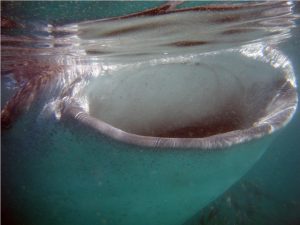
Very sound advice to be sure but swimming with sharks – whale sharks that is – in the Sea of Cortez is truly one of life’s great (and, sadly for you danger junkies, very safe) adventures. While whale sharks have thousands of teeth in hundreds of rows in their enormous mouths (imagine armed shark mouths 4 to 5 feet wide), they can neither bite nor chew. That’s right, they are happy to forego all human body parts in favor of plankton, krill and small fish. Go figure!
Whale Shark Mouth! Photo by Deni Ramirez
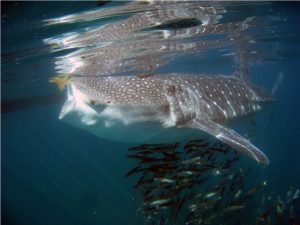
So now you feel safe but even if you were on the varsity swim team you’re probably wondering how you could actually keep pace with a shark in the water. Well, the whale shark got its moniker because it is the only fish that is literally as big as a whale; mature adults can reach 60 feet in length and 50 tons in weight. Reaching these proportions requires an immense amount of energy, which the whale shark gets by consuming huge volumes of plankton-rich water, then straining it out through its gills. In fact, to get the food it needs it is not unusual for a whale shark to filter 400,000 gallons of water anhour. To conserve this hard-won strength – and continue eating – whale sharks tend to do a lot of hanging about in the water, or, if moving, doing so at a very slow pace. This lollygagging is what makes it possible for non-bait types like humans to jump in and swim alongside them for a bit. Of course, when they want to put on the speed they certainly can so when a whale shark tires of your company all you will see is a swishing tail receding into the distance.
Now you’d think it’d be a relatively simple matter to learn about a mammoth fish the size of a school bus dawdling through the water eating up everything in its path. But the fact is that scientists still know relatively little about the whale shark, and La Paz resident Dení Ramirez of Whale Shark Mexico is trying to change all that. Originally from Mexico City, Dení has been studying whale sharks in La Paz since 2001, and completed her Ph.D. in marine biology last year. The whale shark’s skin is covered in a pattern of pale yellow spots and stripes that is unique to each animal, a type of fingerprint if you will, so Dení has been able to track some of the inhabitants of La Paz Bay. In fact, she has been tracking the young sharks Flavio, Tikki Tikki and Tango for almost a decade now, and has determined that they are true Baja residents. While whale sharks have been spotted across the globe from Australia to Djibouti, from the Philippines to Mozambique, Dení’s juveniles appear to travel only in the Sea of Cortez, from the Bay of La Paz to Bahia de Los Angeles – roughly 600 miles. We asked Dení why we seem to be seeing the whale sharks around La Paz so much more over the last couple of years than we ever did before.
Whale Shark Feeding in the Sea of Cortez: Photo by Deni Ramirez
“It’s really just a question of food. Over the last two to three years the conditions in the Bay of La Paz have been just right to produce an enormous amount of plankton for the whale sharks to feed on. The wind, currents, mangrove conditions – all these have combined to create an excellent environment for plankton growth that we just didn’t have for such extended periods in earlier years. Also, in the Bay of La Paz the plankton is rich in the coastal waters, and these relatively shallow waters give the young sharks in my group a certain amount of protection.” Dení is happy to take visitors with her on her research trips and share some of her extensive knowledge of whale sharks and research methodology.
Dení is currently doing a lot of work with the pregnant females who inhabit the deeper waters around Espiritu Santo Island and have found that they have much larger migrations than the young sharks due to their different needs as mothers, mothers who surely will work to ensure the long life and happiness of their offspring by admonishing “and dear, don’t try to eat the humans. They’ll just clog up your gills.”
TOSEA guest Mary Winzig recounts her whale shark adventure:
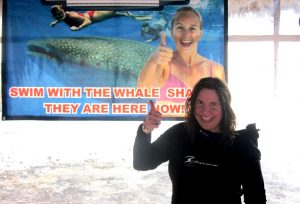
“Swimming with whales sharks is the most amazing thing I have ever done in my life. They are such magnificent animals and I felt so lucky to be in their presence. I was scared—to see something so large and to know you are jumping in the water with them made me pause for a moment. My heart seemed to be almost leaping through my wetsuit – I asked the guide to make sure they were whale sharks because their dorsal fins were so huge! But after watching them and seeing their polka dots, I realized I had to swim with them. You can’t be afraid of anything with polka dots! Jumping in and seeing them through the snorkel was magical. Once I was in the water, I wasn’t afraid. I have no idea how long I was in the water with them, 2 minutes? 15 minutes? I was transfixed. Their mouths look like the grill of a ‘57 Chevy. I have never felt so small or insignificant, but also so powerful. I have decided I have to do everything in my power to help save these magnificent creatures. Thank you Todos Santos Eco Adventures for this wonderful opportunity. I look forward to swimming with the sharks again!”
So there she was in Boston on Patriot’s Day 1976 explaining to Rosalynn Carter that her (Rosalynn’s) luggage had been stolen out of her (Donna’s) car while they made a campaign stop on the way to the hotel from the airport. Rosalynn was sad because the bible that Jimmy had given her years before was in the luggage. Donna was sad because she thought this snafu pretty much spelled the end of life as she knew it. She was right. To help the luggage-less future first lady Donna ran around town and bought Rosalynn all of her favorite beauty products, and Rosalynn was very touched by this act of kindness. So touched that when she and Jimmy moved into the White House she invited Donna to a state dinner in honor of German Chancellor Helmut Schmidt. Now invitations to state dinners at the White House are traditionally bestowed only on the true elites of the business, political and entertainment worlds, not 26-year-old legal secretaries cum campaign volunteers. Donna was stunned by this remarkable expression of thanks for a kindness she had rendered, and she took to heart what it means to not only help people when you can, but to express gratitude for the kindnesses you have received. The children of Todos Santos are benefitting greatly from these lessons.
But long before arriving in Todos Santos (and not so long after leaving her secretarial job) Donna moved into a very elite world herself, co-owning and operating one of the finest restaurants ever to grace the city of Boston, L’Espalier. Often credited with being the first independently owned restaurant to bring haute cuisine to Boston, L’Espalier opened in 1978 and to this day remains the only independent restaurant in New England to receive Five Diamonds from AAA. When she sold her share of the business in 1988, Donna moved to Virginia and thought she would concentrate solely on being a mother for a while. She did. But not long after she’d enrolled her youngest child in kindergarten she decided to open another restaurant, which she also sold for a nice profit a few years later. But not before she married one of her best customers, a BMW dealer named Marc Viglione.
School’s in Session with Donna Viglione at The Palapa Society
Now Marc is a man who has always loved the water and not long after he and Donna married in 1995 they decided to move to an ocean-side town in New Jersey. When they bid at a silent auction for charity they naturally put their money on a week at a 16,000 square foot ocean-side vacation house in Cabo… and won! So in 2003 the whole family headed down to Baja. But the surfing in Cabo was not to the liking of Donna’s son Omar so he persuaded the family to take the drive up to Los Cerritos in Todos Santos, a drive that they wound up repeating every single day of the vacation. But Donna and Marc weren’t making the drive just to cater to Omar’s surfing passion; they had quickly developed their own love for Todos Santos, one of the loveliest ocean-side towns they had ever seen. By the time they got on the plane to go home they had bought a house in Todos Santos, albeit with a limited deposit of $300 as that was all the cash they could get out of the ATM machine.
When they got back to New Jersey the Vigliones closed their business, sold their home, sent the rest of the money for the house in Todos Santos, and returned to Baja for good just a few months after first stepping foot on the peninsula. Omar was thrilled and Donna thought she would concentrate solely on being a mother for a while. She did. But soon the house had been remodeled and her son’s days were filled with surfing and high school so in the summer of 2004 she enrolled in a conversational Spanish class. She thought it would be fun to teach her Spanish-speaking friends English, and by the fall of 2005 she’d started an after-school English-language program that met at the Cultural Center. At around the same time she started volunteering at the library of The Palapa Society – a Mexican non-profit focused on improving the lives of local children – and they soon invited her to be on the Board of Directors. Not long after Donna was invited to bring her after-school Bridge-to-English program into The Palapa Society and when they moved into their new space in 2007 the program really took off. The numbers tell the story.
For this current 2011-2012 school year 70 students ranging in age from 5 to 17 are registered for the program, and 16 of those receive Palapa Society scholarships. An additional 45 Todos Santos students receive scholarships from The Palapa Society to pay for their high school education, and 19 receive Palapa Society scholarships for universities in La Paz. It’s a remarkable achievement.
One of the keys to Donna’s success is the passion of the volunteers in Todos Santos who give so generously of their time and talents. These include Todos Santos “Saint” Mario Berceril, the entrepreneurial surfer who runs an 8-week swimming program for the Palapa kids each summer; Todos Santos “Saint” Erick Ochoa, who took over from Donna as president of The Palapa Society in fall 2009 and works with local artists such as Gloria Van Jansky to teach the kids arts and crafts each Wednesday; and hero volunteers like Serena Saltzman and Tim Doyle who have so steadfastly nurtured the program and the abilities of the kids over several years.
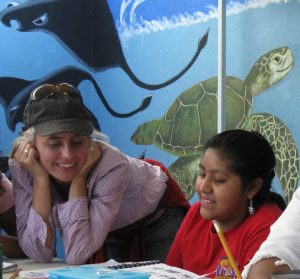
Volunteer Serena Saltzman with Palapa Society Student
The efforts of all these people and many more have made The Palapa Society’s programs so popular with the local families of Todos Santos that the society needs a larger facility to meet the demand. But where to find the money to purchase a permanent home? Well, as it turns out, two things we previously suspected are true: 1) rock ‘n roll really can save the world (or at least some parts of it), and 2) Rosalynn Carter is not the only one who knows how to make a grand gesture.
Peter Buck of the band REM bought a house in Todos Santos about 4 years ago and found he wanted to do something for the town, something specifically connected to education. He hooked up with the Hotel California and the Journal del Pacifico and about 60 days later – in January 2012 – the first annual Todos Santos Music Festival was in full swing. By the time the last guitar chord wafted from the stage $40,000 had been raised for The Palapa Society. But this was not just some one-off fundraiser. Peter Buck plans to make it an annual event to raise money for The Palapa Society and the next Todos Santos Music Festival is already scheduled for the 3 weekends of January 10-26, 2013. Plenty of time to get your tickets!
But if you can’t make it to the Todos Santos Music Festival or if music is just not your thing, there are other ways to get involved. You can:
Martin Buber once wrote, “All journeys have secret destinations of which the traveler is unaware.” Rosalynn Carter. Peter Buck. Donna Viglione. The Palapa Society has been the secret destination for these and so many other travelers. Perhaps it could be for you too.
In the fictional movie Rocky, boxer Rocky Balboa’s hero is real-life boxing champ Rocky Marciano, the only boxer to hold the heavyweight title and go undefeated throughout his career. Both the fictional and the real Rocky come from working-class households, and find discipline, passion and success in boxing. It’s no wonder then that Alexis Nuñez, the son of a Todos Santos palapero, was inspired by the movie Rocky to take up boxing and is passionate about the sport and the discipline it provides. The real wonder is that there is a real-life Mexican boxing champ to coach him – in Todos Santos – and a community that is pulling together the resources to make the boxing dream a reality for local kids.
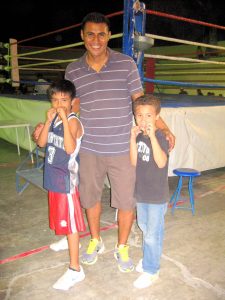
Boxing Champ Ramiro Reducindo Radilla with His Son and Alexis Nuñez
The story begins in the parking lot of Bodega Lizarraga in downtown Todos Santos. General Manager Moises Barraza Morales put up a punching bag one day and started inviting friends over to box. Word began to spread, friends of friends began to participate, and soon enough the local kids started coming around to join in the fun. Local business owners donated some equipment and before long the Chief of Area Promotion and Development of Sport, Julio César Covarrubias Gerardo, got involved and helped the parking lot fun evolve into a more organized program. Most importantly, Covarrubias brought in the coaching talent. And what talent!
Mexican boxing great Ramiro Reducindo Radilla won the gold medal at the Pan American games in Santo Domingo in 2003, represented Mexico at the Olympics in Athens in 2004 and turned pro in 2005. Reducindo believes so much in the talent of the boxing students in Todos Santos that he drives here from La Paz after a full day of his own training to coach. Says Ramiro, “I started boxing when I was 13, about the same age as the kids I’m coaching in Todos Santos now. My goal is for at least one of these Todos Santos boxing students to be successful on the global boxing stage. I definitely see that potential in them.”
That potential was shown to the town during the first amateur boxing contest held here on October 29 in the auditorio. Two of our local boxing students with only 4 weeks of training – Alexis Nuñez and Cuauhtemoc Aviles – went head-to-head with seasoned champions from La Paz and Los Cabos, winning several points off of their opponents, if not the matches themselves. Coach Reducindo was thrilled with their performances and is confident that we’ll be seeing great things from these two in the months and years to come. Reducindo is so committed to helping the Todos Santos boxing students realize their potential that he coaches them at least twice a week for nothing more than a little gas money.
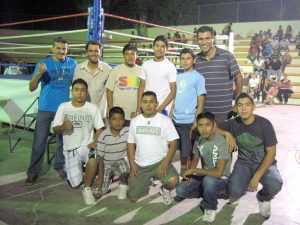
Mauricio Duran, Samuel Dominguez Pino, The Champ and the Todos Santos Boxing Kids
But to be successful the kids must practice every day, so Todos Santos locals Mauricio Duran Ramirez and Samuel Dominguez Pino keep the program organized and keep practice going on the nights when Reducindo is not in town. Reducindo leaves instructions for exercises and activities, and Samuel (a local store owner) and Mauricio (a guide with Todos Santos Eco Adventures) make sure the students follow the program. Says Mauricio, “It has been really great to watch these kids gain confidence and become more focused in their lives, to see them setting and working to achieve goals. Boxing requires a type of discipline that is not demanded of them in the other sports available here and it is making a big difference in their lives. We’re also seeing the kids lose weight and getting more focused on health and nutrition. It’s very positive from almost every aspect of their lives.”
And you can help keep that positive trend going. Reducindo is donating his time and local businesses have donated some equipment, but the needs are still great for everything from gloves, mouth guards and head gear, to a ceiling canopy to hang punching bags. If you would like to get involved please contact Mauricio for specifics: Cell: 612-13-44478 or email: . Rocky Nuñez? Cuauhtemoc Ali? It’s all possible and you can help make it happen!
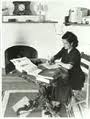
“My mother was a free spirit, an egalitarian and a bohemian, and ended up getting sent away to school because she was always running off to work with Diego Rivera on his murals. And all this was when she was just 10 years old. You know, she never really cared for Frieda Kahlo very much.” So begins Alejandra Brilanti’s story of her mother Ana Nuñez Basso de Brilanti, the matriarch of the Brilanti family of Todos Santos and renowned silver artisan of Taxco.
While the likes of Eleonor Roosevelt ultimately became fans and customers of Ana’s, and her story is featured prominently in the histories of the silver jewelry industry in Taxco, it can be definitively declared that her artistic success was not her mother’s fault. When Ana was a little girl one of her sisters died and was laid out in the family parlor for 3 days. Ana thought the scene was beautiful and painted it. Her mother thought the painting was blasphemous and smashed it. These constant struggles over art earned Ana a passage to boarding school where, at the age of 14, she graduated to a teaching position to contribute to the family income. She worked incredibly hard for the rest of her life, but – despite her mother’s best efforts – she worked doing what she loved most: art.
Ana Brilanti
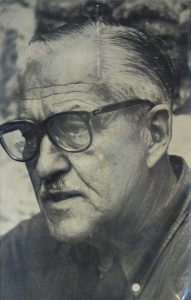
Ana and her husband Rafael moved to Taxco from Mexico City in the 1930s for Rafael’s government job. Around the same time, an American named William Spratling left his job as an instructor in architecture at Tulane University in New Orleans (where he shared a house with William Faulkner) and moved to Mexico full-time. He became an integral part of the Mexican art scene, and used the proceeds of a commission earned securing a New York exhibit for Diego Rivera to purchase a house in Taxco. At this time, the early 1930s, Taxco was famous for the production and export of silver, but there was no silver jewelry industry in the town to speak of. That all changed under Spratling. He opened his first store in Taxco in 1931, and by 1933 silver jewelry and silver objects designed by Spratling had become the major sellers in his shop.
William Spratling
Spratling needed talented artists and artisans to create the jewelry for his store, and he was continually on the lookout for new apprentices for his workshop. One day as he was walking down the street, he saw Ana Brilanti in front of her house, and couldn’t help but notice the beautiful designs carved into her door. He inquired and Ana admitted that she was indeed the wood carver and designer, and Spratling persuaded her to share more of her designs with him. Amazed by what he saw, Spratling invited Ana to learn to work silver with him and the Brilanti silver dynasty was launched.
By 1940 Ana – like many other Spratling apprentices around that time – felt accomplished enough to go off on her own and, with Spratling’s blessing, opened her first silver store in Taxco, Plateria Victoria S.A. Ana’s husband had created a new technique for making jewelry of both copper and silver, and this combination became one of the distinctive hallmarks of Ana’s line of Victoria jewelry. American department stores accustomed to buying jewelry for their customers in Europe had their supply lines disrupted by World War II, so they started purchasing silver jewelry and objects from Taxco. Ana’s store did so well that her husband left his government job to become Ana’s manager and promoter, and their success lead to the opening of a 2nd store in Taxco in 1958 called Cony.
Alejandra was 12 when her father passed away, and it was only then that she really got to know her mother. And despite all of Ana’s success, the woman that Alejandra discovered was still that 10-year old egalitarian at heart. She never spent any money on herself (“why would a person need more than one pair of shoes?”) but continually gave her money to those in need. Not only did she run a small local hospital, she also made all the clothing and sheets that it needed. Alejandra continued to live near her mother after she married Ruben Gutierrez, and the couple only left Taxco and Ana when the tough economy in Taxco drove them to seek opportunity in Mexico’s last frontier, Baja California Sur.
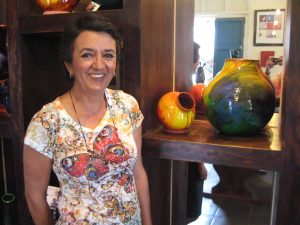
Alejandra Brilanti with Ruben’s Pottery in Manos Mexicanos
Cabo was Alejandra and Ruben’s first home in Baja, but a few weekends in Todos Santos soon convinced them to move north, and for the last 16 years they’ve made their home, built their business, and raised their family in Todos Santos. Their beautiful store of pottery, handicrafts and jewelry – Manos Mexicanos – has been in at the corner of Centenario and Topete since its inception.
And the magic of our pueblo magico has nurtured the artistic leanings of the family. Shortly after moving to Todos Santos Ruben took a pottery class with a Navajo Indian who had been invited to town by founding artist Charles Stewart and his wife Mary Lou. While Ruben had always been good with clay, that instruction and inspiration set him on a path to creating some the most beautiful and distinctive pottery to be found in Baja. Alejandra and Ruben’s nephew Arturo also found his artistic calling in Todos Santos: he works at Manos Mexicanos by day, and paints every night after putting his children to bed. His works can be found in both his mother’s store Galeria A and Manos Mexicanos. And of course there are the Brilanti silver stores. After Ana Brilanti’s death, Alejandra’s brother Pepe joined her and Ruben in Todos Santos. He opened Joyeria Brilanti, a store that pays wonderful homage to Ana’s beautiful designs. Pepe’s son Rafael also runs a Brilanti Joyeria in Todos Santos, producing silver works based on both his Grandmother Ana’s designs and his own.
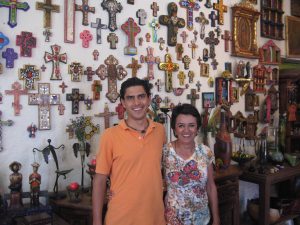
Alejandra and Arturo in Manos Mexicanos
Given the fierce battles that she fought to pursue her own artistic career, Ana Brilanti would no doubt be thrilled to see her skills, designs, and innate artistic talent blossoming and thriving with her descendents in an artist colony. Her only note of disapproval might be for the Frieda Kahlo Christmas ornaments on sale in her daughter’s store!
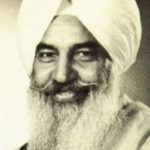
It was 1968 and Robert Hall was living The American Dream. He had a thriving psychiatric practice, a huge house in Mill Valley, and a wonderful family with his childhood sweetheart of a wife and their children. The only drawback was that it was killing him. He was working 24/7 – a Rolfing practice during the day and a Gestalt therapy practice at night – and he was exhausted, drained and he needed some answers. As has happened at every critical juncture in his life, he got them – immediately. He went to a friend’s house and, while waiting for him, saw a piece of paper on the floor. He picked it up and found it was a transcript of a talk by an Indian spiritual master. As he began to read he found it was like a voice speaking in his mind, a light literally shining in the darkness. It was a light so bright that his wife actually saw it too. He dialed the telephone number at the bottom of the page, and it was his next-door neighbor in the geodesic dome. The signs were clear and Robert didn’t hesitate.
Charan Singh, Robert’s Spiritual Master
Robert and his wife Alyssa left their 3 children with a friend and went to India for 4 months to study with Charan Singh, the man whose talk Robert had read on that fateful day, and the man who was to remain Robert’s spiritual master for the rest of Singh’s natural life…and beyond. As Singh’s guests their 4 months in India were completely free, but not without some costs. Alyssa contracted typhus and Robert was frantic as there were no doctors in the area they were living except one who didn’t like to work on Westerners, despite– or perhaps because of – the fact that he was an Austrian-born American himself: Dr. Randolph Stone. He also happened to be Charan Singh’s personal physician, who was finally able to persuade him to see Alyssa. When Robert and Alyssa arrived at his garden office, they saw lots of Indians sitting around in various stages of distress, many with metal clamps on their fingers. There was screaming coming from Dr. Stone’s office. Robert, an army veteran, pressed on. When Dr. Stone worked on Alyssa with his hands he swayed and sang like the religious ecstatic he was. Robert tried not to freak out. When Dr. Stone finished working on Alyssa he had completely healed her. On the spot. Robert became his apprentice.
Robert’s career to that point had been shaped by his apprenticeships with two leading lights in the psychiatric world, both of whom were focused on mind-body integration in treating patients: Dr. Fritz Perls who developed Gestalt Therapy, and Dr. Ida Rolf, originator of the body-work known as Structural Integration or “Rolfing”. In fact, he ended up with that house in Mill Valley when Dr. Perls asked him to move to the Bay Area to start the Gestalt Institute of San Francisco. Robert’s apprenticeship with Dr. Stone took his approach to mind-body work to a whole new level. Dr. Stone, the founder of Polarity Therapy, taught Robert how to work and heal with the energy of the body.
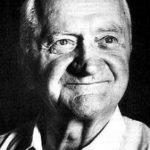
Randolph Stone, Robert’s Teacher, Partner and Friend
Inspired by his experiences in India, the teachings of Charan Singh, and his 3 main apprenticeships, Robert co-founded the Lomi School in Santa Rosa, California in 1970 “to bring together a group of far-out modalities into one practice. Lomi was founded on the principle of the integration of mind, body, and spirit, with particular emphasis on the life of the body.” Robert, his wife Alyssa, and two other couples formed the core of the school, and Dr. Stone became their partner and teacher. Robert earned an international reputation for his innovative and pioneering therapies and the Lomi School thrived. Robert no longer had to do Rolfing during the day and Gestalt at night – he had integrated it all into one unique, inclusive and embracing practice. Turns out The American Dream just needed some Indian spice.
But this wasn’t the path that Robert had set out on in life. When he was 15 and living in upstate New York, his passion was to go into surgery, and he managed to get himself apprenticed to the town surgeon. He paid for medical school at the University of Buffalo by working nights as a surgical nurse, then took a year of internship and beginning surgery residency in Salt Lake City. Surgery was his calling. But in Salt Lake City Robert was hit with the realization that surgery residencies didn’t pay enough to support his growing family, so he joined the army as a captain and enjoyed a pay grade that covered his family’s needs. The tricky part was that at that point the army didn’t want more surgeons, it wanted more psychiatrists. So Robert agreed to a psychiatric residency under the army’s auspices, with the result that his first job out of residency was as Chief of Neuropsychiatry at Fort Knox (where his job description covered something called Mental Hygiene). When contemplating his numerous accomplishments in a field chosen for him by the army, a field that he so obviously loves and thrives in Robert says, “I didn’t do any of it. I didn’t make any of it happen. There is no such thing as free will. You just have to say yes to life.”
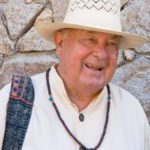
Robert in Mexico. Photo by Alvaro Colindres
In 1999 Robert decided that he was ready to retire, so he and his partner Alvaro began searching the world for the best place for them. (Robert and Alyssa had divorced, although they remain very close to this day and share 6 grandchildren.) They traveled to Italy and Spain and points beyond, but never found exactly what they were looking for. Then one of Robert’s apprentices called to tell him about a great artists’ colony he had heard about from a woman named Catherine Wall, a Todos Santos resident and artist. Robert and Alvaro came to Todos Santos to visit soon after, and within 10 minutes Robert fell in love with it. In fact, he remembered driving through Todos Santos on a vacation in 1987 and sensing “something very special in the air.” Alvaro, however, was less enthusiastic. Robert returned by himself a few months later and asked Janet Howey, the owner of El Tecolote Bookstore, if she knew of any places to rent. In short order Robert had signed a lease on La Ruina, a house in as good a state of repair as the name implies. He didn’t mention it to Alvaro until he returned home. Within 6 months Robert (eagerly) and Alvaro (reluctantly) had moved all their belongings to Todos Santos and made the town, and La Ruina, their home.
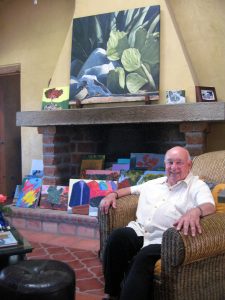
Robert at home in Todos Santos with his paintings and an Erick Ochoa original
Like many Americans, Robert had the bulk of his retirement encased in his home, a beautiful old Victorian in Tomales Bay, Marin County. With the final move to Todos Santos Robert put his house on the market and – as was common and expected at the time – it was quickly snapped up and placed in escrow. But at the last minute the buyers found some termite damage and abruptly withdrew from the deal. Robert and Alvaro found themselves shockingly, jarringly and absolutely flat broke. Literally no funds to survive on. They decided that prayer was in order, so they got down on their knees and prayed for guidance. While they were kneeling on the floor a knock came at the door. Alvaro got up to answer it and there stood an American woman whom neither of them had ever seen before. “She said ‘I heard that Robert was a follower of Charan Singh and thought he might like to have this.” She handed a book to Alvaro, who went inside to give it to Robert. When they both returned to thank her, she had left. The book was the memoirs of Robert’s spiritual master in India, Charan Singh, now long dead but clearly not gone. Two weeks later the Tomales Bay house sold, Robert and Alvaro bought their current home in Todos Santos, and Robert settled in to enjoy retirement. As added grace, Alyssa bought a house nearby, and Alvaro grew to love Todos Santos as much as Robert, becoming a real estate agent and a great photographic chronicler of the town and its surrounding natural beauty.
One of the many results of his first trip to India was that Robert became a serious practitioner of meditation, and a firm believer in its benefits for the mind and body. In 1974 he befriended several dharma teachers who practiced Vipassana, or Insight Meditation. He started going on 10, 11, 12-day silent retreats with them and saw that these types of retreats strongly dovetailed with Gestalt therapy, helping people to really focus on the here and now, on being in the immediate present. He also came to embrace Buddhism because he saw how practical it was and how it actually answered the question of the meaning of life. He became an ordained Buddhist priest and started leading his own silent retreats in 1980. He also became affiliated with Spirit Rock Meditation Center, and currently serves on the Center’s Teachers Council.
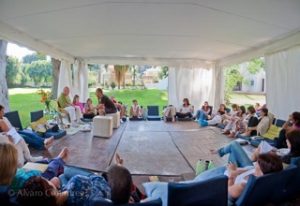
When he retired to Todos Santos Robert had no intention to teach again. He had taught thousands of people all over the world and served as a mentor to hundreds more. He loved teaching, but now just wanted to sit back, relax and enjoy the serenity of Todos Santos. “Then one day Alvaro told me he thought I should teach again. I was against it, but he finally persuaded me to at least give it a try. So we advertised a dharma talk at La A.R.C.A., and to my surprise over 30 people showed up. And Alvaro was right, the teaching really stimulated me and I realized then that I would like to continue.” Now residents and visitors alike find that one of the best things about being in Todos Santos is the opportunity to participate in Robert’s weekly Sunday morning dharma talks at L La A.R.C.A. They also have the opportunity to participate in the week-long silent meditation retreats that Robert offers several times a year in Todos Santos. Robert does not confine his activities in Mexico to Todos Santos alone. A fellow student of Fritz Perls contacted him a few years ago and persuaded him to hold workshops in various cities around Mexico, and he now conducts several of these every year. “I absolutely love teaching my Mexican students. Mexico is my home now and it’s wonderful being able to connect with young Mexicans in this way. This has been a great part of my so-called retirement.”
Robert Teaching in Puebla. Photo by Alvaro Colindres
On the Easter Sunday when Robert was 12, he took his young boy’s worries up the hill to seek some solace in nature. As he sat there, he was struck with the forceful inspiration, with what seemed like Word from on High, to be open to all of life’s experiences. Robert embraced that inspiration, and built an inspired and inspiring life around it. Luckily, Robert is willing to share some of the knowledge, some of the learning, some of the magic that flowed from that moment, and thereby inspire the rest of us in this pueblo magico. Thank you for prodding him on Alvaro!