There are four mangrove species that dominate in Baja California, and in 2010 they were all reclassified from “special protection / Protección especial” to “endangered / Amenazadas” species by SEMARNAT, Mexico’s environmental protection agency. These include: Red mangrove/ Mangle rojo (Rhizophora mangle), Black mangrove / Mangle negro (Avicennia germinans), White mangrove / Mangle blanco (Laguncularia racemosa), and Buttonwood mangrove / Mangle botoncillo (Conocarpus erectus).
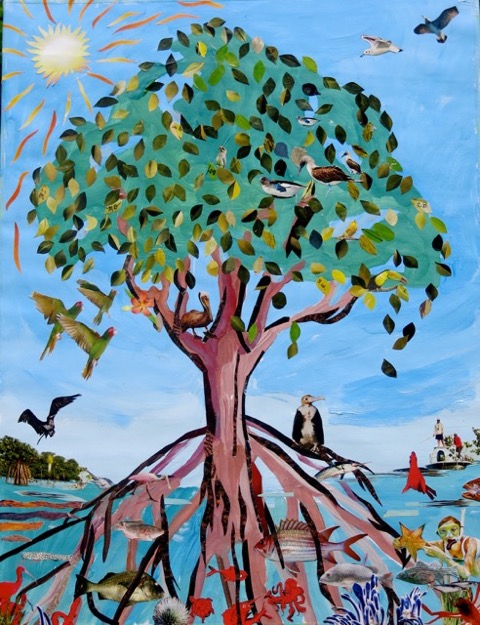
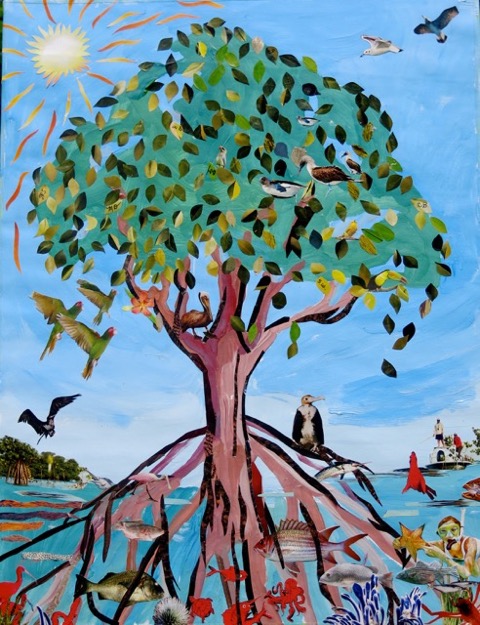
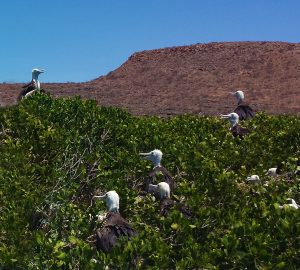
Red mangroves are the most prevalent in Baja California Sur and they are easily identified by their gangly, aboveground “prop roots”, which have earned them the nickname “walking mangroves”. Like all mangrove species, red mangroves had to solve the problem of breathing and collecting nutrients in anaerobic, or oxygen-free soil, and the prop roots are a brilliant solution. These roots grow down from branches above and in the water, and eventually anchor in the mud, transporting air and nutrients. This nutrient-rich environment attracts a huge array of organisms, from protozoa to sea turtles to dolphins -creating a magnificent and complex food web. In the tropics, red mangroves can shoot past 80 feet, but in the arid climate of Baja California they rarely get past 15. On Isla Espiritu Santo, in San Gabriel Bay, the Magnificent Frigatebird uses a red mangrove canopy as a huge, elongated nursery, just a few feet off the water. It’s a sight worth seeing. Of all the mangrove species, red mangroves in Baja extend into the deepest water, the seaward zone, where conditions are harshest. Many species spend their entire life cycle among the red mangrove’s prop roots.
Black mangroves, like all mangroves, must deal with the troublesome issue of being a tree growing in seawater with a high concentration of salt – which is toxic to trees. Black mangroves solved this problem by exuding surplus salt through their leaves, where it appears as salt crystals. And, in contrast to red mangroves, they solved the problem of breathing in anaerobic soil by growing aerial roots up from a subterranean main root growing in the mud. When the tide is low these aerial roots are exposed to air and they breathe, and when the roots are covered in seawater, they take in all the nutrients they need. The black mangroves grow in the shallowest water of all the Baja California species, the landward zone. Like red mangroves, the aerial roots of the black mangroves form a natural living room, dining room, bedroom and nursery for a vast array of species along a very long food chain.
White mangroves, like their other Baja mangrove counterparts, have solved the problem of how to reproduce in such harsh, watery conditions by adopting a reproductive strategy that is more commonly found in mammals than in plants: vivipary. That is to say, they bring forth live young. Unlike most plants, the mangrove seeds germinate while still safely attached to the parent plant, producing “mangroves to go” or “propagules” – complete, miniature, folded plants that have already completed almost half a year’s growth while still attached to the parent tree. When mature, these baby plants fall into the water and drift with the sea currents. When a propagule reaches land, it immediately produces roots and soon sends up a seedling. At 40 days, the drift period is longest for red mangroves and at 5 days, it is shortest for white mangroves. Uniquely, the drift period of the white mangrove also includes germination, making it the only semi-viviparious of the Baja California mangrove species. White mangroves reach maximum density between the red and black mangroves, and the three species together form the bulk of the mangrove forests of Baja California.
Buttonwood mangroves, like all mangrove species, are working to solve the problem of global carbon emissions by burying enormous amounts of carbon in their peat soils. In fact, mangroves sequester 15 times more carbon, 50 times faster, than inland forests. Buttonwood mangroves are very sparsely distributed across Baja California, and generally as individual plants of 7 to 9 feet. Only one stand of buttonwood mangrove has been documented in BCS and that is at Isla Espiritu Santo.
So what about sweet mangroves / mangle dulce / Maytenus phyllanthoides? In Baja California sweet mangroves often form part of the salt-scrub vegetation associated with mangroves on the landward side. Yet, because they grow inland, sometimes even a good distance from the water’s edge, many more people of the Baja peninsula are familiar with this species and have a great fondness for it. As sweet mangroves are typically not in watery conditions, they take a much more traditional approach to reproduction, putting their seeds in a bright red aril, or seed covering, that develops from the seed stalk. The bright color attracts birds who act as seed dispersers. Happily, sweet mangroves do not appear on SEMARNAT’s list of protected species in Mexico.
Extinction. It happens. In fact, scientists estimate that 99% of all species that have ever strutted, slithered, swum, fruited, flitted or flowered on earth no longer exist. Cataclysmic events like asteroid hits, smashing continents and massive volcanic eruptions have already caused 5 mass extinction events over the last 4.5 billion years, each wiping out 50% to 90% of extant species. So why do some people currently get so het up about the extinction of a pretty bird species here or a weird-looking fish species there? Because it’s personal this time. After only 200,000 years on the planet our poor homo sapien habits have disrupted 65 million years of peaceful evolution to trigger the 6th mass extinction. That is, this time humans are not only the major cause, we’re also a likely casualty. Let’s face it, being at the top of the food chain matters not if there’s nothing underneath.
Mangrove Circle of Life. Collage by Tori Sepulveda and her students Monica Devine, Carol Bailey, Susan Willison, Joanna Spinoza, Christina Douglas and William Dubroraw.
Two Mexican biologists – Gerardo Ceballos and Andres Garcia of the National Autonomous University of Mexico – workingwith colleagues from Stanford, Princeton, Berkeley and the University of Florida, recently published an article in Science Advances showing that if the loss of species in the world continues at its current rate, then the current extinction could be on par with the 5 previous ones in 240 to 540 years – three to seven human life spans. A mass extinction happening fast enough to be perceived within a human lifetime – it’s completely unprecedented. The study states that the triggers for these deaths – pollution, predation and habit change – are all manmade. But Dr. Ceballos, the lead author on the study, offers some hope, “I’m optimistic in the sense that humans react – in the past we have made quantum leaps when we worked together to solve our problems.”
In other words, we need to get our collective act together. The study concludes, “Avoiding a true sixth mass extinction will require rapid, greatly intensified efforts to conserve already threatened species and to alleviate pressures on their populations – notably habitat loss, overexploitation for economic gain, and climate change.” It’s perhaps not surprising that two of the study authors are Mexican, as Mexico is one of the most biodiverse countries on the planet, and actually is considered mega-diverse – one of only 17 countries in the world with 70% species diversity. And here in Baja California Sur, mangroves are one of the most biologically important ecosystems in the state. In fact, mangroves are one of the most productive and biologically complex systems on the planet.
Magnificent Frigatebird Rookery at Isla Espiritu Santo by Ettore Botta
Mangroves are arboreal amphibians – salt tolerant trees that have evolved to bridge land and sea in tough coastal environments. They cover over 700,000 hectares (over 1.7 million acres) of the Mexican coastline, which is 5% of the world total – only the huge coastal countries of Brazil, Australia and Indonesia have more mangroves than Mexico. And they don’t just look cool, they are a full service life support system, providing food, refuge and breeding grounds for numerous crustacean, fish and bird species, waste processing and pollutant filtering for good ocean and wildlife health, and hurricane and storm surge protection for coastlines and coastal communities; with roots deeply embedded in mud, mangroves can absorb up to 90% of a wave’s energy. On top of all that, they’re a heckuva lot of fun to explore recreationally. Dr. Octavio Aburto of the Scripps Institution of Oceanography has calculated that these services can reach an annual value of US$100,000 per hectare, which means that every year, Mexico’s mangroves contribute up to 70 billion dollars to the national economy.* Even Donald Trump would call that a lot of money.
Yet every year humans clear thousands of hectares of mangroves in Mexico to make way for tourism developments, shrimp farms and other agro-industrial developments, giving Mexico the dubious distinction of having one of the highest mangrove deforestation rates in the world. Dr. Exequiel Ezcurra, Director of the Institute for Mexico and the United States at the University of California laments, “This short-term vision ignores the losses for society that are generated by degrading such a valuable ecosystem.”* Dr. Aburto and Dr. Ezcurra predict that, at current deforestation rates, in 25 years close to 50% of Mexico’s mangroves will have been lost, and countless more species will succumb to habitat loss. To put this into perspective, the World Wild Fund for Nature (WWF) estimates that the planet lost 50% of its wildlife in the past 40 years, and that habitat loss is the greatest threat to all remaining species.
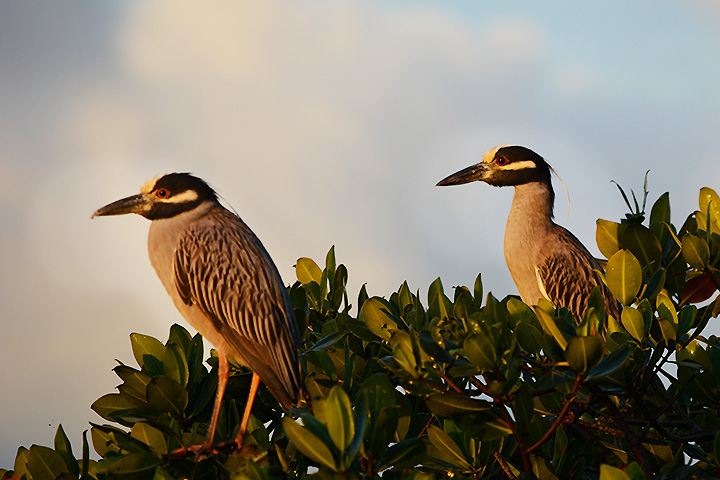
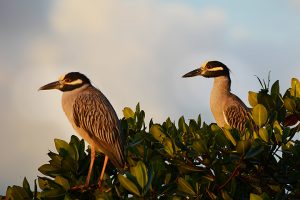
Yellow-crowned Night Herons in Mangroves by Kaia Thomson
Dr. Patricia Gonzalez Zamorano, a landscape ecologist at CIBNOR (Centro de Investigaciones Biológicas del Noroeste) in La Paz who has been studying the mangroves of the Baja peninsula since 1997, cites a book† on mangroves recently-published by her institution and others when discussing the importance of mangroves to biodiversity in Baja California. “The mangroves of Baja California are the northernmost in the Eastern Pacific, and they support a tremendous number of species. Research over the years has confirmed that our mangroves support 159 fish species, 152 bird species – 43% resident, 57% migratory, 214 seaweed species, and 213 species of marine macroinvertebrates, including 72 species of crustaceans such as crab, shrimp, and krill, and 62 species of bivalves including oysters, clams, and mussels. While the rate of mangrove loss in Baja California is comparatively low at “only” 2% per year, between 1973 and 1981 we lost 23% of the mangrove forests surrounding La Paz alone due to development.” It can cost several thousand dollars and up to 100 years to restore a single hectare of mangrove to its full environmental services capacity.
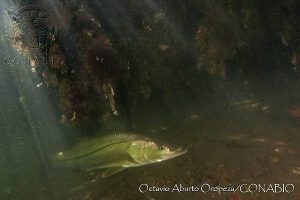
Fish in Mangroves by Octavio Aburto
Dr. Aburto and Dr. Excurra worry that mangrove loss could cause irreparable damage to fisheries. Mangrove-related fish and crab species account for 32% of the small-scale fisheries landings in Baja California Sur, and mangrove loss, coupled with overfishing, have already had a severe impact on the state’s fishing industry. While the evidence is only anecdotal at this time, it is clear that many families who have been fishing in the state for generations are already looking to other sources of income as rapidly declining fish stocks are challenging their traditional livelihoods.
As homo sapiens we often make the short-sighted decision to allow a habitat to die, because we feel the resources required to sustain it are needed to allow mankind to live. It can take great creativity and commitment to find solutions to immediate human problems that will provide the biodiversity mankind needs to flourish past more than just the next three generations. The stakes are about as high as they come: Dr. Ceballos and his colleagues state that if the loss of species continues on the current projection, then “On human time scales, this loss would be effectively permanent because in the aftermath of past mass extinctions, the living world took hundreds of thousands to millions of years to rediversify.” In other words, save that pretty bird, that weird-looking fish, that mangrove today, and they just might return the favor tomorrow. Extinction. It happens. But it sure feels different when it’s coming for you.
*National Geographic Voices, the International League of Conservation Photographers, and Proceedings of the National Academy of Sciences, Mangroves in the Gulf of California increase fishery yields
†Los Manglares de la Península de Baja California, Centro Interdisciplinario de Ciencias Marinas, Centro de Investigaciones Biológicas del Noroeste, Universidad Autónoma de Baja California Sur
Get Involved!
Rescatando Nuestros Arrecifes Y Manglares (Rescuing Our Reefs and Mangroves) is a brand new project taking place in BCS. It’s the brainchild of four marine biologists who, while sitting around the pool enjoying a cold beer, got into their favorite topic: how dirty the ocean is becoming and how plastic seems to be everywhere. Usually that would have been the end of it. But not this time.
Rescatando Nuestros Arrecifes Y Manglares
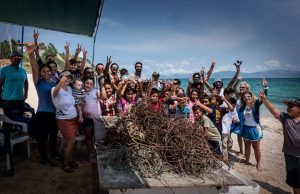
A date was set, a plan was made, and on July 22, 2015 more than 50 divers cleaned four reefs. Then less than a month later, on August 16, more than 100 kayakers and SUPers cleaned all the mangroves in La Paz Bay. Just a few weeks later, on September 6, the divers cleaned Pargo Villa, a rocky reef in 60 feet of water south of Cerralvo Island. While the divers were out a classroom of 5th graders cleaned the beach at La Ventana. Afterward the two groups got together to share what they had found, talk about how it got there, and how to prevent it from returning.
The organizers of Rescatando Nuestros Arrecifes Y Manglares – Mariana Padilla, Pepe Torres, Ronaldo Vilchis and Pablo Ahuja – have pledged to do a cleanup of a reef or mangrove every month, and so far have completed 3 cleanups in less than 3 months.
The organizers are seeking donations to purchase a laptop and computer projector so that they can begin environmental education in the schools of La Paz. To learn more about how you can get involved and be a part of the project, please visit them on Facebook at https://www.facebook.com/Rescatando-Nuestros-Arrecifes-y-Manglares or contact organizer Pablo Ahuja at .
ROCKIN’ THE MANGROVES. The rock band Linkin Park is taking center stage in conserving mangroves in Baja California. Through their philanthropic arm Music for Relief, Linkin Park has partnered with the environmental group WildCoast to conserve 61 miles of mangroves in Baja California’s Magdalena Bay. Through WildCoast’s #MangleEsVida campaign, the program is raising funds to help protect mangroves so that they in turn can help mitigate coastal flooding to protect wildlife and coastal communities. For more information on Linkin Park, WildCoast and saving mangroves in Baja California, check out #MangleEsVida and/or contact WildCoast’s Monica Franco Ortiz at .
The cardón cactus, endemic to Baja California, is one of the most massive and ubiquitous cacti on the planet. Huge groves of multi-limbed old timers that witnessed the arrival of the first Europeans over five centuries ago can still be seen the length of the peninsula, and single young upstarts that haven’t even sent up their first arm yet crowd the desert landscape. What accounts for such rampant success? In a word, bats. Now of course there are many factors that help the cardón survive – isolation, summer rains, water retaining skeletons – but none of this would matter if it wasn’t for the bat, because the cardón is a cactus that deigns to open its flowers for pollination only as the sun is setting, a time when the kings of the PM pollination scene are emerging from their caves ravenous for their first meal of the night. That’s right, bats.
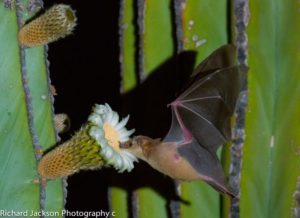
But not just any bat. Researchers have known for years about the role of the lesser long-nosed bat (Leptonycteris yerbabuenae) in cardon pollination. In fact, when a young graduate student named Winifred Frick arrived in Baja in 2004 to work on her dissertation in bat ecology, the lesser long-nosed bat was considered the only cardón pollinator game in town. Says Frick, “The lesser long-nosed bat is highly specialized for nectar-feeding. It can hover at an open cardón flower and use its
Lesser long-nosed bat. Photo by Rick Jackson.
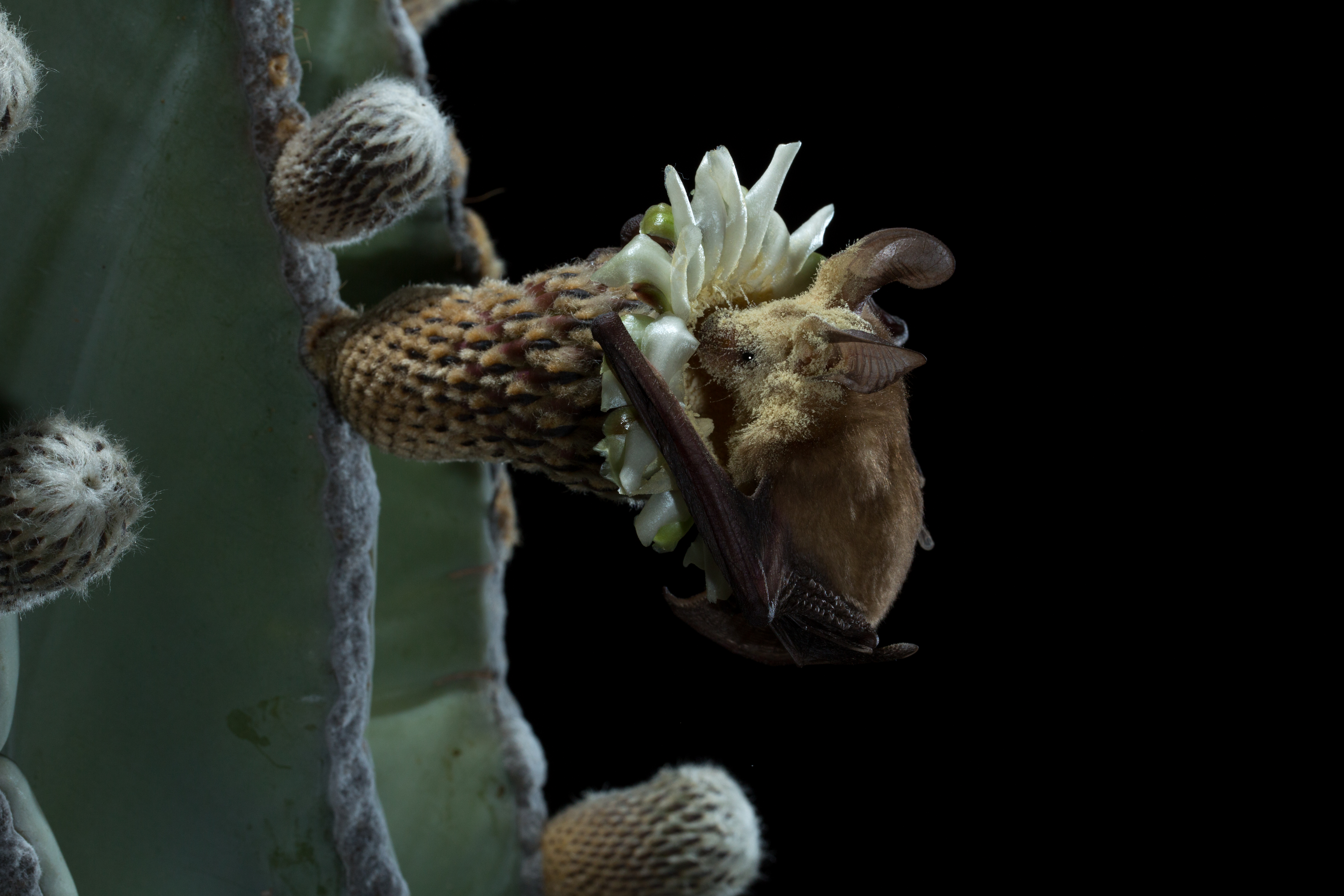
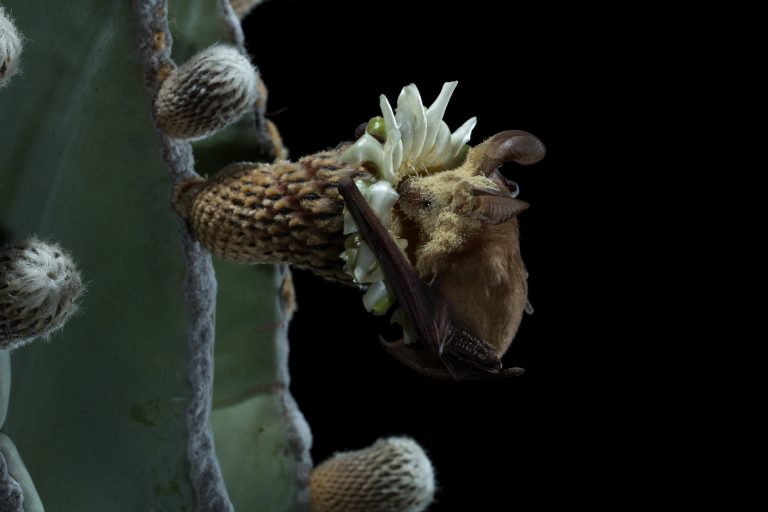
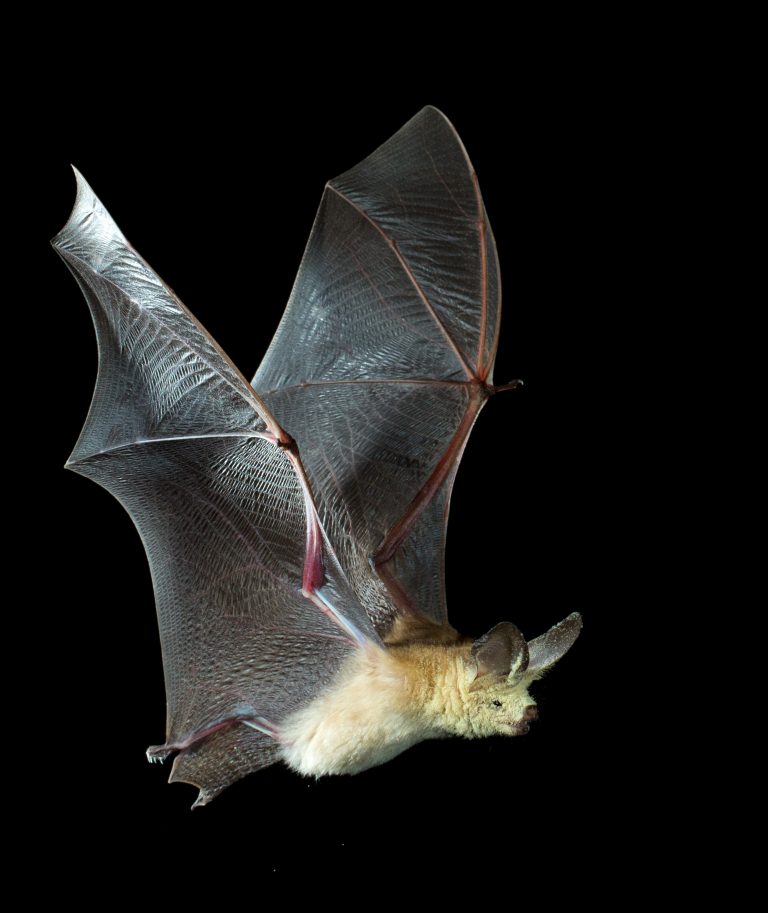
long tongue to extract nectar, transferring pollen from one flower to the next in the process.” Clean, precise, targeted. Evolution at its most elegant. “So I was really surprised to see this other desert bat, the pallid bat (Antrozous pallidus), regularly visiting cardón flowers. The pallid bat has a short face, long ears and loves to eat scorpions off the ground. At first I thought maybe it was visiting the bat-adapted flowers of the cardon to opportunistically glean insects attracted to the flowers. But as we observed it over 2005-2007, we realized that the pallid bat was actually indulging in cardón flower nectar. Apparently it likes a little something sweet to wash down savory scorpion meals. However, unlike the lesser long-nosed bat, the pallid bat doesn’t hover but dives onto the whole flower, caking its whole body in pollen.” A cardón pollinator usurper?
Frick, now Dr. Frick of the Department of Ecology and Evolutionary Biology at the University of California, Santa Cruz, was doing her dissertation on “the relationship between the size and isolation of (Baja) islands and bat species richness in a near-shore archipelago …” so didn’t follow up on her pallid bat observations at the time. But she didn’t forget the pollen-laden pallids, and a few years later teamed up with some of her UC Santa Cruz colleagues to study bats and cardón pollination in more depth, resulting in game-changing research that was published in American Naturalist in 2012 (Frick is the lead author of the study conducted with her colleagues Ryan Price, Paul Heady and Kathleen Kay). For the study, which was funded in part by the National Geographic Society and UC MEXUS, Frick and her team monitored cardón flowers at several sites in southern Baja. When they saw a bat visit a flower they would identify which of the two cardón-nectar-loving rivals it was, then retrieve the stigma of the flower to determine how many grains of pollen the bat had deposited. They also recorded the total number of flower visits by each of the two species at each study site. Turns out, pollination’s not just for the long-nosed crowd.
Pallid Bat on Cardon Flower. Photo by Merlin Tuttle. http://merlintuttle.org
“The results blew us away. The lesser long-nosed bat has an ancient cardón-pollinating lineage that has been co-evolving with the cardón flower for a very long time. We were therefore very surprised to see that the newby, the pallid bat, is a far more effective pollinator, delivering about 8 times as much pollen per visit. We observed several factors that account for this. One is that the pallid bat rests its body on the flower and plunges its whole head into the flower to get at the nectar. It therefore gets far more pollen on its body than the hovering lesser long-nosed bat, who is using its tongue only to access nectar. So this new pollinator is actually better than the more specialized pollinator because it is not well-adapted to nectar feeding. (The pallid is the only nectar feeder from an insect-feeding family, Vespertilionidae). Its stats are also helped by the fact that the lesser long-nosed bat uses pollen as a source of protein, so therefore regularly eats the pollen off its fur, reducing the amount available for pollination. Finally, the lesser long-nosed bat is migratory while the pallid bat is a year-round Baja resident, a fact that makes the pallid bat especially important to the cardón.”
The cardón. Amazing record of longevity and survival. How has it done that? It has been scientifically shown that plants respond to stimuli such as sound and touch. Some wounded plants produce a chemical that acts as an alarm signal, prompting nearby plants to produce chemicals that help them defend themselves against insects – or attract insect predators. Venus fly traps just eat the interlopers. So is it possible that the cardón has sensed that it’s a hair risky to continue entrusting its future solely to an endangered, migratory, picky eater like the lesser long-nosed bat? Has it therefore made its flower scent / nectar taste so enticing that even – or perhaps especially – a scorpion-loving, insect-grubbing, and – until recently – flower-snubbing permanent Baja resident like the pallid bat would literally plunge in head first to its rescue? Says Frick’s co-author Kathleen Kay, “What is actually happening in terms of how species are mutually interacting can be more complicated than what meets the eye.” Wily cardón. Lucky bats.
Pallid bat photo by Merlin Tuttle. http://merlintuttle.org
Photographer Merlin Tuttle
MerlinTuttle decided to devote the remainder of his career to bat conservation in 1982 “as an act of desperation. It was obvious that without major improvement in public attitudes, the situation for bats would continue to worsen.” Battered by centuries of harmful myths and misinformation, bats were despised and casually slaughtered around the world. Merlin has made education – correcting those myths and teaching the economic and ecosystem benefits of bats – a major part of his work. Distressed that most bat photographs showed roughly handled bats snarling in self-defense,Merlin taught himself photography. He became a world-class wildlife photographer whose images have appeared in books and magazines around the world and played a crucial part in his education efforts. To view his amazing photographs and contribute to his bat conservation efforts, please visit http://merlintuttle.org/.
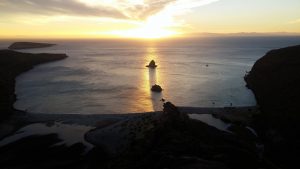
If famed aviator Charles Lindbergh had not fallen in love with the daughter of the US Ambassador to Mexico, the story of Isla Espiritu Santo might be just another sad tale of extraordinary natural beauty undone. But the courtship of his future wife in Mexico instilled in Lindbergh a lasting affection for the country. So when in 1973 his friend and fellow conservationist George Lindsey invited him on a scientific exploration of the Sea of Cortez, Lindbergh jumped at the chance. The two men and their scientific team wended their way through numerous islands between Bahia de Los Angeles and La Paz, ultimately arriving at Espiritu Santo. Lindbergh was enthralled. The islands made such an enormous impression on him that during a trip to Mexico City a few months later, Lindbergh requested a meeting with the president of Mexico to discuss protecting what he now considered one of the most beautiful areas on the planet, the Sea of Cortez. Four years later the Mexican government issued a decree establishing 898 islands of the Sea of Cortez a Flora and Fauna Protection Area (Zona de Reserva Natural y Refugio de Aves Migratorias y de la Fauna Silvestre). George Lindsey, then the Director of the San Diego Natural History Museum, strongly believes that Lindbergh’s intervention helped to create the governmental awareness needed to get the decree enacted. It was a good beginning.
Espiritu Santo photo by Cabo Rockwell
Around the same time as Lindbergh’s transformational trip to Baja, a former Grand Canyon river guide named Tim Means was setting up the first major ecotourism company in La Paz, Baja Expeditions. Means’ business thrived as word of Baja’s remarkable flora and fauna spread, and demand grew for access to the natural wonders that the area’s remote location had kept pristine long after the west coast of the US had been heavily developed. But conservation-minded eco adventurers were not the only ones attracted to the area, and by the 1990s the pressure on Isla Espiritu Santo was intense: a real estate developer wanted to create a resort casino on the island. From the outside it seemed absurd that a casino had even the remotest possibility of being approved in a natural protected area, but Mexico’s traditionally lax approach to conservation enforcement afforded the developer optimism.
Espiritu Santo photo by Craig Ligibel
While most of the islands in the Sea of Cortez were federal lands, a few were privately owned, and Espiritu Santo was owned by an ejido. Ejidos, created as part of Mexico’s land reform movement after the Revolution of 1910, are rural collectives of people who own property communally. Traditionally ejidos were not allowed to sell their property, but the constitutional obstructions to ejido land sales were removed in 1992, and the ejido owners of Espiritu Santo lost little time in taking advantage of this new freedom. By 1997 they had sub-divided 90 hectares around Bonanza Beach into 36 lots and were selling them off. Cabins were actually constructed on some of the lots, but in a move that would have made Lindbergh proud, a federal judge deemed them illegal under the 1978 decree and they were torn down. But the real estate developer who owned some of the properties was pushing hard on his casino proposal. Tim Means was prepared to push back.
Means started his onslaught by personally buying two properties smack in the middle of the developer’s proposed casino area. This immediately diminished the attractiveness of the project for the developer, and inclined him towards negotiation. Means then enlisted the aid of leading Mexican businessmen in the area, who retained and paid for the law firm that was ultimately able to arrange the buy out the developer and all but one of the remaining properties for sale on Bonanza Beach. This all took a great deal of time and maneuvering, but Means and his team persevered. All the properties they bought were donated to the federal government.
Espiritu Santo photo by Carlos Gajon
When the immediate threat of the casino was neutralized, Means and a coalition of conservationists were able to put together a deal to purchase the rest of the island, which they bought from the ejido for US$3.3 million. Their subsequent donation of Espiritu Santo to the nation is commemorated by a famous sculpture of a dove on the malecon in La Paz.
The purchase structure that resulted in Espiritu Santo’s conservation in perpetuity demonstrates the power of collaboration among a diverse group of constituents when fighting to preserve wilderness areas: about one third of the money came from Mexican funders, another third from American funders via the Nature Conservancy, and the rest through an anonymous gift to the World Wildlife Fund. The David and Lucille Packard Foundation then donated US$1.5 million towards the future management of Espiritu Santo. This type of international cooperation set the stage for future and ongoing battles against mega-developments elsewhere in Baja California Sur. As a direct result of Means’ successful activism, Espiritu Santo and 244 other islands in the Sea of Cortez were subsequently named a World Heritage Site in 2005.
But none of this would have happened without the will of the Mexican people. As a result of colonial rule, the Mexican citizenry traditionally felt they had no voice in government, so agitation for change was not a big feature of public life. But in the 1970s this started to change, most notably in the environmental arena, and Mexicans began to create organizations committed to protecting the country’s immense natural resources. This process lead to the creation of the Secretaria de Desarollo Urbano y Ecologia (Secretary of Urban Development and Ecology) in 1983, and in 1987 the general law of ecology and natural resources. One of the early successes of all this effort was the 1988 declaration of the Monarch Butterfly Biosphere Reserve in the states of Mexico and Michoacan.
Worthy of Protection. Photo by Carlos Gajon.
The people of Mexico in general, and of Baja California Sur in particular, are now intently focused on protecting their natural heritage. In Baja California Sur residents have banded together in recent years to defeat mega-developments in Balandra Bay, El Mogote and Cabo Pulmo, using the reach and resources of both local and international NGOs to aid their cause (See our blog post Conserving the Beauty of Baja). Public outrage and grassroots campaigning have stymied the efforts of companies seeking to operate open-pit gold mining companies in the Sierra de la Laguna Mountains. Like Lindbergh and his nonstop solo flight across the Atlantic, they are succeeding against considerable odds. Like Tim Means and his environmental coalitions, they are hunkered down and ready for the long haul. As the great conservationist Teddy Roosevelt once said, “Great thoughts speak only to the thoughtful mind, but great actions speak to all mankind.” The protection of Isla Espiritu Santo and the islands of the Sea of Cortez wrought by Tim Means and his coalition will speak to the world for generations to come.
Sources: Two excellent books and Tim Means provided the source material for this article. The books are Isla Espiritu Santo: Evolución, rescate y conservación by Exequiel Ezcurra, Harumi Fujita, Enrique Hambleton and Rodolfo Garrio; and Wildlands Philanthropy: The Great American Tradition with essays by Tom Butler and photographs by Antonio Vizcaino.
Todos Santos Eco Adventures operates a tent camp on Isla Espiritu Santo from which visitors can explore the wild natural beauty of the island and the Sea of Cortez.
Why do we care about Espiritu Santo and other areas of Mexico?
There are over 200 countries in the world today but only 12 of them can claim to be “mega-diverse”. A country is considered mega-diverse if it has between 60% and 70% of the total biodiversity of the planet, and Mexico is one of only 3 such countries with coastlines on both the Atlantic and Pacific (the United States and Colombia are the other two). Mexican government sources indicate that Mexico’s global ranks for biodiversity are as follows:
Reptiles: #2
Mammals: #3
Amphibians: #5
Vascular plants: #5
Birds: #8
That’s something worth bragging about – and protecting!
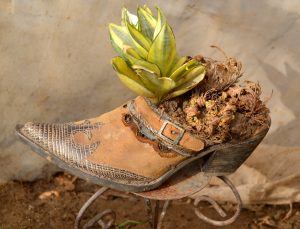
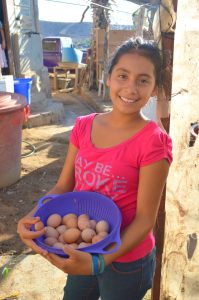
When you arrive at Areli Sarah Castillo’s house in Pescadero on a late summer afternoon, the look and feel of the front of her house is very similar to that of her neighbors: there’s a teenage boy working on his truck in beat to the radio’s tunes; two young girls are playing with dolls on the sofa under a well-placed beach umbrella; and several dogs are enjoying afternoon napping bliss in various poses. There’s nothing to suggest that the Castillo family is at the forefront of a movement to change the eating and health patterns of a town – until you go around back. There you find the riot of green and rampant plant life that is the greenhouse built by Areli and her children, and from which they feed the twelve people who now call their house home. Beautiful long vines of tomatoes, steamy-looking chiles, delightfully prickly pineapples, all manner of herbs and spices, all lovingly cared for in a space next to the chicken coop where the happy, well-cared for hens oblige the family with at least 15 eggs a day. All healthy, all organic, all the time. It’s not really what you’d expect from a woman who used to sell hotdogs for a living.
Greenhouse Greats of Pescadero
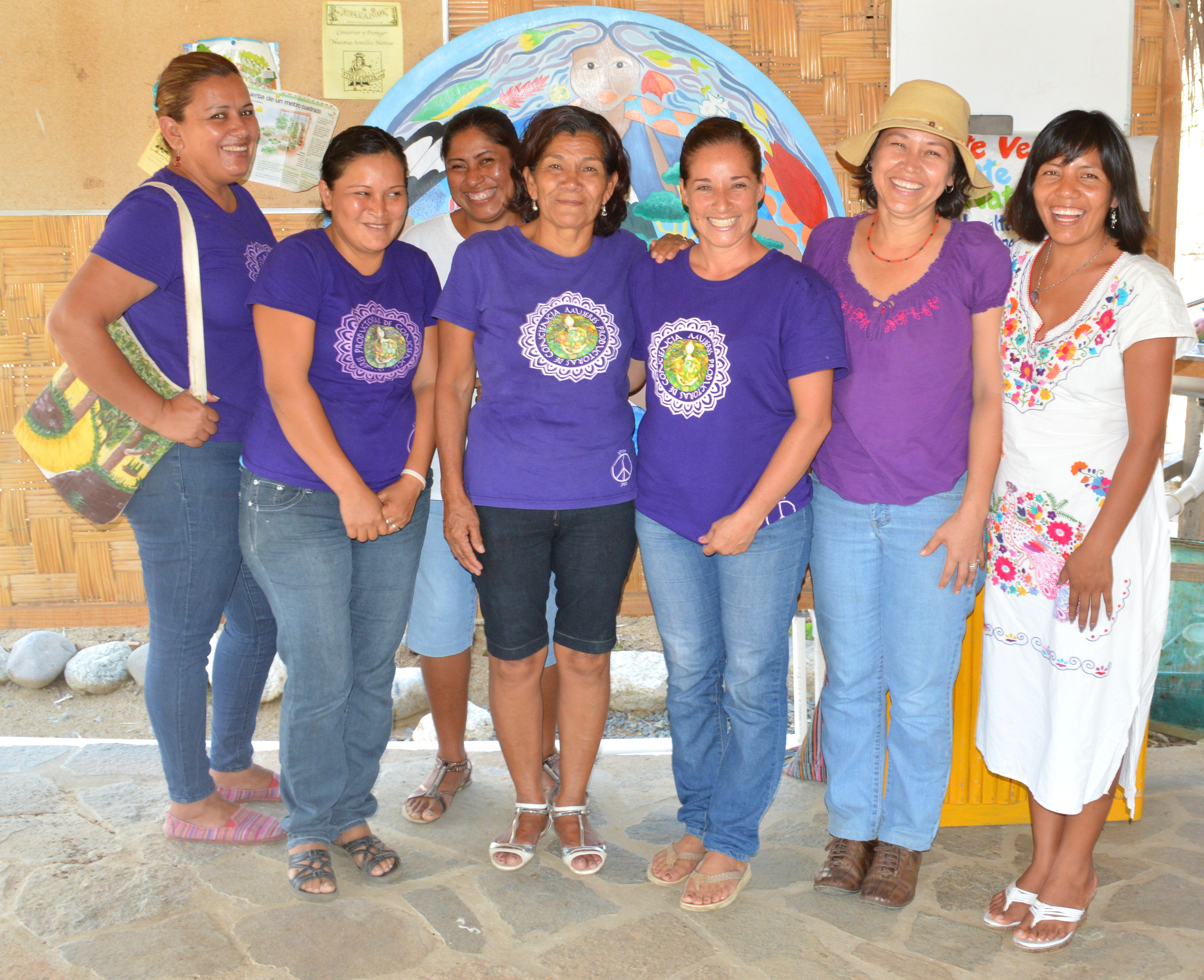
Areli is one of 18 women in the Sistemas Naturales y Desarrollo AC (SINADES) greenhouse program in Pescadero run by Inés Melchor Pantoja, with assistance from her husband, Julio César Rivas García. Inés and Julio, with a grant from Fondo Acción Solidaria AC, or Fasol* , started a community center about five years ago where their first program was teaching the children of Pescadero in accordance with the SINADES motto, “Educar para conservar” – Educate to preserve. Here kids were able to learn about composting, recycling, healthy eating, and growing things. The kids loved the program so much (seriously, we’re playing in dirt here – what’s not to love?) that they wanted to get their parents involved, so Inés and Julio started a pilot program for women in the community called Conscious Cooking. It has transformed the lives of the women and their families.
Like many Mexican towns across the country, Pescadero is plagued by health problems associated with poor diets. Manuela Tapis, one of the participants in the Conscious Cooking program, has lived in Pescadero for 40 years. She says that many of her neighbors in town suffer from diabetes, severe allergies, gastritis and other chronic health issues. Pescadero is not alone. Mexican government statistics indicate that 71% of the entire Mexican population is either obese (32%) or overweight (39%). That’s over 48 million Mexicans walking around in plus sizes. According to journalist Olaya Astudillo writing in The Lancet, a leading medical journal, one of the key culprits in this rise in obesity in Mexico is the global trend away from traditional diets towards highly processed foods. More specifically writes Astudillo, “Cost is highly influential for when a family with limited income has to make decisions about the home diet. They will spend their money on the food that contains more calories for lower prices. But the food might not necessarily be more nutritious, of best nutritious quality, nor contribute to a more adequate diet than other products with less calories.”
Clarisa
The Conscious Cooking program aims to change all that by making healthy foods affordable, desirable and an integral part of family life. And it was the desire to procure organic, pesticide-free produce at a reasonable price that drove SINADES and the women of the Conscious Cooking program to start building greenhouses. As Margarita Vasquez, one of the women in the group explains, “The older people in Pescadero used to grow their own food, but we lost all those skills. Now with SINADES and the greenhouse project we’re recovering those values. Through this program we’ve learned how to make our own organic fertilizer by composting, we’ve learned about watering our plants using gray waters from the house for irrigation, we’ve learned great skills like how to make nutritious snacks by drying fruit in the sun and so much more. We have learned such an incredible amount here about how to have healthy food at a low cost, and the impact on our personal health and that of our families has been remarkable.” Janette Albañez, who has lived in Pescadero for 25 years agrees. “Health, health, health is what this program means for me. I used to have chronic asthma and ate very poorly. Now my asthma has cleared up and even my junk-food guzzling husband loves eating raw vegetables.”
Ines Melchor Pantoja
Janette got involved when she saw one of her neighbors building a greenhouse, and this is the type of knock-on effect that the SINADES program is having in Pescadero. As more people see the health benefits that their friends and neighbors are achieving, the more that are interested in learning the skills to achieve similar results for themselves. And even more than for themselves, they are motivated on behalf of their children. Angeles Caballero, mother to two children ages 3 and 7, really speaks for all the women involved when she says “I started this program because of my kids. I’ve only been in Pescadero 10 years and was so surprised to see all the young children here that already have diabetes. I was motivated to save my children from this fate, but now my kids are even more motivated than me. Their friends think it’s weird that they’ll have tomatoes with salt instead of potato chips, but they don’t care. My kids love working in the garden and love this program. It is wonderful for us as a family.”
Areli couldn’t agree more. “My children are actually even more excited about the greenhouse than I am. They love coming out here and working every day. They love that we no longer buy any canned food, and they love how much better they feel with so much less junk food in their diet. These are benefits that you just can’t put a price on.”
But there is a price of course, and the 4,000 pesos (~US$285) required to build a greenhouse is a fairly high barrier to entry for many of these families, a barrier that they must surmount once again as Hurricane Odile (September 2014) destroyed every one of the greenhouses built by the women and children of SINADES in Pescadero. But they are not discouraged. Says Inés, “We recovered some of the material from the greenhouses and received a small donation to buy more mesh, so we are slowly coming back around. Some of the families are already in production again and everyone is continuing to move forward. It’s a strong community and we will rebound.”
Before the hurricane, there were signs around the Pescadero community center that read “Cue da-temba, nuestra casa”. Cue da-temba means Mother Earth in the language of the Guaycura Indians, the now extinct indigenous people of Baja California Sur. And of course nuestra casa is Spanish for “our home”. The goal of Inés, Julio and the women and children of SINADES is to create a sustainable and healthy lifestyle for the families in their community. Helping them to do that is really just enlightened self interest because, after all, “Cue da-temba, nuestra casa” applies to us all. Inés can be reached at and the SINADES Facebook page is https://www.facebook.com/SinadesAc.
*Fasol, headed by the dynamic Artemisa Castro and a group of likeminded environmental activists, provides financial support to grassroots groups that are working for social and environmental change in Mexico. SINADES is a great example of the type of success they have achieved in communities across Mexico. For more information please visit their web site at: http://fasol-ac.org/fasol_wp_ing/
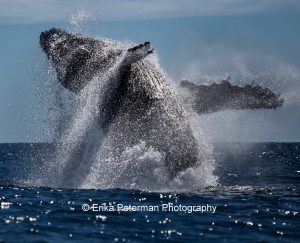
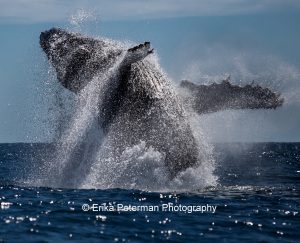
If science had all the answers, poets and dreamers would be out of a job. So when scientists tell us that they’re not really sure why humpback males sing – and it is only the males that sing – then it’s up to the rest of us to look at the evidence and help science along. And here’s what the evidence shows us. Like traditional mariachis, all-male college a capela groups, and the Rat Pack, humpback whales in Baja clearly understand that singing, particularly with the harmonious help of your mates, is the best way to get the girl. Now some scientists theorize that humpback males are singing only as a type of echolocation exercise of the type used by their dolphin cousins, a way to map out the world around them. This certainly
Humpback Happiness. Photo by Erika Peterman
may be true – because how else are they going to find the girls? But that really doesn’t explain why some humpback whale songs are several hours long and, according to the Journal of the Acoustical Society of America, grammatically complex and loaded with information. Like a ballad. Or why sexually immature young males join their virile older brothers in song. Like frat boys with their pledges beneath a sorority girl’s window. Or why all the males in one region will congregate in an arena and sing the same song. Like a boy-band in an outdoor stadium. Or why a male escorting a female and her calf will sing. Like a lullaby. These are all great mysteries that the poets are currently best equipped to ponder, but they don’t begin to touch on the greatest mystery of all – how does the female humpback decide which singer is worthy of her affections? Science presently has no answer, but maybe this is why Elvis always sang alone.


 When you arrive at Areli Sarah Castillo’s house in Pescadero on a late summer afternoon, the look and feel of the front of her house is very similar to that of her neighbors: there’s a teenage boy working on his truck in beat to the radio’s tunes; two young girls are playing with dolls on the sofa under a well-placed beach umbrella; and several dogs are enjoying afternoon napping bliss in various poses. There’s nothing to suggest that the Castillo family is at the forefront of a movement to change the eating and health patterns of a town – until you go around back. There you find the riot of green and rampant plant life that is the greenhouse built by Areli and her children, and from which they feed the twelve people who now call their house home. Beautiful long vines of tomatoes, steamy-looking chiles, delightfully prickly pineapples, all manner of herbs and spices, all lovingly cared for in a space next to the chicken coop where the happy, well-cared for hens oblige the family with at least 15 eggs a day. All healthy, all organic, all the time. It’s not really what you’d expect from a woman who used to sell hotdogs for a living.
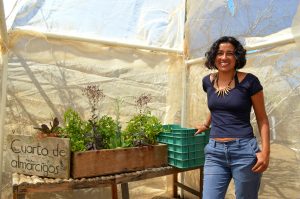
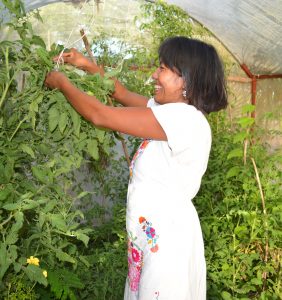 But there is a price of course, and the 4,000 pesos (~US$285) required to build a greenhouse is a fairly high barrier to entry for many of these families, a barrier that they must surmount once again as Hurricane Odile (September 2014) destroyed every one of the greenhouses built by the women and children of SINADES in Pescadero. But they are not discouraged. Says Inés, “We recovered some of the material from the greenhouses and received a small donation to buy more mesh, so we are slowly coming back around. Some of the families are already in production again and everyone is continuing to move forward. It’s a strong community and we will rebound.”
 home”. The goal of Inés, Julio and the women and children of SINADES is to create a sustainable and healthy lifestyle for the families in their community. Helping them to do that is really just enlightened self interest because, after all, “Cue da-temba, nuestra casa” applies to us all. Inés can be reached at