Niparajá is the god of the now-extinct Pericu Indians of Baja California Sur whose mandate is to care for the oceans and the land. It is also the name of the dynamic conservation organization that, since 1990, has been engaged in the same tasks, working hard to protect the oceans and lands of southern Baja for a vibrant and sustainable economy. The organization has been successful on a variety of projects over the years, and two recent achievements in particular demonstrate how powerful previously disenfranchised local voices can be.
The Battle for Balandra Bay
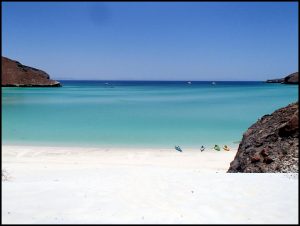
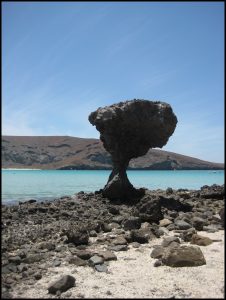
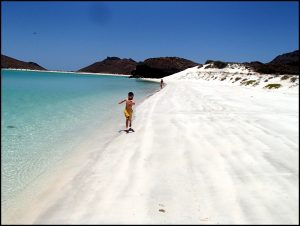
Balandra Bay is, without a doubt, one of the most beautiful beach areas to be found anywhere in the world. The waters are fantastically blue, the beaches stunningly white, the mangroves thrillingly vibrant and the iconic mushroom rock formation that sits at the mouth of the bay an instantly recognizable symbol of the city of La Paz. For generations of La Paz citizens Balandra Bay has simply been the town beach. It is where everyone in La Paz learned how to swim and it is where everyone in La Paz goes on a free summer afternoon. But very few people in the city realized that their beloved “town beach” was in fact privately owned, and had been for decades.
Balandra Bay
That all changed abruptly in 2005 when the owners began soliciting designs from architectural firms throughout Mexico for a major development at Balandra Bay, a project that would include a hotel, golf course, beach club and vacation homes. The potential for a world-class resort is undeniable, and many of the firms responded with thrilling designs. But a partner in one of the solicited firms sits on the board of Niparajá, and the owners got quite a different design concept from that organization – namely, how to build a social movement.
At that point in time little had been done to protect the public spaces that people come to La Paz to enjoy. A few years before a resort complex had been built in El Mogote, a sand bar in the Bay of La Paz. Despite strong local opposition the owners were issued permits to build, and the citizens of La Paz were bitter. While ultimately the owners were forced to abandon the project for environmental noncompliance, they had already created a large group of buildings that are no longer maintained (some of them actually occupied), a tough daily visual reminder of what can go wrong with some development efforts.
Mushroom Rock at Balandra Bay
So when the owners of Balandra Bay announced their intentions to create a large resort complex, citizens and city government alike were galvanized to prevent a repeat of El Mogote. Niparajá helped direct that strong social discontent into a strong collective action through the creation of Colectivo Balandra. It involved thousands of citizens, scientists, researchers and NGOs, all committed to preserving Balandra Bay in a pristine way for public enjoyment. They organized a huge media campaign – “A mi me importa Balandra (I do care about Balandra)” – creating TV spots featuring everyone from the lady everyone took piano lessons from as a kid, to a popular local ranchero band, to favorite local luchadores, to the local water polo team (although that spot was later deemed too racy and wasn’t aired). Local bands gave free concerts in the streets and raised tons of money for the effort, while volunteers worked the crowds relentlessly to collect over 30,000 signatures on a petition to save Balandra.
That the public wanted to protect Balandra from development became very clear to all involved, but the federal government believed the area was too small for it to focus on and suggested a more local solution. The state, however, does not have the authority to declare places like Balandra protected as the water and beaches to 20 meters above the high tide line are under federal jurisdiction. The municipal government of La Paz therefore took matters into its own hands and declared the area around Balandra a protected area. But the action was easily annulled as the municipal government had no authority to create a protected zone. That is, they had no authority until Colectivo Balandra stepped in, got the law changed and gave them the authority. 6 years into the battle to save Balandra Bay, the municipal government of La Paz declared it a protected area.
It was an exciting, but short-lived victory. During a period of electoral transition in the municipal government, the owners of Balandra pressed their case and won back 80% of the land that the city had declared protected. It was then that all parties involved realized that if Balandra was going to be shielded from development in any meaningful, long-term way, the federal government would have to take action.
It was now November 2012. The citizens and government of La Paz had been battling for Balandra for 7 years. For 6 of those years Felípe Calderón had been president of Mexico and his government was fully apprised of the situation. It was now the final days of his presidency and Colectivo Balandra was desperate to obtain federal protection from him; there was no way to know when or if the new government of Peña Nieto would focus on such a relatively small local issue. But the papers sent to Calderón for his signature simply lay on his desk. The clock ticked. Soon it was November 30, 2012, the last day of Calderón’s presidency. The party faithful were gathered for a last dinner with no actionable items on the agenda. But Carlos Mendoza Davis, a senator from BCS, stood up in the middle of the meal and made an impassioned plea for the federal protection of Balandra Bay. He recounted how he had learned to swim there then how his children had learned to swim there and how Balandra was an integral part of the public life of La Paz, the capital of BCS. He made those gathered feel what a deep loss it would be to the community to give the land over to development. He made Calderón feel what a great thrill it would be to end his presidency with a declaration of Balandra’s protection. This feeling carried Calderón back to his office where, in one of his very last acts as president of Mexico, he signed the paperwork that made Balandra Bay a federal Area of Flora and Fauna Protection. One crucial voice, at one critical moment, channeling thousands of voices united over millions of hours to preserve a pristine location central to the identity of a city. The god Niparajá was certainly smiling.
Cabo Pulmo: Who Gets the Money?
In many cases local communities embrace development. When the Spanish developer Hansa Urbana announced plans to build Cabo Cortés, a massive development with over 30,000 hotel rooms on the shores of the Cabo Pulmo National Marine Park, many of the residents of Cabo Pulmo initially loved the idea. They had overseen the effort to have Cabo Pulmo declared a protected National Marine Park – it is home to the Sea of Cortez’s only living coral reef and a UN World Heritage Site – and benefited from the
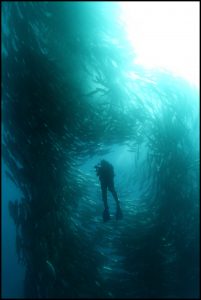
Cabo Pulmo National Marine Park. Photo by Carlos Aguilera
subsequent revival of the area’s fisheries and ecotourism industry. They saw the Hansa Urbana project as an exciting extension of what they had been doing and a great way to move their tourism industry into high gear. They loved the vision of jobs, infrastructure and prosperity that Cabo Cortés appeared to offer. In a town of meager resources, limited electricity and often impassable roads, it was a wildly appealing prospect. To some.
But there were those in the community who believed that the development would essentially destroy the very resources that the local citizens had fought so hard to protect in the first place, namely the Cabo Pulmo National Marine Park. (To get a sense of scale, the Hansa project envisioned 30,000 hotel rooms while all of Los Cabos today has only 17,000. In addition to the development itself, they would have to build a city for roughly 30,000 people to staff the development. The water needs alone for a project this size are staggering.) They also believed that most of the economic benefits of the project would flow to outside interests and do very little for the livelihood of the town. These citizens reached out to Niparajá and a coalition of like-minded organizations , who began working to develop a large community sustainable development process in Cabo Pulmo.
In the meantime the legal and media teams were scoring big points and Hansa sold the development rights for Cabo Cortés to a Spanish bank. In response, Greenpeace in Spain went out and met with individual Spanish retirees whose pension plans were being invested in Cabo Cortés via the bank to inform them of the risky nature of the investment and thereby bring more pressure to bear on the project. Actions such as these combined with the unraveling Spanish economy, Hansa’s poorly constructed environmental impact assessment, and the collective outrage of global environmental groups ultimately bankrupted the project in late 2012.
But they’ll be back. So Niparajá is working with the local Cabo Pulmo community on alternatives to combine social and economic development with the health of the Park. Not only is the continued resurgence and well-being of Cabo Pulmo National Marine Park important in and of itself, but a healthy marine park that attracts visitors is also one of the best ways for local businesses to prosper and have the means for controlling the destiny of their community. As Tim Means, one of the founding board members of Niparajá puts it, “The most practical reason for local communities to preserve their natural resources is that they can make more money that way. Visitors will pay to enjoy the pristine natural beauty of Baja. If that is destroyed, what reason would they have to come here?” Adds Amy Hudson Weaver, Director of Niparajá’s Marine Conservation Program, “Beautiful colonial cities, colorful traditional handicrafts, indigenous peoples living a unique way of life – none of these are found in Baja. People go to mainland Mexico for these things. People come to Baja first and foremost to enjoy our unspoiled nature. If that is destroyed, by accident or design, then the whole economy of BCS is at risk.”
Moving Forward
Theodore Roosevelt once famously quipped, “If you could kick the person in the pants responsible for most of your trouble, you wouldn’t sit for a month.” Development will happen in BCS and groups like Niparajá and communities like Cabo Pulmo see that it can be positive for local residents. But to ensure that it is, Amy Hudson Weaver believes that the citizens of BCS need to take hold of their development destiny by embracing the legal tools at their disposal, namely municipal planning and zoning. There are 17 major approved development projects on the East Cape alone, and no organization has the resources to ensure that they are all implemented with the least environmental impact and greatest financial benefit to local residents. Municipal zoning plans and regulations have been created for Los Cabos and La Paz, but never implemented. Few of the other municipalities or districts in BCS have developed any sort of plan at all. If BCS is to be successful in preserving its resources for future generations, Niparajá believes the communities should decide now what they want developed and how, before outside forces decide it for them. Otherwise, in a few years time we’ll all be kicking ourselves in the pants and not able to sit for a very long time.
Charles Scammons is the whaler cum naturalist who hunted the gray whales of Baja’s lagoons nearly to extinction in the 1850s and ‘60s. Stories from that time abound of the lagoons running red with the blood of the slaughtered mammals, and of mother gray whales attacking boats in a futile effort to protect their young. Scammons later regretted his slaughter of the whales and, partly as tribute to them, wrote a book that is now considered a classic, The Marine Mammals of the North-western Coast of North America.
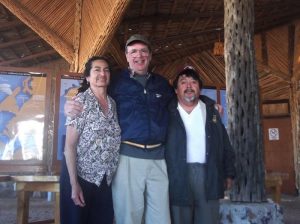
Chris Scammons with Mario and Sara in Guerrero Negro during his 2011 visit.
But guilt continued in the Scammons’ bloodline and in 2011 a great, great grandson of Charles Scammons came to Laguna Ojo de Liebre, or what foreigners call Scammons Lagoon, to apologize to the now-protected whales. Eye witness accounts indicate that four pairs of mother and baby gray whales surrounded his boat and, as he apologized for the actions of his ancestor, the whales stayed with him for an hour, exuding forgiveness and grace. The younger Scammons returned home, filled with the peace he had long sought.
The story of Chris Scammons visit was relayed to us by Rebeca Kobelkowsky, the former director of the Vizcaino Biosphere Reserve and current Ph.D. student at UABCS. We thank her for the story and also for so graciously allowing us to use this photo.
We are giving away a free spot at our May 26-June 1, 2013 Surfari! Baja Surf Camp for Women! To win, all you have to do is click on the photo below, “like” our page, then hit “Click to Win!” Just like that you’re entered in the contest!
The trip includes:
• Six nights in lovely Los Colibris Casitas with the most stunning views in Todos Santos
• Daily expert surf and yoga instruction
• Two post-surf massages with our marvelous Mexican masseuses
• Baja adventures including swimming with sea lions, horseback riding on the beach, and cooking class with local Mexican chef
• All breakfasts, all lunches, and all dinners in great local restaurants; nutritious daily snacks
• Expert guides with extensive local knowledge, who go above and beyond to cater to your every need
• Complimentary Todos Santos Eco Adventures / Baja Surf Camp for Women rash guard and water bottle
If you have any questions about the full details of the prize do not hesitate to contact us at
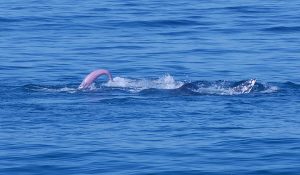
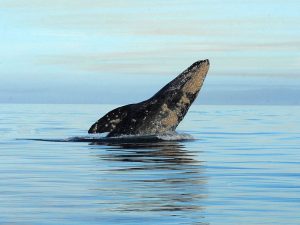
The sexual revolution may have reached humans in the fairly recent past, but the gray whales in the lagoons of Baja California Sur have been free thinkers on the subject of sex for millennia. Females in estrus commonly take several different lovers throughout their winter respite in the lagoons, and the males actually appear to be quite relaxed about the situation. In fact, when two males vie for the affections of the same female, the “loser” willingly assists the “winner” in consummating the relationship. Seriously. When the winner is chosen in his romantic bid, he typically waves his 12-foot long penis – affectionately known by Baja guides as “Pink Floyd” – in a victory lap through the air while the object of his affection sidles up to him through the water. Once the lovers are floating belly-to-belly, the winner’s new wingman – AKA the “loser” – braces the female from the back with his pectoral fins, helping her to maintain a good position (consider the logistical issues of two 40-ton mammals propagating the species in water). The trio can maintain this pattern for up to an hour, during which time the female and her consort-of-the-moment mate several
“Whale Celebration” photo by Kaia Thomson
times with the aid of the second male. All parties then swim away, the “winner” likely satisfied with his contributions to the gene pool and the “loser” probably pondering how to be on the other side of the equation next time. No fighting, no brawling, just that cool gray whale demeanor. And the female? Likely as not casting an appraising eye on the other males hanging about the lagoon. After all, she’ll be pregnant for the next 12 to 13 months with the duties of motherhood to follow so she’ll want to enjoy this time of carefree romance in Baja as much as she can, while she can. Clever girl.
The Baja peninsula has long been famous for its remote and beautiful islands, most of which we are accustomed to visiting via water craft. But there is an island near Todos Santos that is readily accessible by car that we can easily explore on foot: the Sierra de la Laguna Biosphere Reserve. Part of an island off the coast of Baja some 10 million years ago, the incredible diversity of plant and animal life of the Reserve still reflects the island isolation the area once enjoyed – over 23% of plants and 10% of animals found in the Reserve are endemic to the area. Nestled between Todos Santos to the west and Los Barriles to the east, La Paz to the north and Los Cabos to the south, it is truly an island of lushness surrounded by shores of desert and sand.
Biosphere Reserves in Mexico
The Sierra de la Laguna Biosphere Reserve was created by presidential decree in 1994 by Carlos Salina de Gortari. To be designated a biosphere reserve in Mexico a place must meet 3 basic criteria:
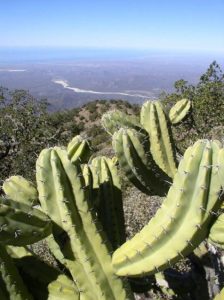
Photo by Craig Ligibel
Have an endemic or threatened species. And we’ve got that in spades! The Sierra de la Laguna Biosphere Reserve boasts an astounding 79 endemic plant species, 8 endemic reptile species, 4 endemic bird species and 4 endemic mammal species. A total of 59 species of birds, 40 species of mammals, 31 species of reptiles and 61 species of insects have been recorded in the Reserve. Over 900 species of plants have been observed. It’s truly extraordinary.
Cover an area greater than 10,000 hectares. There’s plenty of room to spread out! The Biosphere Reserve covers 11,600 glorious hectares (~28,665 acres), while the Sierra de la Laguna area itself, including the Biosphere Reserve, encompasses 112,436 hectares (roughly 277,835 acres).
Have one ecosystem that is not substantially altered by human contact. The Sierra de la Laguna is one of Baja’s most beautiful but least explored areas, with plenty of wild spots that have largely escaped the impact of human civilization. In addition to animals such as mountain lions, mule deer, gophers and badgers, a wonderful array of birdlife inhabits the reserve, including the endemic cape pygmy owl, Xantus hummingbird and Belding´s yellowthroat, making the area a bird-lover’s paradise.
Biosphere reserves in Mexico are created with three main objectives in mind: conservation, training and sustainable human development compatible with conservation. Unlike national parks, biosphere reserves allow people to continue to live in the protected areas – although new population centers are prohibited – and our reserve has 35 private properties and 6 ejidos. That result is that the Sierra de la Laguna retains a thriving ranchero culture that is great fun to explore.
Hiking the Sierra de la Laguna
There are a variety of ways to explore and enjoy the Sierras on foot and in all these hikes the diversity of terrain is amazing. At the base is San Lucan Xeric Scrub, also known as Mezquital, which merges with the dry forest. These areas feature a large number of plants that have adapted well to life with limited water including palo zorillo (skunk trees), torotes (elephant trees), lomboy trees and ironwood. The dry forest extends up to about 800 meters (~2,600 feet) and is remarkable in the juxtaposition of plant life, with mosses and other plants that thrive on water co-habiting with more arid types like cardon and biznaga. If you’re still hiking at this point you’ll experience the wonder of moving up through an unexpected oak forest in Baja then on into lush preserves of pine and oak from about 1,400 meters (~4,600 feet). It’s a remarkable transformation of terrain.
Photo by Craig Ligibel
If you’ve made it this far chances are you’ll be camping in the high valley and at this point you may start to ask yourself, “If this is the Sierra de la Laguna, i.e., Mountains of the Lagoon, where the heck is the lagoon?” Well, there was indeed once a lagoon in the flat meadow between the highest peaks but that drained away around 1870 after years of supporting local agricultural and mining operations, leaving only the name behind. But that doesn’t mean that there isn’t water in the Sierras. Indeed in normal, non-drought years the Sierras can receive over 100 centimeters (39 inches) of rain and serve as a key water source for Todos Santos, Pescadero and other coastal communities. If you have a few nights to camp you should take a day to explore the beautiful waterfalls near the high valley created by this relative abundance of rain.
And of course, if you’ve come all this way you must take a day to explore El Picacho, the incredible 2,161 meters (~7,000 foot) peak from which you can enjoy sweeping panoramic views of the peninsula, with the Sea of Cortez on one side and the Pacific Ocean on the other. If you’re lucky enough to make it up to El Picacho you’ll see clearly that the Sierra de la Laguna Biosphere Reserve is not only a literal island now rooted firmly in a landmass, but also a magical, magnificent island of the sky.
In the Know – Mauricio Duran, Head Guide with Todos Santos Eco Adventures. On the geographic scale the Sierras are mere youngsters, clocking in at about 138 million years old. By comparison, parts of the Appalachian Mountains in the U.S. are 650 million years old, while the Barberton Greenstone Belt in eastern Africa has mountains that are 3.5 billion years old, widely believed to be the earth’s oldest.
Hiking with Todos Santos Eco Adventures
We offer several different options for hiking and exploring the incredible beauty and diversity of the Sierra de la Laguna Biosphere Reserve:
Day Hikes: We have 2 day hike options in the Sierras. One is called Reaching for the Sky and, as the name implies, we climb as far as we can before we have to turn around to make it home before dark. The other is the Riverbed Stroll, which is generally flat and easy and in which we encounter waterfalls at certain times of the year. There is magnificent flora on both hikes and excellent birding.
Overnight Hikes: We offer two 4-day/3-night hikes and a 2-day/1-night hike. The 4-day hikes include Sea-to-Sea in which we start at the Pacific Ocean, hike across the peninsula through the Biosphere Reserve, and end at the Sea of Cortez. The other 4-day hike is the Todos Santos Loop. The main difference is that the latter features an easier descent and less exciting logistics. On both 4-day hikes there are burros to carry all the gear, guides to lead the way, cooks to prepare the food and pour the wine, and warm sun showers to wash away the exertions of each day. Decidedly comfortable camping! The 4-day hikes are only for avid walkers. The 2-day/1-night hike is a terrific combination of Reaching for the Sky and Riverbed Stroll. All hikes are lead by experienced guides and naturalists who are certified Wilderness First Responders. www.tosea.net


 Theodore Roosevelt once famously quipped, “If you could kick the person in the pants responsible for most of your trouble, you wouldn’t sit for a month.” Development will happen in BCS and groups like Niparajá and communities like Cabo Pulmo see that it can be positive for local residents. But to ensure that it is, Amy Hudson Weaver believes that the citizens of BCS need to take hold of their development destiny by embracing the legal tools at their disposal, namely municipal planning and zoning. There are 17 major approved development projects on the East Cape alone, and no organization has the resources to ensure that they are all implemented with the least environmental impact and greatest financial benefit to local residents. Municipal zoning plans and regulations have been created for Los Cabos and La Paz, but never implemented. Few of the other municipalities or districts in BCS have developed any sort of plan at all. If BCS is to be successful in preserving its resources for future generations, Niparajá believes the communities should decide now what they want developed and how, before outside forces decide it for them. Otherwise, in a few years time we’ll all be kicking ourselves in the pants and not able to sit for a very long time.