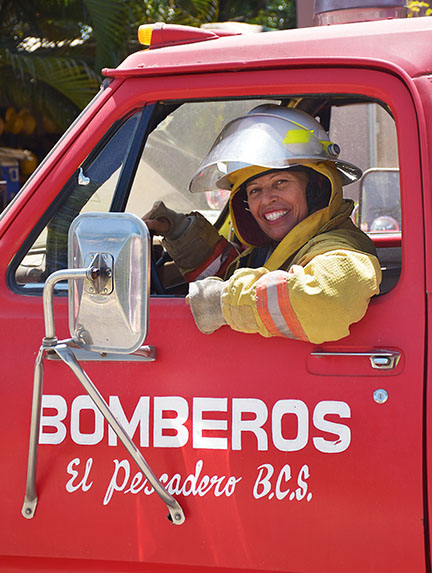
Griselda Lorena Sotelo Amaya: A Family Saved Through Conservation
by Bryan Jauregui, Todos Santos Eco Adventures. This article first appeared in the Journal del Pacifico.
In 1976 Hurricane Liza slammed La Paz so hard that Griselda’s entire neighborhood was washed out to sea when the dam burst. Her parents put her and her brothers in the family Plymouth and for three hours they watched as the bodies of people and animals rushed by in the churning waters, fearing the worst for themselves as the water crept up past their knees. The Plymouth began to float away and was about 30 meters from what had once been their yard when the soldiers came to their rescue. A fireman put her on his shoulders and carried her to safety. She knew then what she wanted to be when she grew up.
Hurricane Liza is still cited as the worst natural disaster in the recorded history of Baja California Sur and one of the deadliest recorded cyclones in the eastern Pacific. The official count was 1,263 fatalities and over $100 million 1976 US dollars in damage, but many thought it was more. Where the home of Griselda’s family had once stood there was now only sand so they, along with hundreds of other families, founded a new neighborhood constructed entirely of cardboard houses. They called it the 8th of October. The government later upgraded them to a sheet rock house with one bedroom, a living room, a kitchen and an outdoor bathroom. The 4 kids slept on the floor in the living room. Despite the sub-par housing and a father devastated by loss, Griselda thrived. She rescued animals at the nearby ranches (yes, there were ranches on the outskirts of La Paz in those days), adopted a falcon named Kila, and did all the dancing, art and writing she could in school. When she was 18 she was crowned queen of the 8th of October Festival and inaugurated the 8th of October Bridge with Mexican president Carlos Salinas de Gortari. She worked ceaselessly to get baseball and soccer fields built in her neighborhood. Griselda had emerged from her childhood disaster smart, popular and a resourceful force for community betterment. The world appeared to be her oyster.
Then, at 22, she got married. By 33 she was divorced. She had 3 great kids but no job, no home, no source of income. It was 2001, her father was gone and her mother was living in a tiny trailer in Pescadero. As her family had done after Hurricane Liza, she built the only shelter she could for her family – a cardboard home – around her mother’s trailer. But she still had no money to feed her children so when she learned about the Internado, the boarding house for ranch kids in Todos Santos paid for by the state, she jumped at the chance to enroll them. Every Monday she would walk from Pescadero to Todos Santos to put the kids in the Internado, and every Friday she would walk to pick them up and walk them home. She had no money for the bus. “All I asked from God was work, a paying job. One of my kids asked me for an apple and I didn’t have the money to buy even that. This was a huge sadness for me, not to be able to provide for my children.”
Now it is a known fact that if your God is prone to answering prayers, the delivery system can sometimes be a bit surprising. For Griselda, the answer came through a real estate agent operating out of an office near the gas station in Pescadero. He was looking for someone to paint his office, and even though she’d never held a paint brush in her life, she pressed him for the job. He was ultimately so impressed with the work she did that he gave her a hundred dollar bonus. That money changed everything; she was able to take her children out of the Internado and bring them home to live with her.
Then the angel showed up. As she was minding the real estate office one day an American named Gary Falcon walked in. They struck up a conversation and he invited her to come work for him as a housekeeper at his rental casitas. From there, the world opened up. Her children learned English from Gary and through him she soon had connections throughout Todos Santos and Pescadero which lead to continuous work cleaning and painting houses. In this way she met Cathy Fleischman who was in the process of opening Spa Cielo and needed someone to help her do hair and nails. Even though Griselda had never done this type of work before in her life, she put on the kimono and soon was making enough in Spa Cielo tips, painting and cleaning income that she was able to buy some land and build her own house. A real home. And she could buy her children all the apples they wanted.
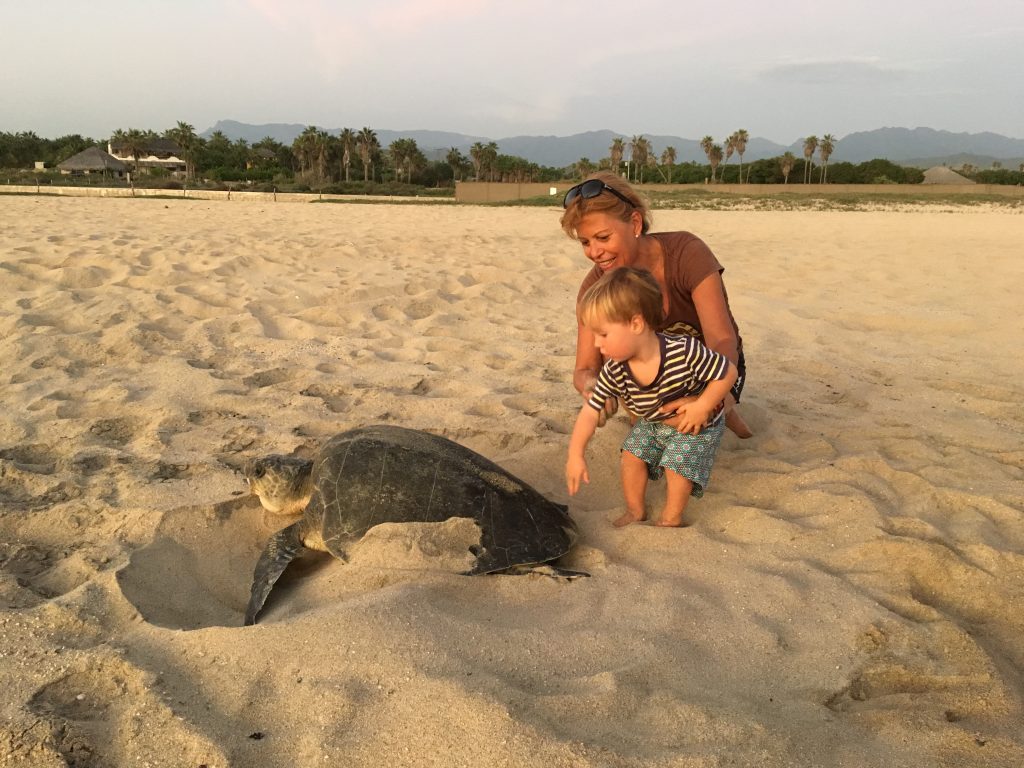
Before she completed her house, Griselda used to house sit on the beach in Pescadero. She loved to walk the beach at night, and one evening came upon a female leatherback who was missing a part of her back fin. “I saw the turtle working so hard to make her nest but she couldn’t dig well because of the injury to her fin so I got down and helped her. There were tears on her face. I felt such a great connection with this turtle, with her struggle, with her determination. It was truly magical. It was like God was telling me that helping turtles is part of your mission in life.”
The next day she met with a biologist, Professor Carlos Ramirez Cruz, who told her that the turtles in Pescadero were largely unprotected and suggested creating a group focused on defending them. So even though she had no experience in working with turtles, in 2004 she found herself the President, secretary and Treasurer of Tortugueros de Pescadero and by 2005 she was the president. The other person in the group gave her a lot of moral support. “In those days the people of Pescadero ate a lot of turtle eggs and there was a lot of hostility to the work we were trying to do, especially since I was not from the area. But once I started giving presentations in the schools and getting the kids involved with the hatchling liberations, the situation really changed. The kids educated their parents and now very few people in Pescadero eat turtle eggs.”
While the real estate agent and Gary Falcon were the emissaries who answered the financial how of caring for her children, the crippled turtle just may have been the spiritual one. “I love turtles because they helped me keep my family together, integrated. I didn’t have the money to give my kids a great education, but I could give them experience to make them good people. They grew up with the ethos of conservation and the desire to help others.”
The turtles also lead Griselda to realize her childhood dream. “When my children and I patrolled the beaches together at night helping the turtles, we would sometimes find people drowning or in accidents on the highway. We would help them all as there were no first responders in Pescadero in those days.”
In 2007 Griselda, with the assistance of her children and a group of young volunteers, established Patrol 64 Preservation and Rescue (her house is at KM 64). She petitioned the governor for an ambulance, and two months later a very old one with no gear arrived. It wasn’t much, but it was something. In the early days of responding to emergencies, Griselda and her volunteers would call a local Pescadero doctor, Dr. Idelfonso Green, and ask him how to help the injured people in their care. But once they got to the point where they were answering four or more emergency calls per day, they knew they needed more intensive training to continue. Therefore in 2009 Griselda and her son Fernando, along with 6 other volunteers, took a one-year course at the Academy of Firefighters in La Paz. At her graduation Griselda became the first female commander (comandante) in Latin America, and remains the only one in Baja California Sur. Now all 3 of her older children are firefighters, first responders and paramedics, and Rescue 64 is now Bomberos Voluntarios de Pescadero, the official, all volunteer firefighting unit of Pescadero. Their logo depicts a turtle on a fireman’s hat.
Turtles remain Griselda’s passion. She still works with them every season, protecting their eggs from predators, and continues her educational campaigns and hatchling releases with local children. “The turtles give me strength and energy. We now have 15 firefighters, 8 of whom have attended the Academy of Firefighters, and they all eat, sleep and shower at my house. The turtles give me the peace and serenity I need to keep doing Patrol 64. I’m not alone – many of our firefighters are also tortugueros. Developing an empathy with nature and animals is such a key part of creating good human beings.”
The firefighter who once lifted Griselda up on his shoulders and carried her to safety would surely be pleased to know that that little girl has carried her own family to safety by doing exactly what he inspired in her that day – helping others in need. Could helping turtles and/or firefighters bring unexpected treasure to your family? It’s certainly worth finding out. You can contact Griselda at or 612-154-2044 to learn more, and also check out their Facebook page at https://www.facebook.com/AmgiosBomberos. A new firetruck, more gear, turtle volunteers and more all needed. Being part of the answered-prayer delivery system is surely a worthy endeavor!
© Copyright Sergio and Bryan Jauregui, Casa Payaso S de RL de CV, 2020