by Bryan Jáuregui | Culture
Straight from the Cafè Brown Cooking Research Center! Made with the Last Mangoes of the Season:
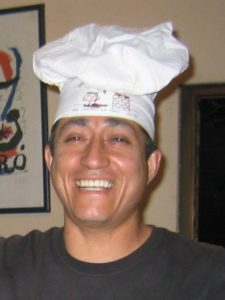 Pork in Mango-Jalapeño Sauce
- 1 kilo of fresh mango, peeled and pitted
- 1.5 kilos of pork leg or shoulder diced in cubes
- 3 to 6 jalapeños (determine according to your “hotness” tolerance)
- 1 medium onion, diced
- 2 medium cloves of garlic or one large one
- Salt
- Black pepper
Place in a blender the mango “meat”, half the onion, the garlic, 2 jalapeños, salt and pepper. Add a little water then hit PUREE or equivalent on your blender.
Dice the other half of the onion and the remaining jalapeño peppers (make sure the center and seeds have been removed or prepare to perm your hair) then saute them in a pan with olive oil until the onion becomes clear. Add the mango sauce and salt/pepper to taste. If you like, add a glass of beer to the pan – and have one for yourself while you’re at it.
While the mango sauce is simmering, in another pan cook the pork meat in olive oil until is is golden outside. Once the mango sauce and the pork are both ready, pour the mango sauce over the pork. Allow them time to meet, share experiences, hopefully fall in love. This should take roughly 13 minutes over a low fire (in human terms this is the equivalent of one night or 3 years, depending on the country and the culture). Goes great with rice. Remember, the main ingredient always is LOVE . Bon apetit!!!
Iker Algorri, Cafè Brown Todos Santos, Baja California Sur, Mèxico.
by Bryan Jáuregui | Adventure, Travel Industry
We are celebrating the launch of our facebook contest to win a free spot on our May 26-June 1, 2013 Surfari! Baja Surf Camp for Women with a collection of great surfing quotes:
“Surfing is very much like making love. It always feels good, no matter how many times you’ve done it.” Paul Strauch, Leonard Lueras’ Surfing Hawaii
“Surfing, alone among sports, generates laughter at its very suggestion, and this is because it turns not a skill into an art, but an inexplicable and useless urge into a vital way of life.” Matt Warshaw, Maverick’s: The Story of Big-Wave Surfing
“As for my own surfing, let’s just say that when the waves start pushing 10 feet, I get this tremendous urge to make a sandwich.” Bruce Jenkins, North Shore Chronicles
“Then, after I’ve gotten rid of Batman and Robin for good, I will rule the waves. Me, the Joker, king of the surf and all the surfers. Then, Gotham City! Later, the world!” The Joker, from Batman
“One of the greatest things about the sport of surfing is that you need only three things: your body, a surf-board, and a wave.” Naima Green, Surfing: Rules, Tips, Strategy, and Safety
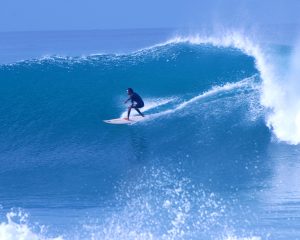
Our Surf Instructor Mario on the Big Wave, Photo by Kaia Thomson
“Surfing is the most blissful experience you can have on this planet, a taste of heaven.” John McCarthy, Surfer
“Surfing equates to living in the very moment of ‘now’. When you ride a wave you leave behind all things important and unimportant, the purity of the moment is upon you.” Bill Hamilton, Surfer
“The best surfer out there is the one having the most fun.” The Truth
by Bryan Jáuregui | Blog, Culture
by Sergio and Bryan Jauregui, Todos Santos Eco Adventures
June through November are the best months for diving and exploring the Sea of Cortés – “the aquarium of the world” – as the warmer water temperatures mean an (even more) incredible variety of fish, superior visibility and calmer seas. But a word of warning for those of you who do venture to the depths of the Sea of Cortés: there is one truly scary thing that you should know about – and be constantly on the alert for – and that is El Mechudo. There are many variations on the story of this wild-haired free diver, but this is the one that the old fishermen around Punta Mechudo tell…
Long ago, when La Paz was the pearl capital of the world, there lived a Yaqui Indian known as El Mechudo, The Hairy One. In those days there were many pearl divers of great skill and daring in La Paz, men and women who could hold their breath for long stretches at a time and knew the secrets of finding large and magnificent pearls. Each year the companies that sold La Paz pearls around the world would hold a contest to see which diver could find the largest and loveliest pearl. The diver who won was awarded the great honor of having his or her pearl presented to the Virgin of Guadalupe. For as many years as anyone could remember, El Mechudo, with his wild flowing black hair, had won the contest; he could hold his breath longer and dive deeper than any of the other divers and he always knew where to find the most fantastic pearls.
Then one year El Mechudo failed to appear at the beginning of the contest. They waited for him for several hours but finally had to hold the event without him. By the time El Mechudo arrived to compete, the contest was over and a winner had been declared. Enraged, El Mechudo insisted on diving. His friends begged him not to risk his life and to simply wait until the following year to prove himself the champion once again. The organizers warned that even if he found the biggest, blackest pearl of all time that they would not crown him the winner, nor would they present the pearl to the Virgin. Unfazed, El Mechudo dove into the water. Time passed. After many minutes he still had not returned to the surface. His friends jumped into the water to search for him and saw a sight that would haunt them for the rest of their lives: the lifeless body of El Mechudo with his hand caught in a giant oyster.
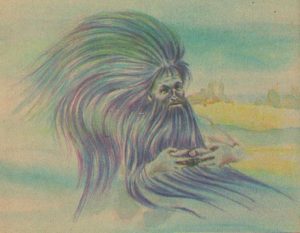
The man known as El Mechudo is dead, but he is not gone. To this day divers, kayakers, fishermen and snorkelers in the Bay of La Paz are visited by the ghost of El Mechudo. There are regular reports of unexplainable touches in the night, rearranged camp sites and voices in the wind. And aspiring pearl divers should beware. Word is that if you go into the Bay of La Paz looking for pearls, El Mechudo will find you and offer you the largest, blackest pearl you can imagine. If you accept, your final resting ground will be the depths of the Bay of La Paz, right beside El Mechudo.
So how did La Paz become the Pearl Capital of the World in
the days of El Mechudo? Tony Burton of MexConnect* explored that story by reaching back to the early 1530s when the explorers of Hernán Cortés sailed into the Sea of Cortés searching for the earthly Paradise of California. The first peoples they encountered on the Baja Peninsula were Pericú Indians. The Spanish explorers were immediately struck by the Pericú’s necklaces which were strung with berries, shells and blackened pearls. As the Pericú did not have metal knives they had been retrieving pearls by throwing oyster shells into a fire, charring the pearls in the process. The Spanish explorers soon determined that opening the oyster shells with their knives gave them access to lustrous, milky-white pearls on par with those to be found in Asia or the Middle East. A robust pearl industry was born, and thousands of pearls were sent from Baja to Europe where they were used in the royal regalía of many European courts. While the Jesuits tried to restrict pearl collection during the period of their missions in Baja (1697 to 1768) due to the poor conditions inflicted in the native Indian divers (see story of El Mechudo above), traffic in the pearls persisted. It was estimated that by 1857, 95,000 tons of oysters, that yielded about 2,770 pounds of pearls, had been removed from the Sea of Cortés. The coves around La Paz and Isla Espiritu Santo were the center of the Baja pearl industry.
Pearl diving was revolutionized after 1874 when larger vessels, equipped with diving suits and accompanying equipment, first entered Mexican waters. The new equipment lengthened the season to include the cooler winter months and had the added benefit of reducing shark attacks. But new dangers emerged: divers confined to diving suits for hours at a time frequently suffered rheumatism, paralysis (due to compression and sudden temperature changes) and partial deafness. Equipment failure led to many deaths. (Never fear new divers – Jacques Cousteau radically enhanced the functionality and safety of scuba gear and since his first Aqua-Lung in 1943, equipment safety has increased dramatically.) Despite the problems faced by the divers, by 1889, a La Paz-based pearl company had come to completely dominate the world pearling industry. A 400-grain pearl, found in the shores of Mulege, now forms part of the Spanish crown jewels.
A 1903 article in The New York Times says that the Baja pearl industry had produced more than two million dollars worth of pearls in 1902, including some of the “finest jewels of this kind found anywhere in the world”. The article emphasizes that the area is “noted for its fancy pearls – that is to say, the colored and especially the black ones”. But by 1936 the natural oyster stocks had been depleted past the point of recovery. This depletion, combined with the widespread availaility of relatively inexpensive cultured and artificial pearls, led to the demise of the natural pearl industry in Baja. Today very few natural pearls are harvested in the Sea of Cortés, but several Baja California firms do cultivate pearls. So La Paz, once the center of the world’s pearling industry, is still known today as the “Pearl of the Sea of Cortés”. But remember, should you encounter one of those few remaining natural pearls while diving in the Bay of La Paz and decide to take it home, El Mechudo will make sure grabbing that pearl is the last thing you ever do!
*Much of the information on the pearl industry in La Paz presented here was researched by Tony Burton and presented in his Did You Know column for MexConnect in June 2008. His sources include:
Anon. Important Pearl Fisheries on the Coast of California. The New York Times, June 14, 1903.
Hardy, R. W. H. 1829 Travels in the Interior of Mexico in 1825, 1826, 1827 and 1828. London: Henry Colburn & Richard Bentley. Reprinted in 1977, Texas: Rio Grande Classics.
Kunz, G. F., and Stevenson, C. H. The Book of the Pearl: Its History, Art, Science and Industry.Dover. 2001.
Mayo, C. M. Miraculous Air: Journey of a Thousand Miles through Baja California, the Other Mexico.Milkweed Editions. 2007.
by Bryan Jáuregui | Wildlife
by Todos Santos Eco Adventures
The California Sea Lion (Zalophus californianus) is one of the most sociable and fun-loving marine mammals around, and they love to congregate in large colonies of one thousand or more along the Pacific coastline. They are called the lions of the sea because of the loud roars they can produce. The males of some sea lion species also grow thick manes around their necks. From Todos Santos you can visit and interact with sea lions at the famous sea lion colony of Los Islotes in the Sea of Cortez.
Baby sea lions are usually born in late June and are fairly well-developed from day one. Just after birth they can swim a little bit, call for their mothers, and open their eyes. Several days after birth the sea lion mothers leave their youngsters in the rookery and head into the ocean in search of food. When they return they call for their babies with a loud trumpeting noise and the babies reply in a series of bleats. This goes on until mother and pup are reunited. The mother’s final test to determine that she has found her pup is to sniff the pup all over.
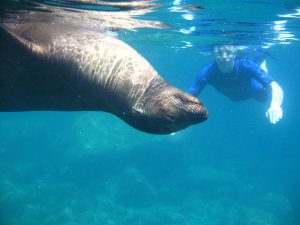
Getting to Know the Neighbors: Snorkeler & Sea Lion
Sea lion males are quite impressive in size (and seem especially so when you’re snorkeling nearby), growing up to 8 feet long and 660 pounds. Females are much smaller although they are still the size of a large man, growing up to 6.5 feet long and weighing in at over 200 pounds. As they mature, males grow a crest of bone on the top of their heads, and it is this crest that gives the sea lion its generic name: loph is forehead and za in an emphatic, so Zalophus californianus means “Californian big-head”.
The main difference between a sea lion and a seal in appearance is that sea lions actually have ears, while seals do not. Sea lions are also built to move on both land and water, although they definitely look more graceful in the ocean! The sea lion’s front flippers have a bone structure that is quite similar to that of a human arm and hand. These front flippers propel a sea lion forward while it is swimming, while the rear flippers control steering. The sea lions use both pairs of flippers to walk (waddle) on land.
California sea lions enjoy a wide variety of seafood and feed mainly on squid and fish. Adult females forage for food anywhere between 10 and 3,000 kilometers from the rookery and can dive as deep as 274 meters, with average dives of 31 to 98 meters. Sea lions can stay underwater for up to 15 minutes by sealing their noses shut. The Californian big-head lives to be about 17 in the wild, somewhat longer in captivity.