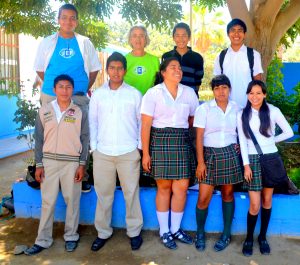
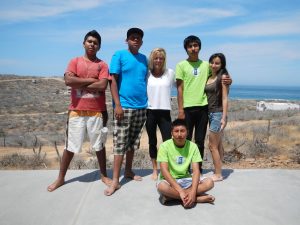
Eco Educator Paty Baum with current Joven Ecologístas de Pescadero (Youth Ecologists) group
Sometimes the most non-conventional people get that way through the most conventional of means: they learn it from their parents. So it’s not so surprising to discover that eco educator, punk rocker, beach dweller, film maker, turtle protector, surf breaker Paty Baum’s parents were hard-core union supporters who regularly took the kids to marches and protests, or that her father was a professor of revolutionary literature. The surprise is to discover that kids of local migrant workers here in Todos Santos and Pescadero are doing yoga, reading the ocean for rip tides and currents, documenting the impact of change on the biodiversity of their town, and going on kayaking and camping adventures. And that’s just a tiny piece of what Paty has achieved since she moved to Todos Santos in 1995 and started her non-profit Eco-Educadores Verde y Azul de BCS.
Bringing creativity and education into the lives of under-served youth has been a calling for Paty since her first days as a freshman at Lewis & Clark College. One of her first moves on campus was to join ACTION, a type of urban peace corps program, where she taught photography to inner city grade school kids. She then went on to work for the Multnomah County Urban 4H program for two years where she developed and implemented semester-long workshops for inner-city grade school kids in photography, leathercraft, ceramics, nutrition and fishing. That was just her day job.
The Neo Boys with Paty on Drums. Click photo for YouTube video of The Neo Boys playing at The Long Good-Bye in Portland.
Being a classically trained clarinetist, Paty naturally became the drummer for the all-girl Portland punk rock band, the Neo Boys. They played the local club scene for several years and developed a cult following so loyal that K Records will soon be releasing a double album of live and studio recordings by the Neo Boys entitled Sooner or Later. The Neo Boys may have broken up in the early ‘80s but all these decades later the fans are still clamoring for more! And when she wasn’t on stage or with the 4H kids Paty kept the education/punk rock themes all rolling together on her weekly radio show The Autonomy Hour on Portland’s community radio station KBOO, teaching the masses about the great punk music of the time. Then she met Gus Van Sant.
The Neo Boys. (Paty at far left with her arms crossed.)
Van Sant was working on his second film, Mala Noche, and asked Paty to do location sound for the film. She found the film-making process so incredibly fun that as soon as she wrapped with Van Sant in 1986 she wrote a script, shot it, and submitted it as her application to the film program at San Francisco State University. They loved it. She’d gotten too busy with life to continue at Lewis & Clark College, but film school completely absorbed her and she graduated with a BA in Film Production in 1990. And she didn’t waste any time making a name for herself after that.
Her first film in 1990 was 122 Webster, a 12 minute, black and white, 16 mm documentary that she co-directed, co-wrote and co-produced with Daniel Robin. A portrait of Daniel’s heroin-addicted roommate Bobbie, the film was incredibly well-received. It was screened at the 1990 Sundance Film Festival, was part of the 1995 Lalapalooza Music Festival national tour, and was shown in venues as diverse as the Cork International Film Festival in Ireland, The Ann Arbor Film Festival, the Humboldt International Film Festival and the Big Muddy Film Festival in Illinois. But even before 122 Webster was making its rounds Paty was already completing her second film, The Cleansing Machine. It won Best Documentary at the 1992 Humboldt Film Festival and played all over the world. The Fins were particularly crazy about it and tried to get Paty to visit with the film but she just couldn’t make it.
Now it’s a known fact that many surfers try to pretend like they derive the same satisfaction from their non-surfing pursuits as surfing, and will make valiant efforts to resist the urge to live at the beach and surf every day. Just one look around Todos Santos will tell you that for the true-surfer-at-heart, resistance is futile. Paty surfed all through her Oregon and northern California years, then came to Todos Santos on vacation on the advice of a friend. After that it took her 8 months to wrap up her life in the US and move into a trailer on the beach at Los Cerritos. She didn’t leave for 12 years.
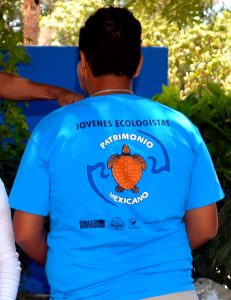
JEP T-Shirt
Paty moved to Todos Santos in 1995 and for the first few years she was happy to just run the Todos Santos Surf Shop at Cerritos and talk surf all day. She created a nice place for people to camp with a composting toilet and it was all pretty blissful. But local folks were leaving a lot of garbage on the beach, and that was definitely killing the paradise buzz. So her first effort with local kids was born out of enlightened self-interest. She wanted people to stop littering so she launched a campaign to make them conscious of their incredible natural heritage and help them understand the value of clean beaches, conservation and recycling. Somewhat to her surprise, the local kids really embraced the campaign and Paty was inspired once again to put her considerable energy into local youth. In 2003 she created the non-profit Eco-Educadores Verde y Azul de B.C.S., under which was formed the Joven Ecologístas de Pescadero (JEP) group.
Funded by grants from various sources, over 300 kids have matriculated through the program to date, and have worked in a remarkable variety of field settings including sea turtle conservation projects, beach and arroyo clean-ups, identifying and growing native plants, studying the impact of deforestation, and mapping the Sierra de La Laguna watershed. (For a detailed analysis of Paty’s experiential learning efforts in Pescadero, please see the article on the program written by Andrew Jon Schneller of the University of Arizona: Environmental service learning: outcomes of innovative pedagogy in Baja California Sur, Mexico )
The JEP group is currently participating in the production of a field guide to endangered sea turtles of the region that highlights the
JEP Kids on Field Trip with Paty
work and successes of twelve years of community-based turtle conservation in BCS (Paty is the co-founder of three community-based sea turtle conservation groups in BCS). The kids are involved in all aspects of the book, from data collection to art. Says Paty’s student 14-year old Maria Guadalupe (Lupita) Martínez, “I have had some great experiences on our trips with the JEP, and have gone places that I never would have gone. It was particularly great seeing turtles nesting on the beach at night, then counting and releasing hatchlings in the nursery.” 15-year-old Adalberto Guadalupe Ramírez Gastelúm is also excited about his contributions. “We drew lots of turtles and I discovered that I am an artist. I did not know that my drawings were so good, that I have talent!” The guide created by Paty and her students, as well as the accompanying environmental education curriculum, will be distributed to the Mexican public school system and NGOs, such as Grupo Tortuguero’s network of grassroots turtle conservation groups throughout Mexico.
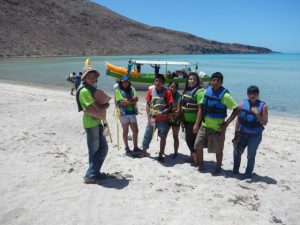
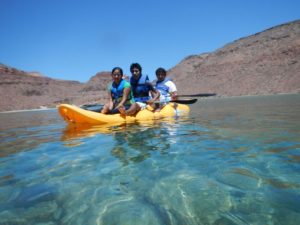
JEP Kids on Isla Espiritu Santo Kayaking and Camping Trip May 2013
When Paty was doing her work with the 4H inner city kids in Portland the highlight of the year was a trip to summer camp where the kids got to stay in cabins and do things like archery, softball, hiking – the fun things of summer. Similarly, this summer Paty was able to take her JEP students on a weekend of kayaking and snorkeling at Isla Espiritu Santo, a trip that was paid for almost entirely through a fundraiser organized by Paty and Amigos de El Pescadero, AC. Says Paty, “Our benefit was a great success, not just for the $1500 we raised through Amigos de El Pescadero and numerous individual donations, but for the students’ self esteem, and the communities’ support from all sectors, including the sub-delegada of Pescadero and the Red Cross.” Needless to say, the kids had a blast at the Island.
Part of the summer program this year includes yoga with Kim Wexman of Baja Zen every Saturday morning,
JEP Kids Doing Yoga with Kim Wexman at Baja Zen
followed by a trip to the beach. Kim, who donates her time says “One thing that stands out to me when I teach the Mexican kids here yoga vs teaching teenagers in the US is that while the US teens may be more flexible physically, they are not as able to meditate. The beautiful students that Paty brings are great meditators. They get very deep into it and this section of the class truly seems to resonate with them. I really, really enjoy doing this class with them. They come with great energy. Of course what Paty is doing with these students is incredible. They all seem truly inspired and eager to learn. Paty is an amazing person.”
Kim Wexmen with Some of the JEP Saturday Yoga Kids
And Paty’s students definitely are inspired. Says 15-year old Carlos Alberto Ramírez Bujín, the son of migrant workers living in Pescadero, “I want to continue studying and go to university. I want to be a lawyer, so I can help people whose human rights have been violated.” And the great thing about inspiration is that it is a renewable resource that people can continually provide to each other. Paty was so inspired by her students, their eagerness to learn, and their excitement in embracing environmental stewardship for their communities that she went back to school and is now completing her thesis for a Masters in Environmental Education at the University of Guadalajara. Says Paty, “It has been an absolute thrill and privilege to work with these students for all these years. To see them documenting their activities and expressing their field learning experiences through not only traditional science-oriented field diaries and data collection tools, but through so many creative outlets like journal writing, poetry, art, photography and video has been phenomenal. Their ability to document and share what are often life-changing experiences is having a real impact on their schools and communities, and has the potential to influence regional and international conservation efforts.”
One punk-rocking film-maker with a passion for surfing, clean beaches and eco-education and a generation of local kids is inspired, energized and ready to be activists for their communities. Paty’s parents are most definitely proud.
If you would like to join Todos Santos Eco Adventures, Amigos de El Pescadero AC and others as a sponsor of Paty’s field trips or other efforts, please email Paty at .
Bryce Courtenay’s best-selling novel The Power of One is a riveting coming-of-age tale about a boy in South Africa who transforms his life through boxing. Speaking about the book years later, Mr. Courtenay said that people generally misconstrued the meaning of the book’s title, thinking it referred to an individual discovering substantial inner strength, when in fact “…the title comes from and is about the power of one teacher. It is about how one teacher can lift a child out of an…environment and allow him or her… to change their life.”
“I am so grateful to all the volunteers and sponsors who have donated their time and money to make the Todos Santos Box program possible. It wouldn’t be possible without their help.”–Ramiro Reducindo Radilla
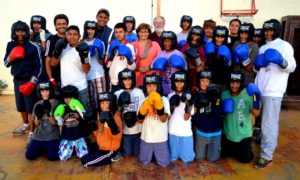
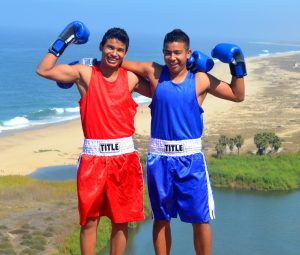
And we can see that power on full display on any given night in the auditorio of Todos Santos when Mexican boxing champ Ramiro Reducindo Radilla comes to town to train the local kids. Ramiro won the gold medal at the Pan American games in Santo Domingo in 2003, represented Mexico at the Olympics in Athens in 2004 and turned pro in 2005. When he started coaching the kids in Todos Santos not one of them had ever been in a boxing ring before. Yet now, not even 18 months later, two of his students have progressed all the way to the national championships. The power of one indeed. Says 17-year old contender Carlos Orozco, “I’d never been an athlete – let alone a boxer – before November 2011 when a friend brought me to a practice session with Ramiro. It never occurred to me then that I would make it this far, and certainly not this fast. It’s been amazing.” Fellow contender 17-year-old Cuahtemoc Aviles agrees. “I’d never boxed before I met Ramiro last year. I had very little discipline, ate a lot of junk food, I just wasn’t in good shape. Now we’ve been winning matches with kids who have several more years of experience than us. Ramiro has really changed everything for us.”
Says Ramiro, “These kids didn’t have much in the way of skill or discipline when I first started working with them, but I believed in them from the very beginning because they always had heart. When we first started we had hardly any equipment but the kids showed up anyway. Many times my car would break down on the drive from La Paz and the kids would wait for me for two to three hours, then still do a full training session starting at nine or ten o’clock at night. I’ve never doubted that these kids are champions and I fully expect to see at least one become successful on the global boxing stage.” Ramiro is so committed to helping the Todos Santos boxing students realize their potential that he coaches them at least twice a week for nothing more than a little gas money.
And with wages like that the support of the local community is critical. When Ramiro’s car engine gave up the ghost just a few weeks before the national championships, neighbors pitched right in to help get it replaced. “Engine Angels” included Michael & Pat Cope at Galeria de Todos Santos, John Stoltzfus & Todd Schaefer at the Todos Santos Inn, Ezio & Paula Colombo at Café Santa Fe, Mario Becerril at Mario Surf School, Sergio Rivera at La Casita Tapas & Wine Bar, Richard Rutowski at AmeriMex, Norm Weill – Volunteer at Large, and our own Baja Surf Camp for Women graduate, Diane Arstein!
“It’s exciting to watch the kids’ progress and see the pride of accomplishment on their faces. They’re learning so much more than boxing. It means a lot to us to be able to offer our time and support.” Cheriy Myers & Steve Stockton
And the community hasn’t been there just as a stop-gap in times of emergency. As Ramiro is eager to point out, it’s been contributing time, money and equipment all along. Moises Barraza Morales, the General Manager of Bodega Lizarraga, got the ball rolling by donating the initial equipment and practice area. When executives from Caracol and Quaker State read the first JDP article about Todos Santos Box they immediately made much-needed cash donations. When Betsy Wall, the mother of Todos Santos resident Janine Wall learned that the kids had only one red and one blue outfit to share among the whole team at competitions, she stuffed her suitcase full of blue and red t-shirts and shorts and brought them to town with her. When Todos Santos residents Cheri Myers and Steve Stockton learned that there were just a couple of sets of gloves and head gear to share among the more than 40 kids who show up to most practices, they donated the resources to get enough protective gear for all the kids. When Adolfo Blanco of the Hotel California saw all the amazing work that coaching volunteers like Mauricio Duran, Arturo Millan and Hector Alberto Agundez Martinez “El Pampa” were doing, he was inspired to donate sharp-looking warm-up suits for the coaches and students to wear to competitions. Todos Santos visitor Doug Newcomb was inspired by the inclusive nature of the program. “I wanted to support Todos Santos Box since they allowed my son Phineas to train with them while we were in town. Even though they knew he wouldn’t be there for more than a month or so, they treated him like part of the club and made him feel included. And the best part was he came home so stoked! If Ramiro can make it all the way from La Paz several times a week, the least I can do is help out by bringing equipment from the US.”
Contenders Cuauhtémoc Avilés y Carlos Orozco
“First with your head and then with your heart” is the life-changing advice dispensed by the boxing champ to an eager young student in The Power of One. The Todos Santos boxing students started out with only heart, but under Ramiro’s coaching they’ve acquired the skills and discipline to lead with their heads. As for the Todos Santos community, they’ve made the well-reasoned decision to support this program with plenty of heart.
If you would like to join Todos Santos Eco Adventures as a sponsor or volunteer with Todos Santos Box please contact Mauricio Duran for specifics: Cell: 612-13-44478 or email: .
In 1972 when the Pioneer 11 spacecraft was sent to explore the outer solar system, it was outfitted with a pair of gold-anodized aluminum plaques featuring pictographs designed to explain to any intercepting extraterrestrials about humans, hydrogen and the earthly origins of the spacecraft. The human figures are clear enough but seriously, to the uninitiated eye everything else in the picture looks like nothing more than a bunch of circles and lines.
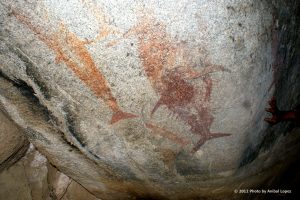
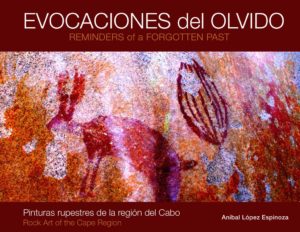
So when you take a walk in southern Baja with anthropologist Aníbal López to view some of the pictographs he’s documented for his forthcoming book, Reminders of a Forgotten Past: Rock Art of the Cape Region, and in amongst the deer, rabbits and fish you see a series of circles and lines left there maybe 1000 years ago by the now-extinct Guaycura or Pericú Indians, you can’t help but wonder who these people really were, and what their images would say to an informed observer.
Searching for clues to these mysteries has been Aníbal’s quest since he was 7 years old. “My family had the concession to farm scallops in Bahia Concepcion near Loreto, and I would often accompany my dad on long road trips to different villages. I hated it. But my dad loved natural history and one day he took me to a canyon filled with petroglyphs made by the Guaycura Indians. It changed everything for me. From then on the long road trips became my dreamscape, and I would spend them imagining Indian life and what it must have been like to be a part of these semi-nomadic communities in such inhospitable terrain. I’m still doing essentially the same thing, only now I’m the one walking the tough terrain.”
Most of the sites that Aníbal has documented – there are 11 in the book but he’s documented nearly 300 in the Cape Region of Baja California Sur (BCS) so far – are found in or around mountain ranges near Rancherias, or temporary Indian settlements that were visited on a seasonal or ceremonial schedule. In modern times this means that they are mainly located on private ranches, so Aníbal has spent countless hours cultivating relationships with area ranchers, most of whom are keen to help but maybe a little fuzzy on the logistical details; it is not unusual for Aníbal to spend three to six days on a ranch hunting for a single site that a rancher remembers seeing as a boy.
Photo by Anibal Lopez
But when he finds the site often what the Indians recorded about their lives on large granite boulders can send his imagination straight back into childhood overdrive. “Being deep in the mountains and coming across ochre paintings of fish and sea turtles is really incredible. Clearly these pre-Hispanic peoples were adept at living in both coastal and mountainous environments. They must have had strong skill sets for both places.” Hamuri Fujita, head of the Institute for Anthropology and History (INAH) in BCS adds “The lack of housing sites and archaeological materials at these sites leads us to think that the people who made these rock art paintings moved easily between the Sierras and the coast, often or seasonally, depending on the ceremonies or festivities planned.”
The first people to discover the pictographs were the Jesuit missionaries, who took a decidedly dim view of the locals. “Stupid, awkward, rude, unclean, insolent, ungrateful, mendacious, thievish, abominably lazy….” were the attributes recorded by Jesuit Johann Baegert.
Maybe. But they sure knew how to sail. Unlike their counterparts in the Atlantic, Gulf of Mexico and the southern Pacific coasts of North America, the Baja California Sur Indians were skilled raft makers and sailors, and traveled easily between the mainland and the islands, carrying people and information. Their great fishing and turtle hunting prowess was well-documented by observers throughout the 17th and 18th centuries. But how long ago did they develop these skills? New archaeological evidence indicates that Pericú skulls strongly resemble those of aborigines native to Polynesia and Asia, and many researchers now believe that the Pericú reached Baja California Sur by navigating from island to island in their canoes.
Photo by Anibal Lopez
So if the circles and lines on the Pioneer 11 pictographs were used to represent the hyperfine transition of hydrogen, the binary digit 1 and the solar system, then perhaps the circles and lines in the pictographs of the pre-missionary, pre-Hispanic Indians of BCS were depictions of their original home and its relationship to Baja, or maybe navigational charts to find their way back, or perhaps just the best way to cook dorado over a mesquite fire. These things may be forever unknowable, but thanks to Aníbal’s 6 long years of self-funded work in finding and documenting these sites, we can now be like the extraterrestrials envisioned by the Pioneer 11 pictograph crew: aware now of another race of beings, and free to let our imaginations soar about what their messages might mean.
Todos Santos Eco Adventures has teamed up with Aníbal to take visitors to one of the Guaycura rock art sites documented in his book that is still not open to the general public. Located on a lovely old working ranch along the former Camino de las Misiones, this walk features not only rock art, but other evidence of the Guaycura civilization including grinders, mortars and even some arrowheads. There is about 90 minutes of moderate walking over uneven, rocky terrain that features gentle up and downhill gradients. While at the site you’ll be helping Aníbal collect vital information for the federal registration process to promote future preservation of these unique sites. Funds go directly to supporting the Aníbal’s work. Aníbal’s book is scheduled to be published in September 2013.
Imagine a fellow mammal with a body so magnificent, so enormous, so dominant that it takes a heart the size of a Mini Cooper to power it.
Imagine a fellow creature with a voice so commanding, so forceful, so potent that it can be heard up to 1,000 miles away.
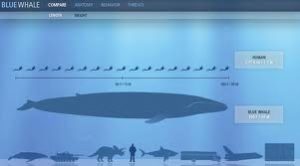
Click to compare the size of a blue whale to the space shuttle, dinosaurs and more.
Imagine the bone structure of a fellow vertebrate so long an NBA basketball court can’t hold it, that weighs so much 8 DC-9 aircrafts can’t lift it, and that is so loud it drowns out the noise of a jet engine.
Imagine arteries so large that an adult human can swim through them; imagine a heart beat so powerful it can be heard two miles away; imagine a tongue as large as an elephant!
If you can do all that then you’re able to conceive of the largest animal ever to inhabit the earth, the blue whale. And as so often happens here in Baja, you don’t have to visit your imagination to encounter some of the planet’s most remarkable beings – you can see them right here. Please enjoy this video of our blue whale encounter on a recent outing in the Sea of Cortez, video courtesy of our guests the Moffats: [youtube=http://youtu.be/DxdFOCTCM5A]
With this enormous size you can well imagine that blue whales have few predators, but it doesn’t mean that they’re not under attack. To learn more about how ship strikes are harming blue whales and what you can do about it, please click here and visit the Great Whale Conservancy website.
The blue whale fun facts in this article are all part of National Geographic Channel’s Kingdom of the Blue Whale video program. They have a great interactive piece comparing the size of the blue whale to various animate and inanimate objects that you can reach by clicking on the blue whale image above.
Niparajá is the god of the now-extinct Pericu Indians of Baja California Sur whose mandate is to care for the oceans and the land. It is also the name of the dynamic conservation organization that, since 1990, has been engaged in the same tasks, working hard to protect the oceans and lands of southern Baja for a vibrant and sustainable economy. The organization has been successful on a variety of projects over the years, and two recent achievements in particular demonstrate how powerful previously disenfranchised local voices can be.
The Battle for Balandra Bay
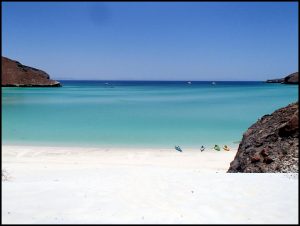
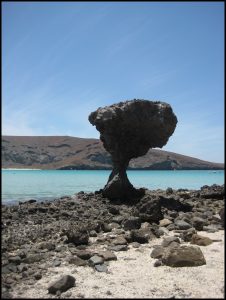
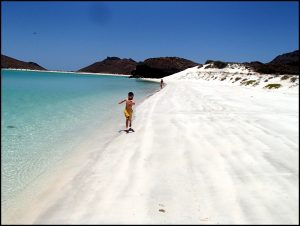
Balandra Bay is, without a doubt, one of the most beautiful beach areas to be found anywhere in the world. The waters are fantastically blue, the beaches stunningly white, the mangroves thrillingly vibrant and the iconic mushroom rock formation that sits at the mouth of the bay an instantly recognizable symbol of the city of La Paz. For generations of La Paz citizens Balandra Bay has simply been the town beach. It is where everyone in La Paz learned how to swim and it is where everyone in La Paz goes on a free summer afternoon. But very few people in the city realized that their beloved “town beach” was in fact privately owned, and had been for decades.
Balandra Bay
That all changed abruptly in 2005 when the owners began soliciting designs from architectural firms throughout Mexico for a major development at Balandra Bay, a project that would include a hotel, golf course, beach club and vacation homes. The potential for a world-class resort is undeniable, and many of the firms responded with thrilling designs. But a partner in one of the solicited firms sits on the board of Niparajá, and the owners got quite a different design concept from that organization – namely, how to build a social movement.
At that point in time little had been done to protect the public spaces that people come to La Paz to enjoy. A few years before a resort complex had been built in El Mogote, a sand bar in the Bay of La Paz. Despite strong local opposition the owners were issued permits to build, and the citizens of La Paz were bitter. While ultimately the owners were forced to abandon the project for environmental noncompliance, they had already created a large group of buildings that are no longer maintained (some of them actually occupied), a tough daily visual reminder of what can go wrong with some development efforts.
Mushroom Rock at Balandra Bay
So when the owners of Balandra Bay announced their intentions to create a large resort complex, citizens and city government alike were galvanized to prevent a repeat of El Mogote. Niparajá helped direct that strong social discontent into a strong collective action through the creation of Colectivo Balandra. It involved thousands of citizens, scientists, researchers and NGOs, all committed to preserving Balandra Bay in a pristine way for public enjoyment. They organized a huge media campaign – “A mi me importa Balandra (I do care about Balandra)” – creating TV spots featuring everyone from the lady everyone took piano lessons from as a kid, to a popular local ranchero band, to favorite local luchadores, to the local water polo team (although that spot was later deemed too racy and wasn’t aired). Local bands gave free concerts in the streets and raised tons of money for the effort, while volunteers worked the crowds relentlessly to collect over 30,000 signatures on a petition to save Balandra.
That the public wanted to protect Balandra from development became very clear to all involved, but the federal government believed the area was too small for it to focus on and suggested a more local solution. The state, however, does not have the authority to declare places like Balandra protected as the water and beaches to 20 meters above the high tide line are under federal jurisdiction. The municipal government of La Paz therefore took matters into its own hands and declared the area around Balandra a protected area. But the action was easily annulled as the municipal government had no authority to create a protected zone. That is, they had no authority until Colectivo Balandra stepped in, got the law changed and gave them the authority. 6 years into the battle to save Balandra Bay, the municipal government of La Paz declared it a protected area.
It was an exciting, but short-lived victory. During a period of electoral transition in the municipal government, the owners of Balandra pressed their case and won back 80% of the land that the city had declared protected. It was then that all parties involved realized that if Balandra was going to be shielded from development in any meaningful, long-term way, the federal government would have to take action.
It was now November 2012. The citizens and government of La Paz had been battling for Balandra for 7 years. For 6 of those years Felípe Calderón had been president of Mexico and his government was fully apprised of the situation. It was now the final days of his presidency and Colectivo Balandra was desperate to obtain federal protection from him; there was no way to know when or if the new government of Peña Nieto would focus on such a relatively small local issue. But the papers sent to Calderón for his signature simply lay on his desk. The clock ticked. Soon it was November 30, 2012, the last day of Calderón’s presidency. The party faithful were gathered for a last dinner with no actionable items on the agenda. But Carlos Mendoza Davis, a senator from BCS, stood up in the middle of the meal and made an impassioned plea for the federal protection of Balandra Bay. He recounted how he had learned to swim there then how his children had learned to swim there and how Balandra was an integral part of the public life of La Paz, the capital of BCS. He made those gathered feel what a deep loss it would be to the community to give the land over to development. He made Calderón feel what a great thrill it would be to end his presidency with a declaration of Balandra’s protection. This feeling carried Calderón back to his office where, in one of his very last acts as president of Mexico, he signed the paperwork that made Balandra Bay a federal Area of Flora and Fauna Protection. One crucial voice, at one critical moment, channeling thousands of voices united over millions of hours to preserve a pristine location central to the identity of a city. The god Niparajá was certainly smiling.
Cabo Pulmo: Who Gets the Money?
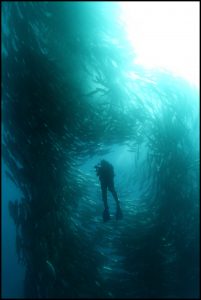
In many cases local communities embrace development. When the Spanish developer Hansa Urbana announced plans to build Cabo Cortés, a massive development with over 30,000 hotel rooms on the shores of the Cabo Pulmo National Marine Park, many of the residents of Cabo Pulmo initially loved the idea. They had overseen the effort to have Cabo Pulmo declared a protected National Marine Park – it is home to the Sea of Cortez’s only living coral reef and a UN World Heritage Site – and benefited from the
Cabo Pulmo National Marine Park. Photo by Carlos Aguilera
subsequent revival of the area’s fisheries and ecotourism industry. They saw the Hansa Urbana project as an exciting extension of what they had been doing and a great way to move their tourism industry into high gear. They loved the vision of jobs, infrastructure and prosperity that Cabo Cortés appeared to offer. In a town of meager resources, limited electricity and often impassable roads, it was a wildly appealing prospect. To some.
But there were those in the community who believed that the development would essentially destroy the very resources that the local citizens had fought so hard to protect in the first place, namely the Cabo Pulmo National Marine Park. (To get a sense of scale, the Hansa project envisioned 30,000 hotel rooms while all of Los Cabos today has only 17,000. In addition to the development itself, they would have to build a city for roughly 30,000 people to staff the development. The water needs alone for a project this size are staggering.) They also believed that most of the economic benefits of the project would flow to outside interests and do very little for the livelihood of the town. These citizens reached out to Niparajá and a coalition of like-minded organizations , who began working to develop a large community sustainable development process in Cabo Pulmo.
In the meantime the legal and media teams were scoring big points and Hansa sold the development rights for Cabo Cortés to a Spanish bank. In response, Greenpeace in Spain went out and met with individual Spanish retirees whose pension plans were being invested in Cabo Cortés via the bank to inform them of the risky nature of the investment and thereby bring more pressure to bear on the project. Actions such as these combined with the unraveling Spanish economy, Hansa’s poorly constructed environmental impact assessment, and the collective outrage of global environmental groups ultimately bankrupted the project in late 2012.
But they’ll be back. So Niparajá is working with the local Cabo Pulmo community on alternatives to combine social and economic development with the health of the Park. Not only is the continued resurgence and well-being of Cabo Pulmo National Marine Park important in and of itself, but a healthy marine park that attracts visitors is also one of the best ways for local businesses to prosper and have the means for controlling the destiny of their community. As Tim Means, one of the founding board members of Niparajá puts it, “The most practical reason for local communities to preserve their natural resources is that they can make more money that way. Visitors will pay to enjoy the pristine natural beauty of Baja. If that is destroyed, what reason would they have to come here?” Adds Amy Hudson Weaver, Director of Niparajá’s Marine Conservation Program, “Beautiful colonial cities, colorful traditional handicrafts, indigenous peoples living a unique way of life – none of these are found in Baja. People go to mainland Mexico for these things. People come to Baja first and foremost to enjoy our unspoiled nature. If that is destroyed, by accident or design, then the whole economy of BCS is at risk.”
Moving Forward
Theodore Roosevelt once famously quipped, “If you could kick the person in the pants responsible for most of your trouble, you wouldn’t sit for a month.” Development will happen in BCS and groups like Niparajá and communities like Cabo Pulmo see that it can be positive for local residents. But to ensure that it is, Amy Hudson Weaver believes that the citizens of BCS need to take hold of their development destiny by embracing the legal tools at their disposal, namely municipal planning and zoning. There are 17 major approved development projects on the East Cape alone, and no organization has the resources to ensure that they are all implemented with the least environmental impact and greatest financial benefit to local residents. Municipal zoning plans and regulations have been created for Los Cabos and La Paz, but never implemented. Few of the other municipalities or districts in BCS have developed any sort of plan at all. If BCS is to be successful in preserving its resources for future generations, Niparajá believes the communities should decide now what they want developed and how, before outside forces decide it for them. Otherwise, in a few years time we’ll all be kicking ourselves in the pants and not able to sit for a very long time.
Charles Scammons is the whaler cum naturalist who hunted the gray whales of Baja’s lagoons nearly to extinction in the 1850s and ‘60s. Stories from that time abound of the lagoons running red with the blood of the slaughtered mammals, and of mother gray whales attacking boats in a futile effort to protect their young. Scammons later regretted his slaughter of the whales and, partly as tribute to them, wrote a book that is now considered a classic, The Marine Mammals of the North-western Coast of North America.
Chris Scammons with Mario and Sara in Guerrero Negro during his 2011 visit.
But guilt continued in the Scammons’ bloodline and in 2011 a great, great grandson of Charles Scammons came to Laguna Ojo de Liebre, or what foreigners call Scammons Lagoon, to apologize to the now-protected whales. Eye witness accounts indicate that four pairs of mother and baby gray whales surrounded his boat and, as he apologized for the actions of his ancestor, the whales stayed with him for an hour, exuding forgiveness and grace. The younger Scammons returned home, filled with the peace he had long sought.
The story of Chris Scammons visit was relayed to us by Rebeca Kobelkowsky, the former director of the Vizcaino Biosphere Reserve and current Ph.D. student at UABCS. We thank her for the story and also for so graciously allowing us to use this photo.









 Theodore Roosevelt once famously quipped, “If you could kick the person in the pants responsible for most of your trouble, you wouldn’t sit for a month.” Development will happen in BCS and groups like Niparajá and communities like Cabo Pulmo see that it can be positive for local residents. But to ensure that it is, Amy Hudson Weaver believes that the citizens of BCS need to take hold of their development destiny by embracing the legal tools at their disposal, namely municipal planning and zoning. There are 17 major approved development projects on the East Cape alone, and no organization has the resources to ensure that they are all implemented with the least environmental impact and greatest financial benefit to local residents. Municipal zoning plans and regulations have been created for Los Cabos and La Paz, but never implemented. Few of the other municipalities or districts in BCS have developed any sort of plan at all. If BCS is to be successful in preserving its resources for future generations, Niparajá believes the communities should decide now what they want developed and how, before outside forces decide it for them. Otherwise, in a few years time we’ll all be kicking ourselves in the pants and not able to sit for a very long time.