























The shimmering emerald cove beckons; reaching it requires a trek up the cacti-dotted cliffs under the Baja sun, then a scramble across boulders on a small beach. But if you arrive at the right time, the water is calm enough for a swim, and you may spot sea lions on the rocks or a whale in the distance. You might also, unfortunately, see a few plastic bottles.
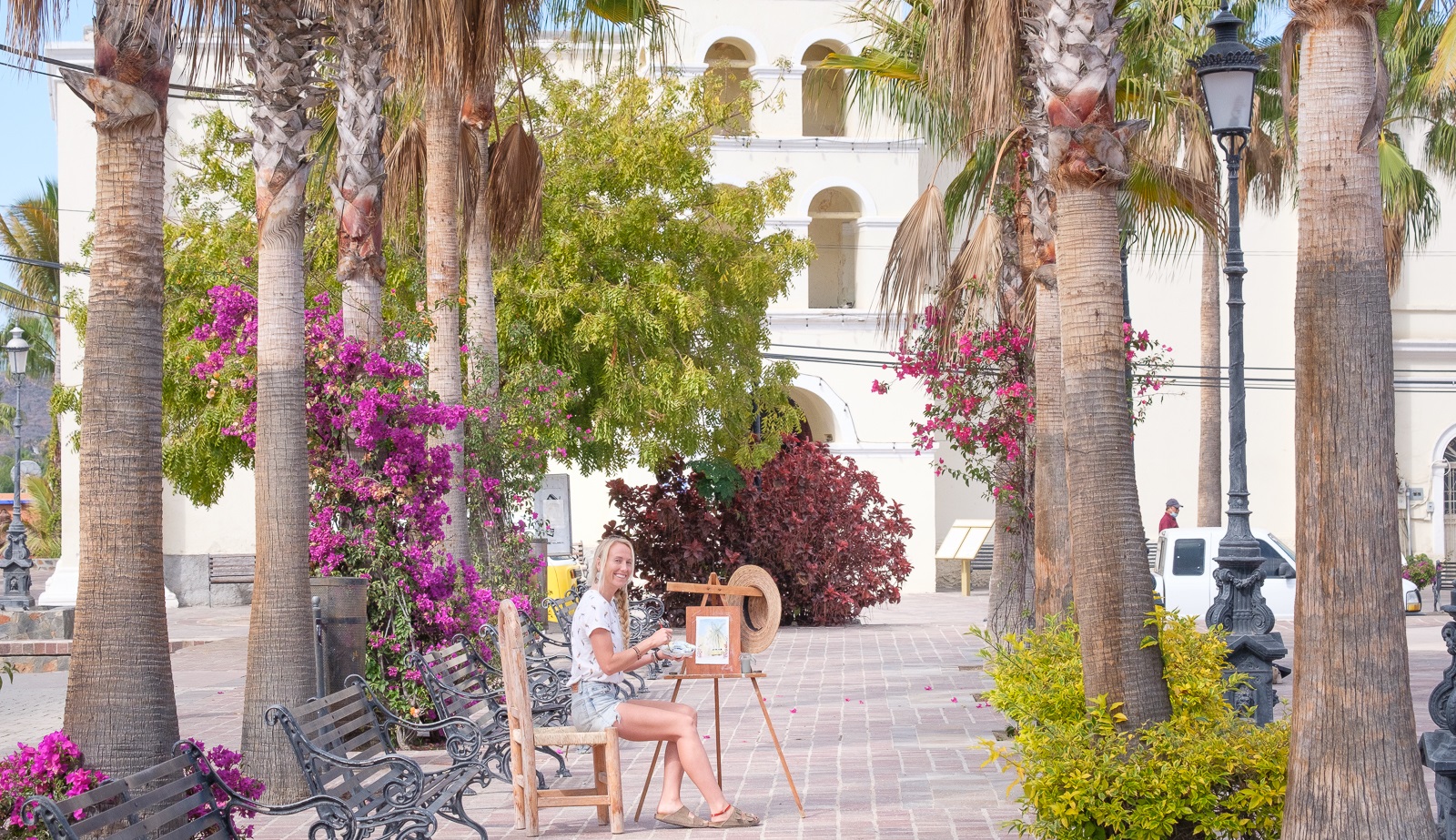
This popular trail in Todos Santos, Baja California Sur, became a favorite of mine during the nearly two years I was based there. Now the small town is grappling with the effects of enchanted visitors who end up staying (hello, me), and it’s trying to avoid going the way of other overdeveloped coastal areas—ones without the infrastructure to support rapid growth, thus ending up with overflowing landfills and waste that leaches into the ocean (hello, Tulum).
“How do we prevent ourselves from becoming just another overrun beach town?” Bryan Jáuregui says. She’s a founding member of Alianza Cero Basura – Zero Waste Alliance, a community-led initiative to implement a plan for a zero-waste future for Todos Santos and the neighboring town of El Pescadero. Jáuregui’s question has urgency: These towns are located in Baja California Sur, the least populated but fastest-growing state in Mexico. As the co-owner of Todos Santos Eco Adventures and Los Colibris Casitas boutique hotel, she calls it “enlightened self-interest” to take on her town’s waste problem.
This tension is not unique to Baja. Around the world, destinations are struggling to balance tourism and economic growth for locals while protecting their natural resources. And even though travelers are more conscious of their environmental footprints than ever, what can they realistically do about them? Is leaving behind zero waste during travel even possible?
Born out of the 1970s ethos of environmental advocacy, the zero-waste movement is focused on sending as little material waste to landfills as possible. The “five Rs” of a zero-waste lifestyle, coined by Bea Johnson in her book, Zero Waste Home, are the movement’s mantra: refuse, reduce, reuse, recycle, and rot (i.e., compost).
A growing number of individuals are embracing these concepts at home: They are eschewing single-use plastics, purchasing bulk items at grocery stores, and taking their food scraps to community compost centers. It gets harder, however, to keep this mindset on the road: Most travelers eat out for most meals and, depending on where they go, don’t necessarily have access to potable drinking water. Travelers are inherently overconsumers.
In some places, tourists generate up to twice as much waste as residents due to the packaged goods they buy, including travel-size toiletries. Eight out of 10 tourists visit coastal areas, contributing to the 8 million tons of plastic that enters oceans and kills 100,000 marine animals a year, according to the United Nations Environment Programme. But it’s more than plastic; often overlooked is food waste. The hotel industry alone produces 79,000 tons of food waste yearly. Cruise ships can generate about 1.3 pounds per person per day on average. Cutting down can make a significant difference, says Vishal Kumar, CEO of Waste Warriors, a nonprofit in the Indian Himalayan Region.
“The creation of less waste means less demand for the production, packaging, and distribution of goods, which results in reduced greenhouse gas emissions throughout the value chain,” Kumar says. When organic waste is dumped into landfills, it releases methane, which has 20 to 80 times more global warming potential than CO2. Aiming for zero waste, then, is a climate solution.
We don’t need 12 people doing zero waste perfectly each year. We need 12 thousand, or 12 million people doing it imperfectly. Court Whelan
In 2007, Natural Habitat Adventures eliminated plastic water bottles from their trips and became the world’s first carbon-neutral travel company. It then took on another ever-growing environmental issue: waste.
Twelve years later, in July 2019, the company led the world’s first zero-waste trip in Yellowstone National Park. To divert 99 percent of the trip’s waste—which would otherwise end up in a landfill—guests carried bamboo cutlery that they washed between meals and a compost bucket for all uneaten food scraps.
While Natural Habitat Adventures isn’t leading 100 percent zero-waste adventures anymore, that doesn’t mean the experiment failed. “We learned that zero waste is possible. However, it is indeed very resource- and time-intensive,” says Court Whelan, chief sustainability officer of Natural Habitat Adventures, of the 18 months researching and planning for the trip.
“I don’t think the extreme confines of zero-waste travel is the end goal. I think examples of zero waste, whether it’s on a certain trip or camp, leave an inspirational echo across the industry.” It’s more about instigating change, and any “waste-lessening movement” is moving toward the goal line, he adds.
“We don’t need 12 people doing zero waste perfectly each year. We need 12 thousand or 12 million people doing it imperfectly.”
One of the best ways travelers can work toward a zero-waste mindset on the road is to dig deeper into where their dollars are going.
Alianza Cero Basura created a way for travelers to support businesses in Todos Santos and El Pescadero that self-assess their waste-reductions impact with a directory of Waste Wise All Stars. Beyond using this guide to find local restaurants and hotels actively working to reduce their waste, travelers can fill up their water bottles at one of Alianza’s refill stations installed throughout town. Alianza also created the first community-led organic waste farm and research center in Baja California Sur; it produces soil-enhancing products and compost, diverting 60 percent of the town’s organic waste from the landfill.
Meanwhile, Norwegian cruise company Hurtigruten—which banned single-use plastics in 2018 and has introduced zero-emissions vehicles and hybrid-powered cruise ships—in April 2024 launched a zero-edible-food-waste program with a goal to, well, reduce food waste to zero grams per guest. Edible food waste from Hurtigruten’s Original Coastal Express ships, which sail along the coast of Norway, will be composted and sent to a local farm that will use it to cultivate products that Hurtigruten will use in its menus. “Farm to fleet to farm” is its goal.
Still, the most obvious and easiest way to create less waste is by refusing. Consider: The more things we acquire, the more things will become waste. On the road, think about what you need. Can you split dishes with your fellow travelers? Get bulk snacks for your road trip? Share some gear instead of everyone packing their own?
Another simple habit is employing reusables—and not just a water bottle. You can buy a zero-waste travel kit, or make one of your own, which could include a reusable tote bag (I carry my trusty Baggu bag on every trip); a reusable silverware kit that doesn’t look like camping gear; and bags and capsules to carry toiletries. My collection of silicone Stasher bags are for more than packing snacks; I use them to carry all my toiletries, which are poured into my magnetic, stackable Cadence Refillable Travel Capsules.
Pack light, and pack items that have multiple uses. Not only does doing so lessen your carbon footprint, but also it can save your sanity and budget. Instead of buying new gear for every trip, consider renting or buying used gear: On a ski trip in Aspen this year, I rented ski pants from Suit Yourself, a mobile ski clothes outfitter. Kit Lender rents outdoor gear and apparel, and Patagonia and REI let you buy and sell your clothing. (Check out AFAR’s guide to places to buy used clothing gear.) Root Adventures also discourages buying new gear by offering a subsidy for any pretrip gear repair, and it includes gear rentals in the trip price.
Mindsets change—maybe not overnight, but slowly, actions create momentum and conservation culture grows. One of the best ways to do this is to let your dollars do the talking, Whelan says. “Single-use is technically easier. Are we happier people because we are consistently able to make and do the easiest thing possible?”
Zero-waste travel is indeed complicated to attempt and even more difficult to adopt perfectly. When we travel, we’re always pushing ourselves—to climb that mountain, to make that plane connection, to attempt that phrase in Spanish. When we put the effort in, we’re rewarded. Leaving nothing behind is just another mindset to get used to.