Marine mammals know how to get the love. Fish, not so much. You post a picture of a sea lion or a dolphin on Facebook, and you’re likely to get comments about cuteness, playfulness, intelligence – the emotion you feel when it looks you in the eye. You post a picture of a sea bass or a dorado on Facebook, and you’re likely to get comments about dinner, seasoning, grilling techniques – apparently fish giving us the fisheye doesn’t tug at our heartstrings.
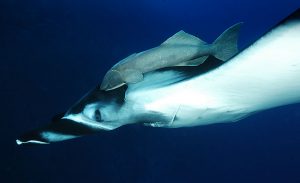
Manta Ray Eye Photo by Kaia Thomson
But there is one fish that no less an authority on charisma than businessman Richard Branson calls “one of the most charismatic creatures in the ocean”, and that is the elegant, enormous, manta ray. With the largest brain-to-body ratio of all elasmobranchs*, the manta ray is one of the most intelligent fish in the sea. Making that brain function well is a system of blood vessels that envelope the manta’s braincase, keeping the brain warmer than the surrounding tissue. A big, warm brain fosters intelligence, intelligence fosters curiosity, and curiosity causes manta rays to interact with human beings in the water. It’s an incredible thrill.
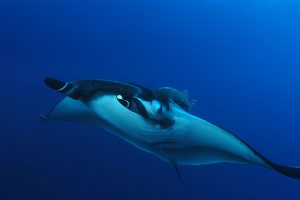
Manta rays are magnificent creatures to behold. It’s not just that they’re huge: they typically reach a width of 22 feet (7 meters) and a weight of over 3,000 pounds (1,400 kg); and it’s not just that they’re prehistoric-looking: they have cephalic fins on either side of their heads to direct food, which look like horns when furled; it’s just that they’re so darn cool: they look like stealth bombers in the sea, yet move that remarkable bulk with utter grace, using their massive triangular wings (pectoral fins) to fly through the sea, exuding the glide and flow of an eagle in flight. So when you realize that this fish that seems straight out of myth is turning in patterns with you, engaging with you, and – like any good dance partner – making direct (fish) eye contact with you, it, well, tugs at your heartstrings.
Manta Ray Coming to Visit Photo by Kaia Thomson
But some people still just see dinner. Despite the fact that fishing for oceanic manta rays was banned in Mexico in 2007, and that the possession and trade of all mantas and mobulids in Mexican waters is prohibited by law, you can walk into local markets in many Baja towns and find stacks of dried and salted rays for sale. They’re considered an excellent, affordable source of protein. On a global scale the problem is more menacing. Across the tropics they inhabit, mantas are now being killed for their gill rakers, the cleansing plates that filter their food from the ocean. Manta and mobula gill rakers are the latest snake oil cure-all in China, touted as a remedy that cleanses the body of everything from gout to cancer. The organization Manta Ray of Hope, which is acting to protect manta rays from this trade, estimates that the annual gill raker trade volume is 61,000 to 80,000 kilograms (135,000 to 176,000 pounds), with an estimated value of US$11.3 million.
But businessman Richard Branson, who is campaigning for manta ray protection, points out that “while the gills are valuable, the trade is also robbing local economies of [the mantas], which could draw millions of dollars each year for those communities.” In fact, Manta Ray of Hope estimates that manta and mobula ray tourism has an estimated annual value of over US$100 million per year, a far more compelling number than the $11 million currently enjoyed by the gill raker trade. If enough awareness is raised and policy makers (and policy enforcers) act quickly enough, there is still time to staunch what many fear could otherwise be the depletion of the global manta ray population.
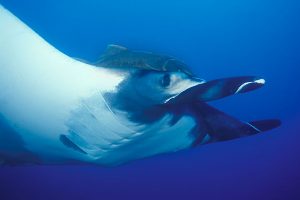
Manta Ray Photo by Kaia Thomson
And in Baja California Sur we know the pure joy of having the mantas and mobulas as neighbors. Many days from the Pacific beach it is possible to see the mobula rays skipping along the water, making that distinctive flap-flap-flapping sound as they soar through the air and hit the water repeatedly. And in the Sea of Cortez we’re starting to see a return of the giant manta rays, with a large number of sightings over the last several months. So if you’re in Baja, take the time out to go engage with these remarkable creatures in their natural habitat, and let their charm work itself on you. Once you get to know them, you’ll definitely be joining Richard Branson in giving the gill raker traders the old fisheye.
*Elasmobranchs are in the Class Elasmobranchii, which covers cartilaginous fishes such as sharks, rays and skates.
Manta Ray Fun Facts:
Manta is the Spanish word for blanket, an apt description of the manta ray shape
Like their shark cousins, the manta’s skin is covered with dermal denticals – sort of modified teeth that are covered with hard enamel. These are packed tightly together with the tips facing backwards. Not only do they help in protecting the animals from predators, they also aid in hydrodynamics. Manta skin is also covered in a type of mucus which helps protect it from parasites and infection.
Manta rays have terminal mouths strategically located at the front of their heads for filtering the large quantities of water they take in as their gill rakers filter out the plankton they feed on (mantas eat about 13% of their body weight each week). Mobula rays have sub-terminal mouths, located underneath the head. While mantas do have teeth, they’re generally nonfunctional – a common occurrence among filter feeders.
Mantas are relatively long-lived – up to 40+ years.
Mantas, like other sharks, visit oceanic “cleaning stations” where they cease all movement and open their mouths and gills wide to allow in cleaner fish like wrasses and gobies who happily consume any nutritious parasites that may be present. Mantas repay the favor by not eating the cleaner fish.
Mantas reproduce via ovoviviparity, i.e., the young hatch from eggs inside the female’s body and the pups are nourished by yolk instead of placenta.
Female mantas give birth to only one or two pups every two to five years, and will have a maximum of 16 pups over a lifetime. By comparison, a great white shark produces a maximum of 14 pups in just one litter. This combination of long life and infrequent reproduction increase the manta’s vulnerability.
Manta rays were practically wiped out of the Sea of Cortez due to targeted species fishing in the 1980s and 1990s, but have been making a comeback under federal protection since 2007. It is now possible once again to see, swim and engage with the mantas in the Sea of Cortez. It’s a remarkable life experience.
When the Supreme Court of the United States ruled in 2010 that “corporations are people”, it was a low day for homo sapiens throughout the world, many of whom felt their “personhood” assaulted, and who resented the notion that their “person” status should be shared with entities lacking a corporeal body ruled by intelligence and passion.
So when in August of this year the government of India became the first in the world to declare all cetaceans – including dolphins – non-human persons, those same homo sapiens breathed a sigh of relief that the standard for personhood had this time been raised, not lowered, and that once again personhood was a mantle to be worn proudly. But what about the dolphins? Did they consider personhood a serious downgrade in their global standing? Douglas Adams, author of the Hitchhiker’s Guide to the Galaxy, offers some insight: “It is an important and popular fact that things are not always what they seem. For instance, on the planet Earth, man had always assumed that he was more intelligent than dolphins because he had achieved so much – the wheel, New York, wars and so on – whilst all the dolphins had ever done was muck about in the waves having a good time. But conversely, the dolphins had always believed that they were far more intelligent than man – for precisely the same reason.”
Now of course when the US and Indian authorities declared corporations and dolphins people, they didn’t mean to suggest that either should embrace the institution of marriage, seek political office, or engage in other acts characteristic of homo sapiens with personhood status. What they meant is that both have implicit rights under the laws of the land and should be treated accordingly. For dolphins, this was an acknowledgement not only of their remarkable intelligence, but their human-like self-awareness. In 2001 the National Academy of Sciences published a study from Columbia and Emory Universities that proved dolphins recognize themselves when looking at their reflection. Of all the other animal species on the planet, only humans and our great ape cousins have demonstrated such mirror-awareness, and the researchers concluded that this stemmed from the dolphin’s large brain and advanced cognitive ability. In fact, just prior to the Indian government’s announcement about dolphins, researchers from the University of Chicago published research demonstrating that dolphins can remember the signature whistles – the dolphin equivalent of names – of absent friends for more than 20 years. The study’s author concluded that dolphins are “operating cognitively at a level that is very consistent with human social memory.”
Other studies have demonstrated that dolphins use tools and understand abstract concepts, and it has been long recognized that dolphins form intimate, multi-generational family bonds that last for a lifetime. In short, they’re a lot like us, and the Indian government has honored that similarity by declaring that dolphins essentially have the same rights to life, liberty and the pursuit of happiness as homo sapiens; it banned captive dolphin shows and declared it is morally unacceptable to keep dolphins in captivity. Costa Rica, Chile and Croatia have also banned dolphin displays, while countries such as England and Brazil have regulated dolphin displays so heavily that they have become too expensive to operate. In other words, these nations have fixed it such that corporate persons cannot hold captive non-human persons for the pleasure of human persons. It’s a concept any dolphin brain can grasp!
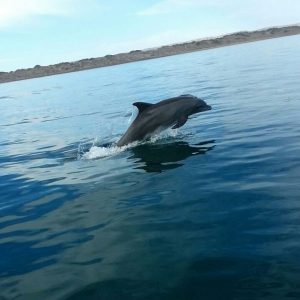
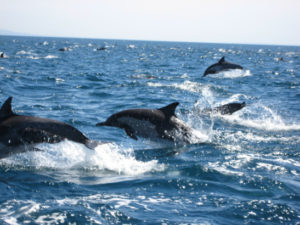
Luckily, when visiting Baja California Sur, there are innumerable opportunities for seeking out the joyful companionship of dolphins in their wild ocean homes. In the Sea of Cortez for example, it is not uncommon to see hundreds of dolphins racing together through the sea, always keen for a game of chase and some graceful dolphin gymnastics.
Scott Taylor, founder of the Australia-based Cetacean Studies Institute, wrote a magnificent book in 2003 titled Souls in the Sea: Dolphins,
Photo by Daniel Ignacio Ramirez Valenzuela
Whales and Human Destiny. Taylor argues that these mammals, who have inhabited the planet much longer than we have, “possess a deep wisdom about how to live sustainably and joyfully.” Taylor ponders why, after centuries of abuse, whales and dolphins continue to engage with humans. Is there something they are trying to tell us? Are they trying to warn us about what is coming next for the human persons of the world? Again, Douglas Adams has answers in the Hitchhiker’s Guide to the Galaxy. “The dolphins had long known of the impending destruction of planet Earth and had made many attempts to alert humankind to the danger; but most of their communications were misinterpreted as amusing attempts to punch footballs or whistle for tidbits, so they eventually gave up and left Earth by their own means. The last-ever dolphin message was misinterpreted as a surprisingly sophisticated attempt to do a double-backward somersault through a hoop while whistling “The Star-Spangled Banner” – but, in fact, the message was this: “So long… And Thanks For All The Fish!”
But perhaps it is not all over for us human persons yet. Maybe this act of compassion for fellow big-brained mammals by the Indian government will convince dolphins that mankind is worth saving after all. Groups such as SpeakDolpin (www.speakdolphin.com) are actively working on achieving full communication between humans and dolphins, and when they do, perhaps the dolphins will once again tell human persons how to escape the destruction of Earth. The corporate persons, alas, will be left to their own devices.
Fun Facts on Dolphins in the Sea of Cortez
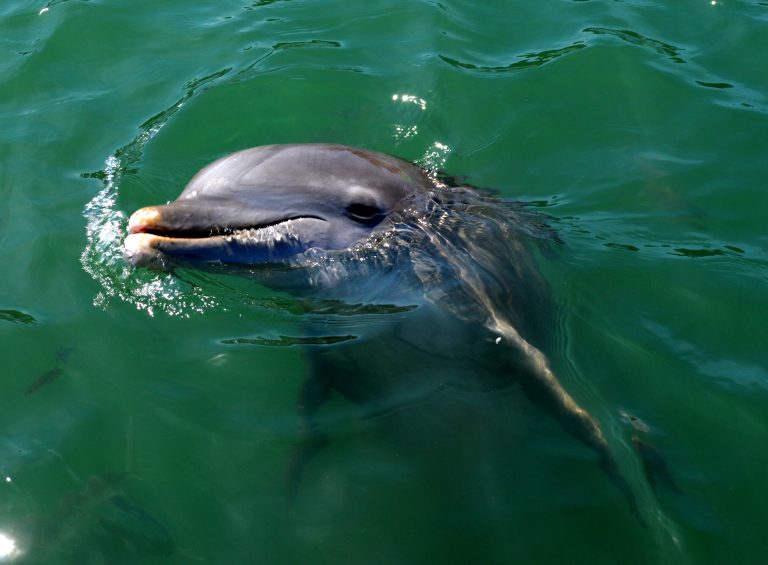
The bottlenosed dolphin loves the Sea of Cortez; it is one of the dolphin species that we see most often when kayaking, snorkeling or boating in its beautiful waters. Some fun facts about our bottlenosed dolphin neighbors:
Similarities to humans:
Breathes air
Likes a good joke
Gives birth to live young
Stays in touch with friends and family
Yacks all day long
Organizes community to achieve common goals such as food procurement
Plays with its food
Performs incredible feats to impress females
Chases off “bad” males trying to get a girlfriend alone
Forms alliances across family groups for strategic purposes
Enjoys hanging about fishing with friends all day
Nurses its young for one to three years
Has teeth
Aids and protects those who get hurt
Likes a good nuzzle
Sleeps about 8 hours per day
Enjoys group activities with hundreds of others
Helps surfers, sailors and snorkelers in distress
Differences from humans:
Gets as big as 10 – 14 feet (3 to 4.2 m) and 1,100 pounds (500kg)
Breathing is voluntary, so must keep half it’s brain alert when sleeping to keep the body breathing and also on the look-out for predators
Often swims while it’s sleeping
Females are pregnant for 12 months
Loses all its hair either shortly before or after birth
Can roll its tongue like a straw so that while nursing a calf can keep salt water out and mom’s milk in
Relatively short life-span, although some outliers make it to 45-50 years
Able to leap up to 16 feet – without a pole vault
Can swim up to 18 mph (30 kph); some say even faster!
Hunts by echolocation – sending out sound to bounce off objects and receiving back information on an object’s size, shape and location
Scientific name is Tursiops truncates, which means “a dolphin-like animal with a shortened snout”
La Paz is running out of water so it’s building an aqueduct to pump it in from El Carrizal. Los Cabos is running out of water so it’s contracting with a private desalination plant to boost supply. El Triunfo has water but residents refuse to drink it; it’s still contaminated by the arsenic released by mining operations at the turn of the last century. Baja California Sur is not only Mexico’s driest state*, but the country’s second fastest growing state by population. These two trends seem to be barreling towards a head-on collision that could take an enormous environmental, economic and public health toll on the state. Whether or not that collision takes place in the future depends largely on the actions we residents take today.
Gabriel Patrón Coppel is Coordinator of the Water Program at Niparajá, a non-profit dedicated to preserving the natural heritage of Baja California Sur (BCS), where freshwater management and use is one of three main programs. Gabriel believes that one of the key problems with respect to potable water in BCS is that residents have little knowledge of where their water comes from. “We conducted a study in 2009 and discovered that most La Paz residents didn’t know that the Sierra de la Laguna mountains are the source for the water that fills their aquifer, just as Sierra water fills the aquifers of Todos Santos and many of the Pacific communities of BCS. They therefore didn’t understand the need to protect the Sierras from outside threats such as gold mines, or internal threats such as soil erosion from overgrazing and illegal logging.” To address this situation, Niparajá launched two major campaigns to educate the citizens of La Paz about their water supply and the threats it faces: Defiende la Sierra la Laguna and “El agua no viene de la llave, viene de las Sierras, Cuidalas !” (Water doesn’t come from the tap, it comes from the Sierras, take care of them!)
Arsenic and Old Mines
The most immediate external threat to the Sierras and the BCS water supply today – open pit gold mines planned by Canadian and American mining companies – is not a new issue. El Triunfo, currently a small town of about 300 souls and a well-loved pizza parlor, had a population of almost 3,500 in
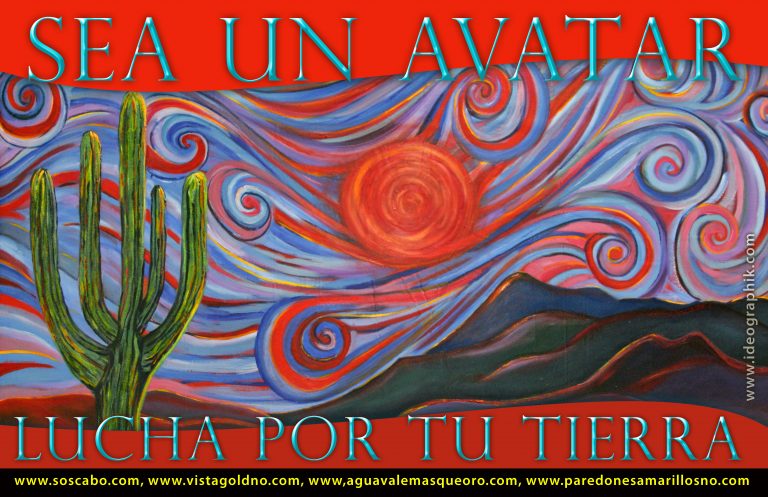
“Be An Avatar, Fight For Your Land”. Poster of the Sierras by Nanette Hayles
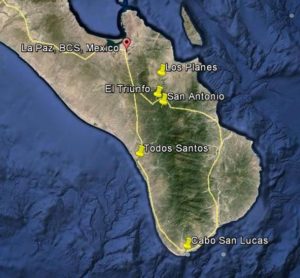
1900 when it was a town teeming with the people and money attached to a large silver mining operation. There are some interesting monuments to that period of silver and gold-exploitation on the surface of the town, including a chimney designed by Gustav Eiffel of the eponymous Paris tower, and a museum that houses a vast collection of trophy pianos owned by wealthy families of the era. The enduring legacy under the surface is not so benign. Enrique Rochin Cota, director of the Los Planes-based organization Defense of the Environment and Sustainable Rural Development, explained the situation. “The Mexican government recently took samples from 80 wells around Los Planes and San Antonio. About half of those have arsenic contamination – from the 100 to 150-year-old mining waste – that is far above the permissible level for drinking water in Mexico. The really scary thing about all this is that these wells are still part of the water system. So not only have the contaminated wells not been shut down, there is now the imminent threat of mining in this area again. We are very afraid.”
Both Gabriel and Enrique referenced a recent study by Dr. Carlos Colin of the State Secretary of Health that confirms the presence of arsenic in the urine of local residents. Tanya Dimitrova, a reporter at the University of California, Berkeley School of Journalism, had a water sample from a Los Planes resident’s tap tested in the arsenic lab at UC Berkeley. In July 2013 she wrote that the sample “showed 53 parts per billion (ppb) arsenic – more than twice the concentration of arsenic allowed under the Mexican government’s standard.” The US drinking water standard is even stricter, only 10 ppb. Sadly, but perhaps not surprisingly, residents of Los Planes and San Antonio speak of high cancer rates in their towns, particularly among children.
Google Earth Image of Lower BCS
Mining in the Sierras is strongly opposed by practically all the local politicians, business leaders and opinion-makers in BCS, including the governor and the local congress. So how is it possible for these foreign companies to hold concessions to mine gold in the Sierras? Easy. Mexico’s antiquated mining laws allow anyone to claim the right to Mexico’s mineral resources. The trick lies in getting their environmental impact assessment (the acronym is “MIA” in Spanish) approved by SEMARNAT, the environmental protection agency, and this is where citizens groups like Enrique Cochin’s Los Planes coalition and Niparajá’s Defiende la Sierra can exert their strength. Says Gabriel, “When the mines present their MIA, every citizen has the right to make comments. These mining groups have been trying for several years now to get the permits to begin blasting the Sierras to get at the gold, but the citizens have prevented it. Participation really does work.” Senator Carlos Mendoza Davis (a key player in the successful fight to win federal protection for Balandra Bay, see JDP Spring 2013) has introduced legislation that would permanently ban metallurgic mining in natural protected areas such as the Biosphere Reserve portion of the Sierra de la Laguna mountains. It’s a great start.
“When the well is dry, we learn the worth of water.” Ben Franklin
Another key problem in the potable water issue in BCS is cost, with some residents paying nothing and some paying substantial fees. The problem with the former is particularly acute in La Paz. Currently less than 25% of the residential and commercial buildings in La Paz have meters, so the occupants have little or no economic incentive to conserve water. And without meters, there is often no way for residents to know if they have a leak, the result being that untold millions of unpaid-for gallons of water have simply evaporated out of La Paz. The city now faces an acute water shortage, with residents often going several days a week with no city water.
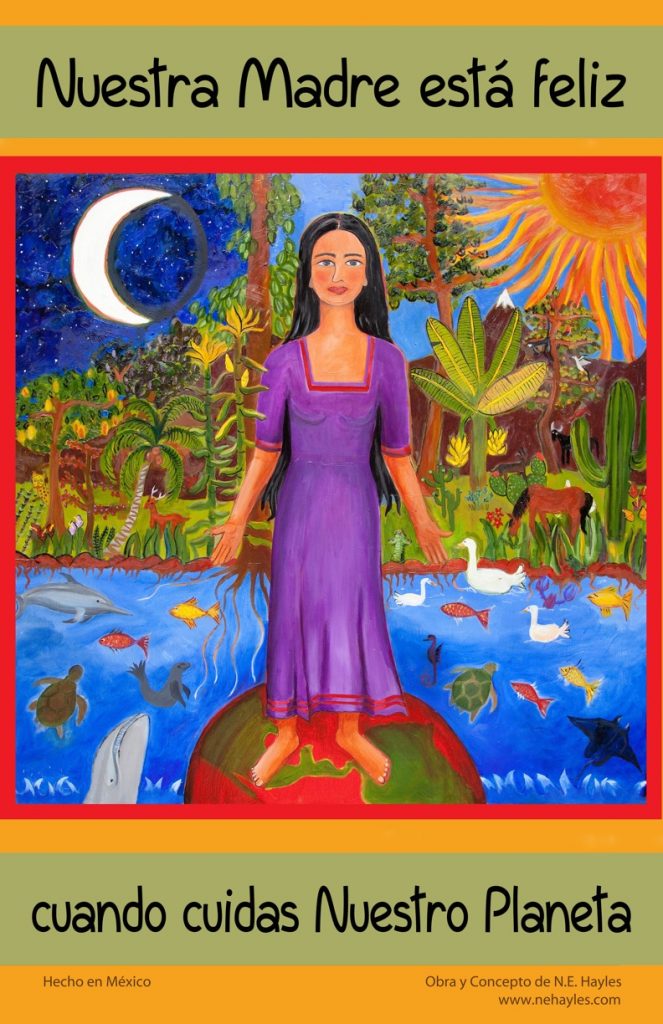
Our Mother is Happy When We Take Care of Our Planet. Poster by Nanette Hayles
To address the issue, La Paz is building a 40 kilometer-long aqueduct to bring in fresh water from El Carrizal, “but that could easily dry up and is just a temporary solution,” says Gabriel. “If exploited sustainably, i.e., the rate of extraction is less than the rate of recharge, it could serve the city indefinitely. The problem is that the new aqueduct will only provide enough water for the current population of La Paz, and the city is growing rapidly with new immigrants, new hotels, new businesses. Once we deplete the aquifer at El Carrizal, there will not be another aquifer within a feasible distance from which we can extract more water to make up for the population increase.” Moreover, only a full aquifer can prevent seawater from leaching in through the soil. Once seawater enters an aquifer, it is dead as a source of fresh water.
So what to do. The CEO of Mexico’s National Water Commission announced in mid-August that La Paz would join desert nations such as Saudi Arabia, Qatar and Libya and construct a seawater desalination plant in the city. Gabriel, like many scientists, environmentalists and economists, does not believe that desalination is the best long-term solution. He cites the enormous carbon emissions required to run a plant that further degrades the environment and the quality of remaining natural water resources. He cites the hazards to marine life created by desalination’s heavy brine discharge, as well as the increase in water costs to a non-wealthy population. Extensive papers have been written on each of these problems and more, and communities across the US and other nations struggle with them regularly. Only a minority opt to limit their growth to what their existing natural resources can handle.
Gabriel favors a two-pronged approach for La Paz: 1) fix the leaks and metering issues in the municipal pipeline of La Paz, and 2) increase the rate of replenishment for the aquifer. One of the key factors leading to low water levels in the aquifers of BCS is soil erosion in the Sierras caused by overgrazing of livestock and illegal logging. Without trees and plants to catch the rain when it falls, it simply evaporates on the surface and never makes it into the groundwater. Gabriel therefore advocates soil conservation. “Soil conservation works” he says. “We need to build filtration dams to return rainwater to the soil and get it back into the aquifer.” He notes that legislation banning the use of exotic plants that cannot survive on Baja’s meager rainfall levels should be passed as well.
Water, Water, Everywhere….
But these are long-term solutions with uncertain outcomes and some neighborhoods facing chronic shortages feel they don’t have the time to wait. The Pedregal in Cabo San Lucas is a case in point. In the early 2000s the city had only enough water to supply the Pedregal two to three days a week, so residents who wanted more water than that were buying water by the truck load. It’s been estimated that in one year, 5,000 truckloads of water were delivered to this neighborhood of 650 homes. Homeowners finally got fed up and bought a solution that would provide better long-term water security. They built a desal plant.
Now it should be noted that the Pedregal occupies some of the highest-priced real estate in Baja, and features a large number of stunning homes. Members of the homeowners association that built the desal plant are, by and large, people with means. They therefore hired a top-notch company out of Houston – Global H2O Investments – to design, build and manage the plant for them, and they are thrilled with the results. They are not the only ones. OOMSAPAS, the water company, plans to contract with the Pedregal / Global H2O plant to provide water to downtown Cabo San Lucas (OOMSAPAS currently supplies the northwestern part of the city through its own desal plant). The Pedregal plant will be the first private facility in Baja to have a contract with a municipal water company to supply potable water to city residents. This has some interesting implications for Cabo water policy.
Two years ago, the Cabo government mandated that all major new developments had to have their own desalination and wastewater treatment plants. The government had gone easy on developers in the early years, but realized it had to take action once too many developments had dried out too many estuaries and other natural water resources. As a result, desal plants blossomed in Cabo. Carlos Hernandez, Operations Manager for the Global H2O / Pedregal plant, estimates that there are currently 30 desal plants operating in Cabo. Some developments now operate completely off the city grid with their own electricity, sewage treatment and water. From the perspective of protecting the city’s resources from the impact of development, this is great. From the perspective of encouraging long-term conservation efforts by all communities in BCS, the implications are not quite so clear.
It’s Chinatown, Jake
The old joke in China is that it will never have to invade Hong Kong to bend the western-leaning city to its will, it can just shut off the city’s water supply; 70% of Hong Kong’s potable water originates in the mainland. Water security for towns, cities, states and nations is tricky business and Baja is certainly not alone in its water woes. In Chinatown, the 1974 movie about a 1937 Los Angeles in which corporations pay off officials to divert water to their projects, one of the characters has this to say about the Pacific Ocean. “Now you can swim in it and you can fish in it but you can’t drink it and you can’t irrigate an orange grove with it.”
For wealthy communities on the Pacific coast, desalination is increasingly the solution of choice to this problem. The demand for progressively scarce potable water outweighs any environmental concerns. For example, the San Diego County Water Authority agreed in February to buy water from the new desal plant in Carlsbad for $2,000 per acre-foot, which is twice the cost of available alternatives. While the hope is that costs will trend down over time, the Pacific Institute of California reports that desal plants on average use roughly 45% more electricity to produce fresh water than other options. In an area like Baja, with its fragile eco systems, large agricultural sector, and limited natural and financial resources, desalination is clearly not an option for all communities. So we must be vigilant in defending the Sierras, pro-active about replenishing the aquifers, and adamant about keeping potable water available for all who need it, not just those who can afford it.
*BCS has an average of 160 mm of rain per year, compared to 760 mm of rain per year for the country as a whole.
Posters by Nanette Hayles. Both posters can be purchased via her website at www.nehayles.com. Nuesta Madre Esta Feliz poster is also for sale at La Esquina and Cafe Todos Santos. All proceeds fund local environmental and community projects.
Parts of this article were originally published in Destino Magazine.
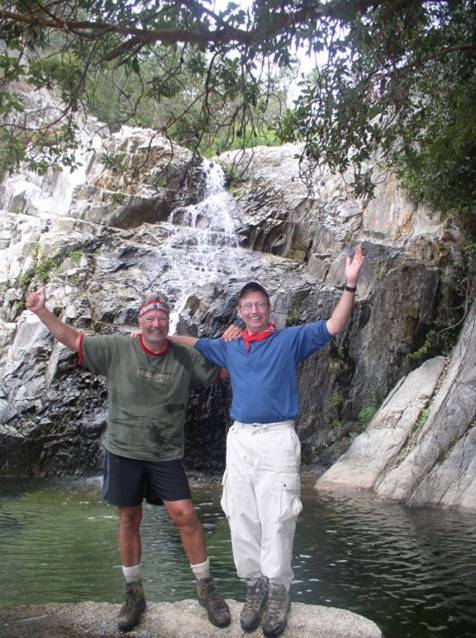
At Todos Santos Eco Adventures we run 4-day hiking trips in the mountains of Sierra de la Laguna Biosphere Reserve, a little-explored but fantastically beautiful area in Baja California Sur. We asked 6 former guests to share what they found most memorable about the trip. So here, in their own words, is each guest’s description of their Sierra trek:
Photo by Thea Thomas
“A few adventurous friends of mine in Baja had hiked to the Sierra de la Laguna and told me how amazing it was, but it was more wondrous than I imagined. At an elevation of 7,000 feet it is a world of its own, an “Island in the sky” as one friend described it. The forests of oak, pine and madrona are host to unique plants and animals. For me as a birder seeing the Yellow-eyed Junco, Oak Titmouse, Baja morph of the American Robin and Acorn Woodpecker was great fun. Our trip was lead by an incredible guide, Mauricio Durán, from Todos Santos Eco Adventures. His knowledge of the natural history of the area added greatly to our experience.”
Thea Thomas, Cordova, Alaska
Photo by John Valentine
“One of the highlights of the trip was meeting our guide Sergio. He is so knowledgeable about everything, a true renaissance guy. I learned so much about geography, birds and the natural world from him. I often think about that trip. The hike itself to the top was more difficult than I thought it would be but absolutely beautiful. What I couldn’t believe is the diversity of trees. There were parts of it that looked exactly like Colorado. The most exciting point was the freak electrical storm one night. I think we had a few snowflakes and our water bottles had ice in them. I have never seen or heard such an electrical display. I remember the beauty and serenity of the camping area and the hikes we took each day to the peak and waterfalls. The beauty and diversity of this area nestled between the Pacific and the Sea of Cortez—so different from the normal Baja tourist itinerary. People need to see the incredible beauty of Baja beyond the beaches.”
John Valentine, Kansas City, Missouri
“Your effort to get to the top will be well rewarded. Seeing both the Sea of Cortez and the Pacific at the same time was an extraordinary experience!”
Jon Dallman, Seattle, Washington
Photo by John Dallman
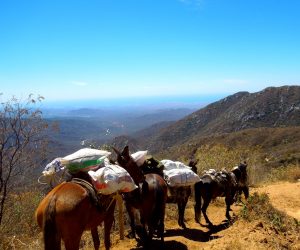
“I’m 58 years old, and consider myself in pretty good condition. I ride mountain bikes three times a week. Practice yoga in-between. But no matter how much you do, climbing to El Picacho in Southern Baja’s Sierra de la Laguna Mountain Range is a challenge, and our hike to base camp took about 6 hours. The most welcome sight at the end of our hike up was that picture-perfect camp, completely set up with pitched tents and snacks laid out on the table. I felt as if I was on a photo shoot for one of those Abercrombie and Fitch high-end tours of Africa. We spent the night enjoying delicious al dente pasta, and a choice of excellent wines by the light of a crackling fire. We camped along the shores of an ancient dry lakebed at an elevation of about 6,000 feet. Giant pine and oak trees sighed in the breeze. Vaqueros (cowboys) had carried all of our gear and food up on muleback. The mules, now hobbled, were happily munching the tawny grasses of this high mountain meadow. It was a scene straight out of the old west.”
Mike Brozda, Todos Santos, Mexico
“My greatest memory of the trip was the bells. The cowboys hobbled their horses and mules so they would not leave the meadow and each of the animals had a bell around its neck. The bells created a symphony under the starlit night, and it was spectacular.”
Patty Romanchek, New Buffalo, Michigan
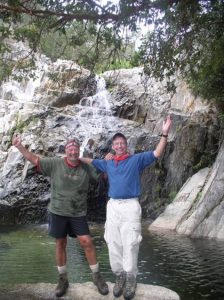
“I went swimming on my birthday in a frigid mountain lake. Everyone was going to join me…but after I took the plunge, they all were still on the rocks
Photo by Craig Ligibel
laughing. That was the coldest birthday swim I have ever had. One of our group was a urologist. He assured me that a certain appendage that had almost disappeared would be sure to return the next day. I’m glad he was right!”
Craig Ligibel, Annapolis, Maryland
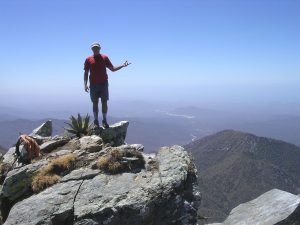
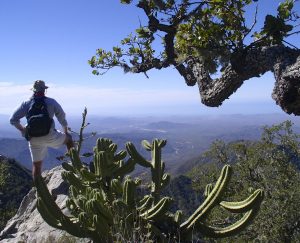
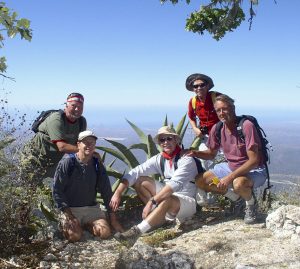
“Sergio led us on a 3 hour climb up the face of El Picacho itself, the literal and metaphorical high point of the trip. The trail winds through shady pine forests before emerging into oak-covered scree. We threaded along a razor’s edge portion of the trail, with a sweeping view of the Pacific Ocean on our left, and the Sea of Cortez on the right. We descended about 100 feet–down the distinctive notch you see in El Picacho–before scrambling up
Photo by John Valentine
huge granite boulders to the top. We spent about 90 minutes at the top of the world in Southern Baja, drinking in the view, munching on snacks, and snapping photos. That evening, back at camp, we had a meal of delicious fajitas, rice and beans, fresh hot tortillas with guacamole, fresh vegetables, and toasted our success.”
Mike Brozda, Todos Santos, Mexico
For more information about trekking in the Sierra de la Laguna Biosphere Reserve please visit our web site at www.tosea.net and/or email us at
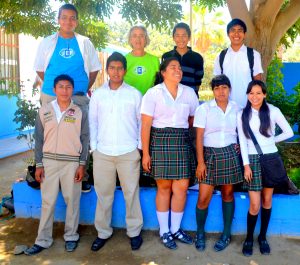
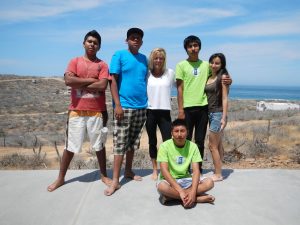
Eco Educator Paty Baum with current Joven Ecologístas de Pescadero (Youth Ecologists) group
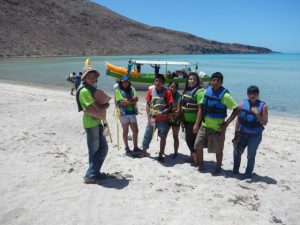
Sometimes the most non-conventional people get that way through the most conventional of means: they learn it from their parents. So it’s not so surprising to discover that eco educator, punk rocker, beach dweller, film maker, turtle protector, surf breaker Paty Baum’s parents were hard-core union supporters who regularly took the kids to marches and protests, or that her father was a professor of revolutionary literature. The surprise is to discover that kids of local migrant workers here in Todos Santos and Pescadero are doing yoga, reading the ocean for rip tides and currents, documenting the impact of change on the biodiversity of their town, and going on kayaking and camping adventures. And that’s just a tiny piece of what Paty has achieved since she moved to Todos Santos in 1995 and started her non-profit Eco-Educadores Verde y Azul de BCS.
Bringing creativity and education into the lives of under-served youth has been a calling for Paty since her first days as a freshman at Lewis & Clark College. One of her first moves on campus was to join ACTION, a type of urban peace corps program, where she taught photography to inner city grade school kids. She then went on to work for the Multnomah County Urban 4H program for two years where she developed and implemented semester-long workshops for inner-city grade school kids in photography, leathercraft, ceramics, nutrition and fishing. That was just her day job.
The Neo Boys with Paty on Drums. Click photo for YouTube video of The Neo Boys playing at The Long Good-Bye in Portland.
Being a classically trained clarinetist, Paty naturally became the drummer for the all-girl Portland punk rock band, the Neo Boys. They played the local club scene for several years and developed a cult following so loyal that K Records will soon be releasing a double album of live and studio recordings by the Neo Boys entitled Sooner or Later. The Neo Boys may have broken up in the early ‘80s but all these decades later the fans are still clamoring for more! And when she wasn’t on stage or with the 4H kids Paty kept the education/punk rock themes all rolling together on her weekly radio show The Autonomy Hour on Portland’s community radio station KBOO, teaching the masses about the great punk music of the time. Then she met Gus Van Sant.
The Neo Boys. (Paty at far left with her arms crossed.)
Van Sant was working on his second film, Mala Noche, and asked Paty to do location sound for the film. She found the film-making process so incredibly fun that as soon as she wrapped with Van Sant in 1986 she wrote a script, shot it, and submitted it as her application to the film program at San Francisco State University. They loved it. She’d gotten too busy with life to continue at Lewis & Clark College, but film school completely absorbed her and she graduated with a BA in Film Production in 1990. And she didn’t waste any time making a name for herself after that.
Her first film in 1990 was 122 Webster, a 12 minute, black and white, 16 mm documentary that she co-directed, co-wrote and co-produced with Daniel Robin. A portrait of Daniel’s heroin-addicted roommate Bobbie, the film was incredibly well-received. It was screened at the 1990 Sundance Film Festival, was part of the 1995 Lalapalooza Music Festival national tour, and was shown in venues as diverse as the Cork International Film Festival in Ireland, The Ann Arbor Film Festival, the Humboldt International Film Festival and the Big Muddy Film Festival in Illinois. But even before 122 Webster was making its rounds Paty was already completing her second film, The Cleansing Machine. It won Best Documentary at the 1992 Humboldt Film Festival and played all over the world. The Fins were particularly crazy about it and tried to get Paty to visit with the film but she just couldn’t make it.
Now it’s a known fact that many surfers try to pretend like they derive the same satisfaction from their non-surfing pursuits as surfing, and will make valiant efforts to resist the urge to live at the beach and surf every day. Just one look around Todos Santos will tell you that for the true-surfer-at-heart, resistance is futile. Paty surfed all through her Oregon and northern California years, then came to Todos Santos on vacation on the advice of a friend. After that it took her 8 months to wrap up her life in the US and move into a trailer on the beach at Los Cerritos. She didn’t leave for 12 years.
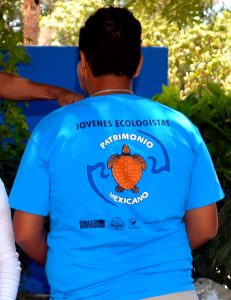
JEP T-Shirt
Paty moved to Todos Santos in 1995 and for the first few years she was happy to just run the Todos Santos Surf Shop at Cerritos and talk surf all day. She created a nice place for people to camp with a composting toilet and it was all pretty blissful. But local folks were leaving a lot of garbage on the beach, and that was definitely killing the paradise buzz. So her first effort with local kids was born out of enlightened self-interest. She wanted people to stop littering so she launched a campaign to make them conscious of their incredible natural heritage and help them understand the value of clean beaches, conservation and recycling. Somewhat to her surprise, the local kids really embraced the campaign and Paty was inspired once again to put her considerable energy into local youth. In 2003 she created the non-profit Eco-Educadores Verde y Azul de B.C.S., under which was formed the Joven Ecologístas de Pescadero (JEP) group.
Funded by grants from various sources, over 300 kids have matriculated through the program to date, and have worked in a remarkable variety of field settings including sea turtle conservation projects, beach and arroyo clean-ups, identifying and growing native plants, studying the impact of deforestation, and mapping the Sierra de La Laguna watershed. (For a detailed analysis of Paty’s experiential learning efforts in Pescadero, please see the article on the program written by Andrew Jon Schneller of the University of Arizona: Environmental service learning: outcomes of innovative pedagogy in Baja California Sur, Mexico )
The JEP group is currently participating in the production of a field guide to endangered sea turtles of the region that highlights the
JEP Kids on Field Trip with Paty
work and successes of twelve years of community-based turtle conservation in BCS (Paty is the co-founder of three community-based sea turtle conservation groups in BCS). The kids are involved in all aspects of the book, from data collection to art. Says Paty’s student 14-year old Maria Guadalupe (Lupita) Martínez, “I have had some great experiences on our trips with the JEP, and have gone places that I never would have gone. It was particularly great seeing turtles nesting on the beach at night, then counting and releasing hatchlings in the nursery.” 15-year-old Adalberto Guadalupe Ramírez Gastelúm is also excited about his contributions. “We drew lots of turtles and I discovered that I am an artist. I did not know that my drawings were so good, that I have talent!” The guide created by Paty and her students, as well as the accompanying environmental education curriculum, will be distributed to the Mexican public school system and NGOs, such as Grupo Tortuguero’s network of grassroots turtle conservation groups throughout Mexico.
JEP Kids on Isla Espiritu Santo Kayaking and Camping Trip May 2013
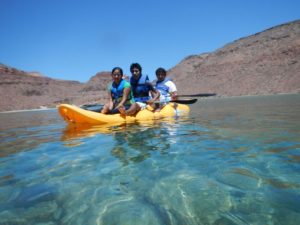
When Paty was doing her work with the 4H inner city kids in Portland the highlight of the year was a trip to summer camp where the kids got to stay in cabins and do things like archery, softball, hiking – the fun things of summer. Similarly, this summer Paty was able to take her JEP students on a weekend of kayaking and snorkeling at Isla Espiritu Santo, a trip that was paid for almost entirely through a fundraiser organized by Paty and Amigos de El Pescadero, AC. Says Paty, “Our benefit was a great success, not just for the $1500 we raised through Amigos de El Pescadero and numerous individual donations, but for the students’ self esteem, and the communities’ support from all sectors, including the sub-delegada of Pescadero and the Red Cross.” Needless to say, the kids had a blast at the Island.
Part of the summer program this year includes yoga with Kim Wexman of Baja Zen every Saturday morning,
JEP Kids Doing Yoga with Kim Wexman at Baja Zen
followed by a trip to the beach. Kim, who donates her time says “One thing that stands out to me when I teach the Mexican kids here yoga vs teaching teenagers in the US is that while the US teens may be more flexible physically, they are not as able to meditate. The beautiful students that Paty brings are great meditators. They get very deep into it and this section of the class truly seems to resonate with them. I really, really enjoy doing this class with them. They come with great energy. Of course what Paty is doing with these students is incredible. They all seem truly inspired and eager to learn. Paty is an amazing person.”
Kim Wexmen with Some of the JEP Saturday Yoga Kids
And Paty’s students definitely are inspired. Says 15-year old Carlos Alberto Ramírez Bujín, the son of migrant workers living in Pescadero, “I want to continue studying and go to university. I want to be a lawyer, so I can help people whose human rights have been violated.” And the great thing about inspiration is that it is a renewable resource that people can continually provide to each other. Paty was so inspired by her students, their eagerness to learn, and their excitement in embracing environmental stewardship for their communities that she went back to school and is now completing her thesis for a Masters in Environmental Education at the University of Guadalajara. Says Paty, “It has been an absolute thrill and privilege to work with these students for all these years. To see them documenting their activities and expressing their field learning experiences through not only traditional science-oriented field diaries and data collection tools, but through so many creative outlets like journal writing, poetry, art, photography and video has been phenomenal. Their ability to document and share what are often life-changing experiences is having a real impact on their schools and communities, and has the potential to influence regional and international conservation efforts.”
One punk-rocking film-maker with a passion for surfing, clean beaches and eco-education and a generation of local kids is inspired, energized and ready to be activists for their communities. Paty’s parents are most definitely proud.
If you would like to join Todos Santos Eco Adventures, Amigos de El Pescadero AC and others as a sponsor of Paty’s field trips or other efforts, please email Paty at .
Bryce Courtenay’s best-selling novel The Power of One is a riveting coming-of-age tale about a boy in South Africa who transforms his life through boxing. Speaking about the book years later, Mr. Courtenay said that people generally misconstrued the meaning of the book’s title, thinking it referred to an individual discovering substantial inner strength, when in fact “…the title comes from and is about the power of one teacher. It is about how one teacher can lift a child out of an…environment and allow him or her… to change their life.”
“I am so grateful to all the volunteers and sponsors who have donated their time and money to make the Todos Santos Box program possible. It wouldn’t be possible without their help.”–Ramiro Reducindo Radilla
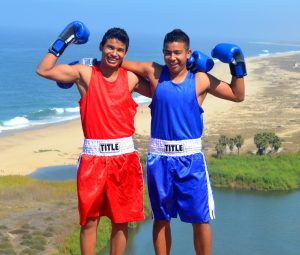
And we can see that power on full display on any given night in the auditorio of Todos Santos when Mexican boxing champ Ramiro Reducindo Radilla comes to town to train the local kids. Ramiro won the gold medal at the Pan American games in Santo Domingo in 2003, represented Mexico at the Olympics in Athens in 2004 and turned pro in 2005. When he started coaching the kids in Todos Santos not one of them had ever been in a boxing ring before. Yet now, not even 18 months later, two of his students have progressed all the way to the national championships. The power of one indeed. Says 17-year old contender Carlos Orozco, “I’d never been an athlete – let alone a boxer – before November 2011 when a friend brought me to a practice session with Ramiro. It never occurred to me then that I would make it this far, and certainly not this fast. It’s been amazing.” Fellow contender 17-year-old Cuahtemoc Aviles agrees. “I’d never boxed before I met Ramiro last year. I had very little discipline, ate a lot of junk food, I just wasn’t in good shape. Now we’ve been winning matches with kids who have several more years of experience than us. Ramiro has really changed everything for us.”
Says Ramiro, “These kids didn’t have much in the way of skill or discipline when I first started working with them, but I believed in them from the very beginning because they always had heart. When we first started we had hardly any equipment but the kids showed up anyway. Many times my car would break down on the drive from La Paz and the kids would wait for me for two to three hours, then still do a full training session starting at nine or ten o’clock at night. I’ve never doubted that these kids are champions and I fully expect to see at least one become successful on the global boxing stage.” Ramiro is so committed to helping the Todos Santos boxing students realize their potential that he coaches them at least twice a week for nothing more than a little gas money.
And with wages like that the support of the local community is critical. When Ramiro’s car engine gave up the ghost just a few weeks before the national championships, neighbors pitched right in to help get it replaced. “Engine Angels” included Michael & Pat Cope at Galeria de Todos Santos, John Stoltzfus & Todd Schaefer at the Todos Santos Inn, Ezio & Paula Colombo at Café Santa Fe, Mario Becerril at Mario Surf School, Sergio Rivera at La Casita Tapas & Wine Bar, Richard Rutowski at AmeriMex, Norm Weill – Volunteer at Large, and our own Baja Surf Camp for Women graduate, Diane Arstein!
“It’s exciting to watch the kids’ progress and see the pride of accomplishment on their faces. They’re learning so much more than boxing. It means a lot to us to be able to offer our time and support.” Cheriy Myers & Steve Stockton
And the community hasn’t been there just as a stop-gap in times of emergency. As Ramiro is eager to point out, it’s been contributing time, money and equipment all along. Moises Barraza Morales, the General Manager of Bodega Lizarraga, got the ball rolling by donating the initial equipment and practice area. When executives from Caracol and Quaker State read the first JDP article about Todos Santos Box they immediately made much-needed cash donations. When Betsy Wall, the mother of Todos Santos resident Janine Wall learned that the kids had only one red and one blue outfit to share among the whole team at competitions, she stuffed her suitcase full of blue and red t-shirts and shorts and brought them to town with her. When Todos Santos residents Cheri Myers and Steve Stockton learned that there were just a couple of sets of gloves and head gear to share among the more than 40 kids who show up to most practices, they donated the resources to get enough protective gear for all the kids. When Adolfo Blanco of the Hotel California saw all the amazing work that coaching volunteers like Mauricio Duran, Arturo Millan and Hector Alberto Agundez Martinez “El Pampa” were doing, he was inspired to donate sharp-looking warm-up suits for the coaches and students to wear to competitions. Todos Santos visitor Doug Newcomb was inspired by the inclusive nature of the program. “I wanted to support Todos Santos Box since they allowed my son Phineas to train with them while we were in town. Even though they knew he wouldn’t be there for more than a month or so, they treated him like part of the club and made him feel included. And the best part was he came home so stoked! If Ramiro can make it all the way from La Paz several times a week, the least I can do is help out by bringing equipment from the US.”
Contenders Cuauhtémoc Avilés y Carlos Orozco
“First with your head and then with your heart” is the life-changing advice dispensed by the boxing champ to an eager young student in The Power of One. The Todos Santos boxing students started out with only heart, but under Ramiro’s coaching they’ve acquired the skills and discipline to lead with their heads. As for the Todos Santos community, they’ve made the well-reasoned decision to support this program with plenty of heart.
If you would like to join Todos Santos Eco Adventures as a sponsor or volunteer with Todos Santos Box please contact Mauricio Duran for specifics: Cell: 612-13-44478 or email: .



 the waves having a good time. But conversely, the dolphins had always believed that they were far more intelligent than man – for precisely the same reason.”
 Other studies have demonstrated that dolphins use tools and understand abstract concepts, and it has been long recognized that dolphins form intimate, multi-generational family bonds that last for a lifetime. In short, they’re a lot like us, and the Indian government has honored that similarity by declaring that dolphins essentially have the same rights to life, liberty and the pursuit of happiness as homo sapiens; it banned captive dolphin shows and declared it is morally unacceptable to keep dolphins in captivity. Costa Rica, Chile and Croatia have also banned dolphin displays, while countries such as England and Brazil have regulated dolphin displays so heavily that they have become too expensive to operate. In other words, these nations have fixed it such that corporate persons cannot hold captive non-human persons for the pleasure of human persons. It’s a concept any dolphin brain can grasp!