by Bryan Jáuregui | Wildlife
by Todos Santos Eco Adventures
What do scorpions have in common with humans? Unlike most of their fellow arachnids and invertebrates but very much like humans, scorpions are viviparous, i.e., they give birth to live young one by one. The scorpion babies look like miniature adults, except that they are very light in color (adults are dark) and cannot sting. This lack of stinging ability may help promote family harmony as almost immediately after birth baby scorpions climb onto their mother’s back, a perch they enjoy for several days until their first molt (longer for some species). The mother scorpion does not feed her babies, but she does carry and protect them until they are able to hunt for themselves. Unless, of course, she gets too hungry in which case she no longer recognizes the small arachnids are her babies and eats them! Some time after the first molt young scorpions leave the (relative) safety of their mother’s back to establish their own territories.
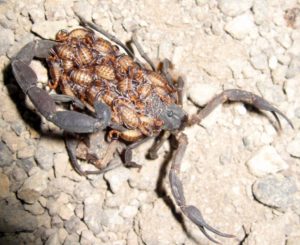
Mama Scorpion with Babies on Her Back
The body of a scorpion is divided into two parts: the cephalothorax (also called the prosoma) and the abdomen (opisthosoma). The cephalothorax is the scorpion’s “head”, comprising the carapace, eyes, chelicerae (mouth parts), pedipalps (claws) and four pairs of walking legs. The scorpion’s exoskeleton is thick and durable, providing good protection from predators. Scorpions have two eyes on the top of the head, and usually two to five pairs of eyes along the front corners of the head. In the summers in Baja scorpions can be seen raising their bodies off the ground to cool their undersides.
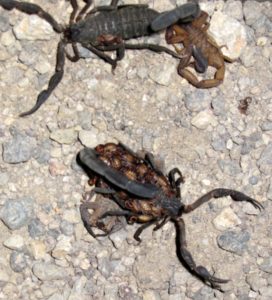
Scorpion Family Photo
Scorpions play an important role in the ecosystem of Baja by helping to keep the insect population under control. They also like to eat spiders, small mice and lizards. But they don’t eat every day; in fact scorpions have been known to go without food for up to 12 months if they have sufficient water. Typically though scorpions will have a meal at least once every 2 to 3 weeks. They are quite resourceful in going after these meals. Some stalk their prey and some will even dig a trap in the sand for their prey to fall into.
Others take a more relaxed approach and just wait by their burrow with their pincers open and stingers raised until unsuspecting prey wanders by. Once prey is within reach the scorpion grabs it and crushes it with their pincers. Scorpions try not to use their venomous sting unless absolutely necessary as it takes a great deal of body energy to produce more venom. Younger and smaller scorpions tend to use their stingers more often than larger and older ones. Scorpions have very small mouths and can only take in liquid, so captured prey is crushed and injected with enzymes that dissolve the insides. Scorpions are remarkable survivors. If necessary, they can slow their metabolism to as little as one-third the typical rate for arthropods. In this way the scorpion greatly reduces its intake of oxygen and can live on as little as a single insect per year. But unlike most hibernating species, even with lowered metabolism the scorpion has the ability to spring quickly to the hunt when the opportunity presents itself.
© Copyright Sergio and Bryan Jauregui, Casa Payaso S de RL de CV, 2012
by Bryan Jáuregui | Travel Industry
Baja California Sur in Top 5 Places in Mexico – April 20, 2011
We have long been telling potential visitors that Todos Santos is the same sleepy town it has always been and that there is no drug violence or cartel activity anywhere near here. This April 20, 2011 piece in in the San Francisco Chronicle confirms that fact and will hopefully put the traveling public’s mind to rest about coming to our wonderful town. Baja California Sur in Top 5 Places in Mexico – April 20, 2011
People read the word “Baja” and panic, but the fact is that the problem areas of Baja are a full 950 miles from Todos Santos – a different world. Most people would not hesitate to board a plane for Los Angeles, San Francisco or Washington, D.C. Yet the fact of the matter is that being in those cities puts you within just a very few miles (if not directly in the center) of the terrible drug violence / drug lords that plague those areas – South Central, Oakland, downtown DC. In Todos Santos we are significantly further from any problem areas (like the distance between Boston and Chicago further!) than residents or visitors of those cities.
So come on down and enjoy the beaches, mountains, surf breaks, art galleries, restaurants and ambiance of Todos Santos – it’s a very safe and truly wonderful holiday.
by Bryan Jáuregui | Culture, Food
In addition to the segment on Doña Ramona, Chef Rick Bayless filmed several other key parts of our Todos Santos Cooking Adventures Week for his TV show Mexico-One Plate at a Time, and this video blog captures several of those elements including:
- Chef Dany and a meal at Santo Vino
- Kayle’s organic farm, Basilfields
- Juan’s Tortilleria California Star
- And of course commentary from TOSEA’s owner Sergio Jauregui!
Photos of some of our guests participating in our Todos Santos Cooking Adventures Week with Chef Dany are posted below the video.
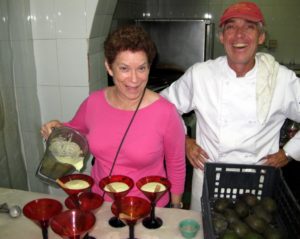
Chef Dany, Christie and Avocado Milkshakes!
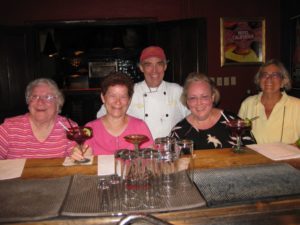
Chef Dany, Margaritas and Cooking Class
by Bryan Jáuregui | Culture, Food
“Award-winning chef-restaurateur, cookbook author, and television personality Rick Bayless has done more than any other culinary star to introduce Americans to authentic Mexican cuisine and to change the image of Mexican food in America.”
And so starts the introduction to Rick Bayless on his website, and we are so pleased to announce that his search for authentic Mexican cuisine has brought Rick Bayless to Todos Santos Eco Adventures. Rick and his film crew were recently in Todos Santos for several days, filming key parts of our Todos Santos Cooking Adventures Week that we offer in conjunction with Chef Dany of the Hotel California / Santo Vino. Attached here is a video blog that features one of the great parts of our Cooking Adventures Week, a cooking class with potter Doña Ramona in the Sierra de la Laguna Mountains. Once you get past the first bit on the Baja Brewing Company (great beer by they way!) you’ll get to the piece that features Rick and TOSEA owner Sergio Jáuregui in Doña Ramona’s kitchen, discussing her cooking techniques and enjoying the great meal she serves up for them. Below the video link are photos of two of our Cooking Adventures Week guests, Dale and Christie, cooking in Doña Ramona’s kitchen earlier this year.
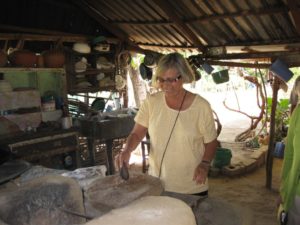
Dale Making Machaca with Doña Ramona
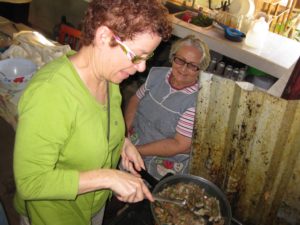
Christie Cooking with Doña Ramona
by Bryan Jáuregui | Wildlife
by Todos Santos Eco Adventures
Scott Taylor, founder of the Australia-based Cetacean Studies Institute, wrote a magnificent book in 2003 titled Souls in the Sea: Dolphins, Whales and Human Destiny. Anyone who has interacted with the (free and wild) whales at Magdalena Bay, or swum with the (free and wild) dolphins in the Sea of Cortez, is aware on some level of the enormous intelligence of these beings, mammals who have inhabited the planet much longer than we have and, as Taylor argues, “possess a deep wisdom about how to live sustainably and joyfully.” In his book Taylor ponders why, after centuries of abuse, whales and dolphins continue to engage with humans. Is there something they are trying to tell us? Are they trying to change our perceptions of them? Taylor provides quotes from different writers who ponder the intelligence and messages of cetaceans:
It is an important and popular fact that things are not always what they seem. For instance, on the planet Earth, man had always assumed that he was more intelligent than dolphins because he had achieved so much – the wheel, New York, wars and so on – whilst all the dolphins had ever done was muck about in the waves having a good time. But conversely, the dolphins had always believed that they were far more intelligent than man – for precisely the same reason. — Douglas Adams, The Hitchhiker’s Guide to the Galaxy
Cetaceans unquestionably have big brains, and the frequency with which they use them in patterns that can only be described as play suggests that they frolic with their minds as readily as they do with their bodies. This tendency towards mental playfulness may in itself have been partly responsible for the enlargement of their brains.
— Lyall Watson and Tom Ritchie, Whales of the World
The brain of a dolphin prepared for microscopic examination reveals these things at the cellular le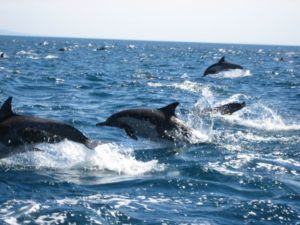 vel:
vel:
- The dolphin’s cell count is just as high per cubic millimeter as is that of a human.
- The connectivity, or number of cells connected to one another, is the same as that of a human brain.
- There is the same number of layers in the cortex of a dolphin as there is in a human brain.
In other words, this brain is as advanced as the human brain on a microscopic structural basis.
— Dr. John Lilly, Man and Dolphin
The cetacea hold an important lesson for us. The lesson is not about whales and dolphins, but about ourselves. There is at least moderately convincing evidence that there is another class of intelligent being on Earth beside ourselves. They have acted benignly and in many cases affectionately toward us. We have systematically slaughtered them.
— Carl Sagan, The Cosmic Connection
The dolphins had long known of the impending destruction of planet Earth and had made many attempts to alert humankind to the danger; but most of their communications were misinterpreted as amusing attempts to punch footballs or whistle for tidbits, so they eventually gave up and left Earth by their own means. The last-ever dolphin message was misinterpreted as a surprisingly sophisticated attempt to do a double-backward somersault through a hoop while whistling “The Star-Spangled Banner” – but, in fact, the message was this: “So long… And Thanks For All The Fish!”
— Douglas Adams, The Hitchhiker’s Guide to the Galaxy