by Sonya Bradley | Blog
By Bryan Jauregui
You are floating in 80 feet of clear blue water off Baja California Sur, and the ocean is talking. You feel it before you hear it — a low, resonant pulse that enters your chest like a bass note from some cosmic instrument. Then it becomes sound: deep, rhythmic clicks, rising and falling in a pattern that is startlingly, unmistakably conversational. Somewhere in the blue dark below, a sperm whale is speaking.
The Sea of Cortez — what Jacques Cousteau called “the world’s aquarium” — is one of the most biodiverse marine environments on the planet. It is also one of the most talkative. At any given moment, the cetaceans that call these waters home or highway are communicating, strategizing, teaching their children, and calling out the names of their friends. They are, in short, doing things we have long considered exclusively human. Language. Culture. Family.
The science is in, and the news is humbling: we are not the only creatures on Earth who talk.
The Sperm Whale: A Language in the Dark
Of all the conversationalists in the Sea of Cortez, none has seized the scientific imagination more fiercely than the sperm whale — a 60-foot deep diver with the largest brain of any animal that has ever lived. And it turns out, that brain has a lot to say.
Sperm whales communicate using patterns of clicks called “codas” — short, rhythmic bursts that, to the human ear, sound like Morse code tapped on a pipe. In his 2020 book Becoming Wild, naturalist Carl Safina spent time with researcher Shane Gero’s Dominica Sperm Whale Project, watching specific families of sperm whales whose individual members Gero has known for years. What Safina witnessed was extraordinary: multigenerational matriarchies — grandmothers, mothers, daughters, calves — using their shared coda repertoire to stay in contact during deep dives, announce their return to the surface, and participate in boisterous group socializing sessions he describes as family reunions in which whales clustered together, rolling and rubbing, clicking furiously back and forth.
In 2024, MIT’s CSAIL lab and Project CETI published research in Nature Communications analyzing nearly 9,000 codas collected from Eastern Caribbean sperm whale families over a decade, identifying a “sperm whale phonetic alphabet” of stunning complexity — including rhythm, tempo, rubato, and ornamentation, where whales make sub-second adjustments mid-conversation to match one another. UC Berkeley linguist Gašper Beguš found that when codas are sped up to match the tempo of human speech, they contain vowel-like sounds and diphthongs. The clicking is not merely communication. It is kinship, transmitted acoustically.
“Despite their dramatically divergent evolutionary lineage, sperm whales have aspects within their communication system typically reserved for humans,” said Dr. Shane Gero, founder of the Dominica Sperm Whale Project.
The Gray Whale: Lullabies in the Lagoon
Every winter some lucky humans make the pilgrimage to Baja’s protected lagoons to meet the gray whales that have been coming to these warm shallows for millennia to mate, give birth and nurse their calves. What most visitors don’t realize is that they’re eavesdropping on a constant conversation.
Dr. Aaron Thode of Scripps Institution of Oceanography has been recording the underwater soundscape of Baja’s lagoons since 2005, documenting a rich vocabulary of at least six distinct call types: low-frequency “conga” knocks, moaning growls, bubble blasts, and a mysterious croaking “S4” call that reminds everyone who hears it of a very large frog. Most poignant is what researchers call a potential “motherese” — a special vocal register mothers may use only with their newborns. A UNAM graduate student, Anaid López Urbán, was the first to formally describe this gentle low-frequency call, the “Ronroneo,” recorded from groups of whales in the lagoon. The idea that gray whale mothers whisper to their calves in a voice reserved just for them, just as human mothers soften their voice for infants, feels less like a surprise and more like recognition. For those of us who have been lucky enough to have a gray whale mother push her calf toward our panga so the little one can be scratched — an experience that will rearrange your understanding of wildness for the rest of your life — the idea that she is also murmuring to it in whale is deeply satisfying.
The Humpback: The Ocean’s Pop Stars
If sperm whales are cryptic scholars and gray whales devoted mothers, humpbacks are the rock stars. From January through March, male humpbacks fill the Sea of Cortez with songs of such length and complexity that marine biologist Philip Clapham called them “probably the most complex in the animal kingdom.” Roger Payne’s discovery of humpback song in 1971 changed conservation history — his recordings, released as a bestselling album, helped launch the Save the Whales movement.
The research has only deepened since. A 2025 paper in Science showed that humpback songs follow the same statistical efficiency laws as human language — a pattern called Zipf’s law that makes complex systems easier to learn, suggesting it emerges in any communication system transmitted culturally rather than genetically. And transmitted it is: researchers have documented “song revolutions” sweeping the South Pacific, entirely new songs spreading eastward from Australia to New Caledonia to French Polynesia — cultural waves of music carried whale to whale across thousands of miles. The humpbacks wintering in the Sea of Cortez are part of this same vast acoustic culture. Meanwhile, mothers and calves exchange a softer repertoire of 30 or more social call types — low grunts and high whistles passed between them in their warm nursery waters. The singing male performs for rivals and mates. The whispering mother keeps her family alive.
Blue Whales, Fin Whales, and the Voices That Cross Oceans
The blue whale — the largest animal to ever exist — communicates at up to 189 decibels in frequencies so low we feel rather than hear them. The Sea of Cortez is among the most important blue whale feeding grounds in the North Pacific, with hundreds of individuals gathering to feast on the extraordinary upwellings of krill. And while they feed, they talk. Stanford researchers have identified a specific acoustic signal that marks the moment when individual blues shift from feeding to migration mode, a change in song that may broadcast “time to move” across hundreds of miles of open water. Since the 1960s, blue whale songs worldwide have been deepening in pitch — a global mystery that nobody has yet explained, a conversation we cannot fully hear, let alone understand.
The fin whale, the second-largest animal on Earth, speaks in 20 Hz pulses so powerful that U.S. Navy hydrophones monitoring for Soviet submarines during the Cold War picked them up and worried when they couldn’t identify them. They were picking up whales. Fin whale calls travel hundreds of kilometers underwater; researchers tracked one vocalizing fin whale crossing 14 kilometers of an active LNG shipping lane while emitting steady calls the whole way — a vocal trail stitched through the deep, connecting one end of a shipping channel to the other.
The Orca: The Family That Never Parts
No cetacean demonstrates the bond between language and family more dramatically than the orca. Resident orcas live in stable matrilines from which neither males nor females ever emigrate. A son stays with his mother for his entire life. The family is not just a social unit — it is permanent and absolute. And the family speaks in its own language.
Each pod maintains a dialect of 7 to 17 distinct call types, unique to that pod and passed down through the matriline the way a surname passes through generations. Calves begin vocalizing within days of birth and learn their family’s calls from their mothers — and research has shown that family-specific calls actually increase following the birth of a calf, as if the whole pod leans in to make sure the newest member learns who they are. In the Sea of Cortez, orca pods coordinate cooperative hunts through real-time acoustic signals, directing family members to surround prey and share the kill. They hunt together, eat together, and apparently talk the whole thing through.
The Dolphin: Everyone Has a Name
And then there are the dolphins — acrobatic, sociable, endlessly present — bow-riding the pangas and assembling in superpods of hundreds that silver the surface with their backs. They are engaging in something that startles even seasoned researchers: they call each other by name.
Bottlenose dolphins develop a unique “signature whistle” within the first few months of life — a high-pitched call they invent themselves and use for the rest of their lives to announce who they are. No two are alike. More remarkable still, dolphins copy each other’s whistles to address one another directly — the equivalent of saying someone’s name. “Raul” — “Yeah, I’m here.” Research has shown dolphins can recognize signature whistles of individuals not encountered in more than 20 years, a feat of social memory that rivals our own. Scientists have also identified non-signature whistles that appear to carry specific meanings: one seems to function as an alarm, another as a query. In a delightful field experiment, researchers played the whistles of two bonded males back to them while they swam together — and heard what the scientists on the boat laughingly called the “WTF whistle” in return. The dolphins were confused. They were together. Why was someone calling their names?
What the Whales Have Always Known
The old question of what separates humans from other animals has always had a short answer: language. We talk, they don’t. The cetaceans of the Sea of Cortez are quietly dismantling that story.
Sperm whales have a phonetic alphabet and family-specific dialects passed down through matrilines. Humpback songs follow the statistical laws of human language and sweep across ocean basins like cultural revolutions. Gray whale mothers whisper to their newborns in a voice reserved only for them. Orcas never leave their families and speak in accents unique to their pod. Dolphins invent names for themselves, remember their friends across decades, and may even talk about individuals who aren’t in the room.
These are not metaphors or projections. These are documented, peer-reviewed behaviors. They point toward something both exhilarating and sobering: the Sea of Cortez is not simply a beautiful place to swim. It is a world of ongoing conversation — of love and strategy and identity expressed through sound, across generations of animals that are, in ways we are only beginning to understand, kin to us.
Project CETI is applying machine learning, robotics, and AI to the codas of the Dominica sperm whale families, hoping to translate what they’re actually saying. When that answer comes, it will not merely be a scientific discovery. It will be a first contact.

by Sonya Bradley | Blog
By Bryan Jauregui
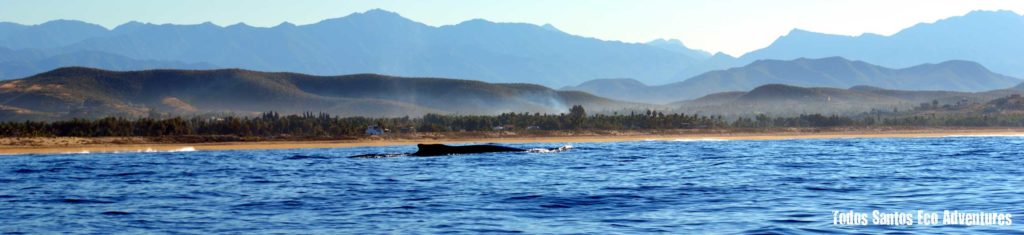
It was a terrible, anguished sound. Guide Citlali Aguilar, her clients, and local fishing captain Agustin Agundez were off the coast of Todos Santos when they heard it. Agustin steered his boat slowly towards the distressing noise and they passed an orca; it was alone, alert, silent, and still. It filled them with dread. A few hundred meters on a fierce battle exploded on the waves. “A second orca was trying to attack a baby humpback whale that was protected by two adult humpbacks” recalls Citlali. “The adults had the baby inside a circle of their bodies to protect it and keep it afloat, and the orca was jumping and jumping trying to make it into the center of the circle to drown the baby.” The sound she was hearing was the humpbacks screaming. Not underwater, but into the air. “You could tell they were calling for help” says Citlali. “They were thrashing
their tails, smashing them near the orca, and calling, calling for help.” The current was carrying the four mammals straight to the other orca that Citlali and Agustin had originally encountered which continued to wait silently, patiently. Notes Citlali, “The orcas definitely had a strategy.”
“It was agonizing to watch” recalls Citlali. The adult humpbacks were working so hard to defend the baby but they were trapped in a deadly dilemma: to protect the baby at the surface they couldn’t dive to gain the momentum needed to overpower the relentlessly attacking orca. “So they kept circling,” recalls Citlali, “thrashing with their tails and screaming. But the orca was tiring them out. It was so distressing that my clients started crying.”
Then an amazing thing happened. Two other adult humpback whales arrived to help, one from the south and one from the west. The distress calls had worked. “That to me was the most marvelous thing” says Citlali. “The new whales were coming from different directions.” The two new whales entered the circle around the baby and took on the fight, giving the whales who had been defending the baby to this point a chance to
recover some energy. But the current was taking them ever closer to the waiting second orca so as soon as they could the original protectors got back into the fight. “Then all of a sudden we saw this huge gush of blood in the water and my clients just completely lost it and were sobbing uncontrollably – we thought the baby had been killed.” But the truth was both hopeful and brutal: the orca had bitten the tail of one of the new
defenders, a large, powerful whale that they felt confident could recover.
But now the whole group – the 4 adult humpbacks, the baby humpback and the attacking orca – had reached the waiting orca on the current. Citali, Agustin and their clients were almost overwhelmed by anxiety about what might unfold next. It seemed entirely possible that the orcas could claim victory with one last ferocious stand. But the orcas simply turned and retreated, conceding defeat to the courageous humpbacks. “It was an edge-of-the-seat thriller!” recalls Citlali. “Even though the orcas had left the area we felt too anxious and invested to leave the humpbacks so we stayed in the vicinity quite a bit longer. Only once the two humpbacks who had answered the distress call swam away did we head back to shore. It remains the most dramatic thing I’ve ever witnessed in nature.”
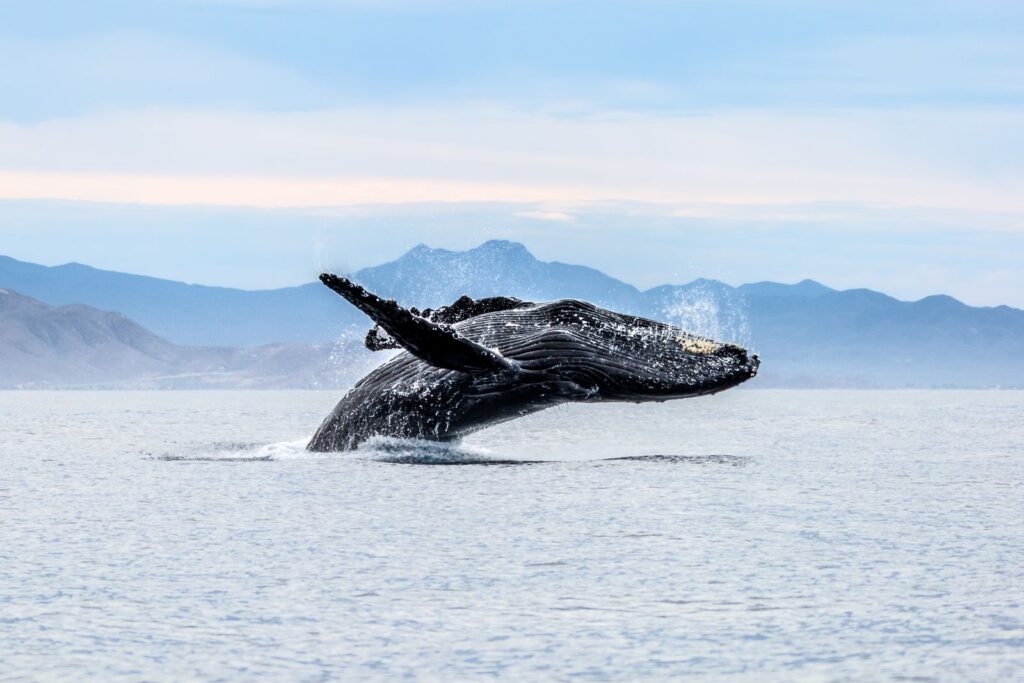
Much has been written in recent years about humpback whales who have been observed intervening to save other species from orca attacks including baby gray whales, sea lions, harbor seals and porpoises. The same tactics Citlali and Agustin observed – powerful tail and flipper slaps, trumpeting sounds and physically placing themselves between the orcas and their prey, sometimes for hours – are all hallmarks of these rescues. What motivates the humpbacks in these dramatic interventions? Is it cross-species empathy? Altruism? Or is it just good old-fashioned payback? Humans have not yet evolved enough to understand the humpback mind, but Citlali’s experience leaves no doubt that humpbacks possess a fiercely protective nature and are true friends to those in need. How happy that they are our ocean neighbors here in Baja California Sur.
by Sonya Bradley | Blog
Don Santiago, Doña Matilda and Baja’s Rad Scientific Fishers
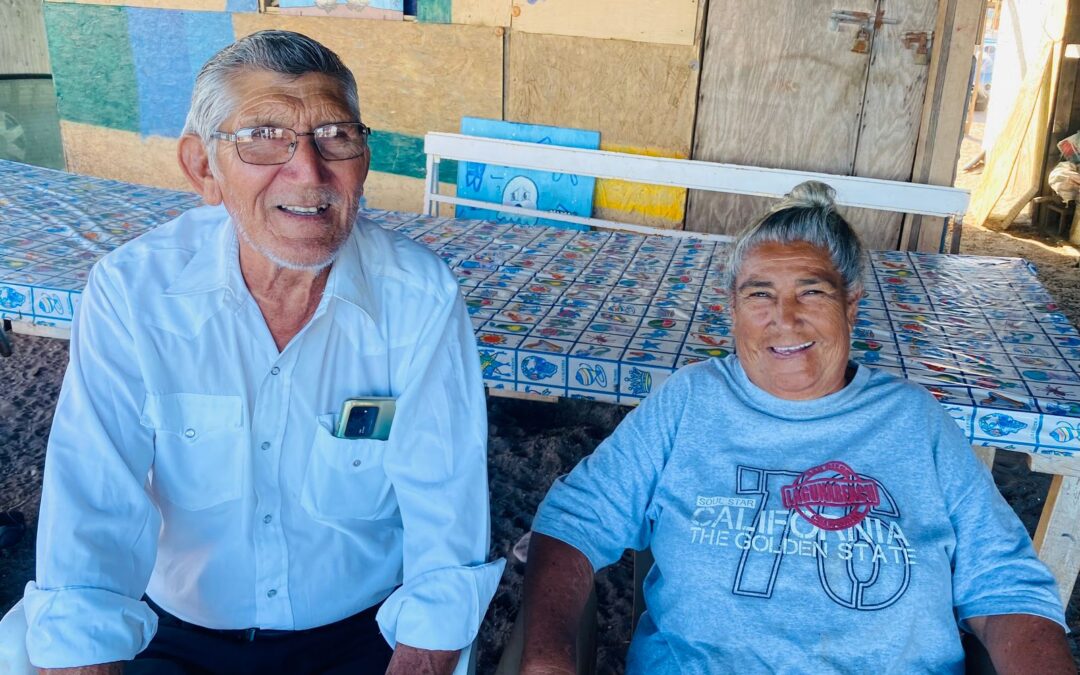
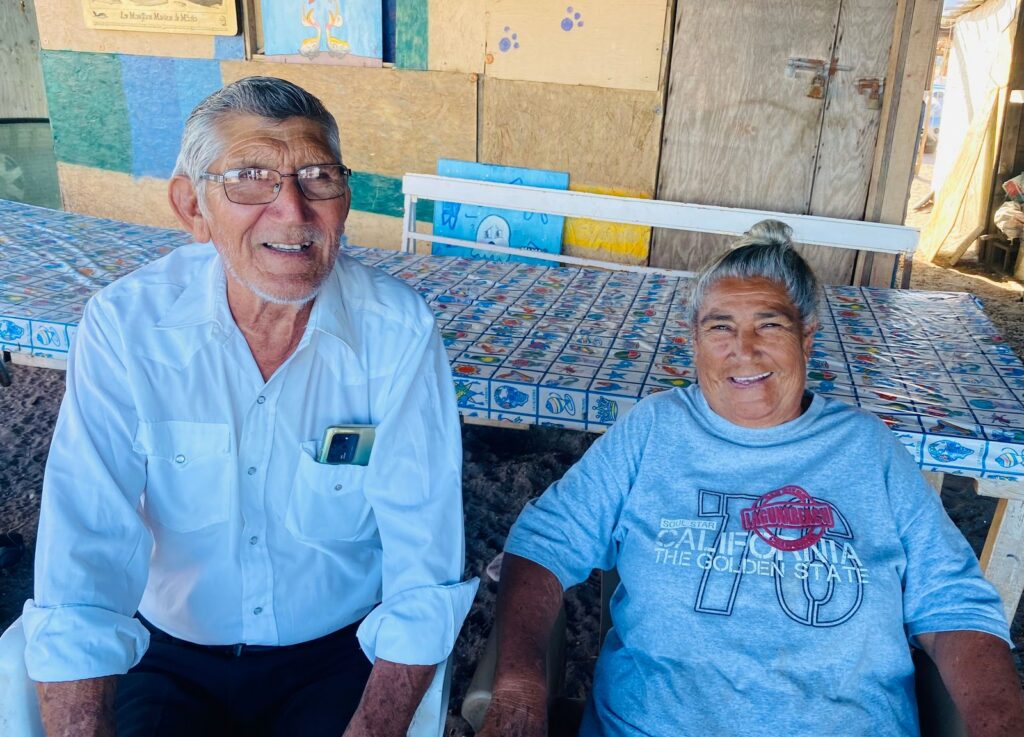
When you first meet Don Santiago and his sister Doña Matilda at their home in the Las Pacas fishing cooperative outside of La Paz, there is nothing to suggest that they are radical agents of change. Las Pacas looks like a place that time forgot, and Santiago, age 67 and Matilda, age 72, seem as eternal and constant as the mountains that backstop their home and the ocean that fronts it. Their great grandparents, grandparents, and parents were all fishermen. Together Santiago and Matilda still fish 3 times a week. To save their way of life, they are prepared to turn it on its ear.
“Santiago is a fisherman who doesn’t think like one” says Ana Karina, a professor of Alternative Tourism at the Autonomous University of Baja California Sur (UABCS) in La Paz. “in fact, all the other fishermen think Santiago is crazy.” The fishermen may suspect Santiago’s sanity because he is on a mission to change attitudes towards fishing reinforced across the generations. Says Santiago, “I don’t want my children to say that I was just a predator. It is now time for all of us fishers to give back to the ocean what the ocean has given to us. Life. From this point on I want to dedicate all my time to the students and to the ocean. I don’t want to fish anymore, I just want to do science.”
 The students and science Santiago mentions come from many different places including Arizona State University’s School for the Future of Innovation in Society. Dr. Jesse Senko is the marine biologist and conservation scientist who heads that program. Jesse has a focus on the health of sea turtles, which he sees as tightly tied to sustainable fisheries and resilient coastal communities. Jesse explains the root of his work with Santiago and Matilda. “Fishing gear is the greatest threat to sea turtles worldwide. Sea turtles are vital for the health of the world’s oceans. They perform fundamental roles in ocean ecosystems, many of which are not fulfilled by other species. And humans need healthy oceans to survive and thrive.”
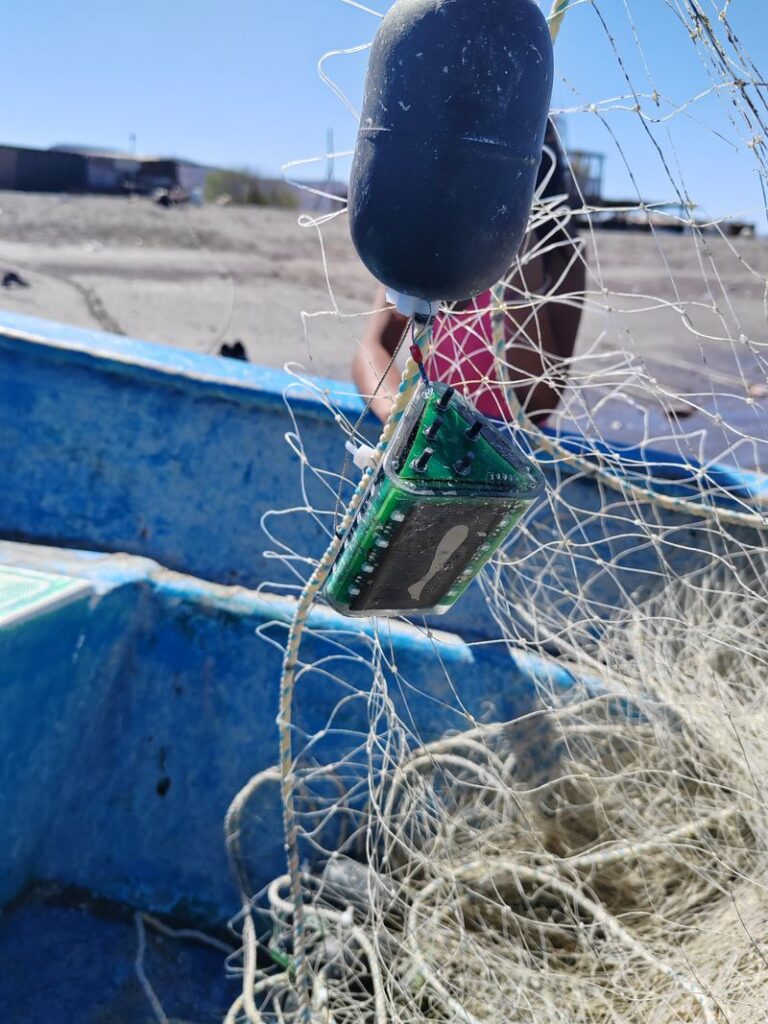
Fishermen in Baja commonly put lights on gill nets to attract fish. While doing research in Baja Jesse noticed that sharks and turtles could see the lights on the nets and turned away from them. To increase the turtle and shark chance of net-avoidance success, Jesse put battery-powered lights on the nets, and quickly saw a 50% reduction in turtle bycatch and 95% reduction in shark bycatch. “The turtles would swim right up to the nets and turn around” he notes. Jesse realized that the battery-powered lights, while effective, were not a sustainable solution; he thought solar-powered fishing lights might be. His engineering colleagues at ASU agreed and created the solar-powered solution he envisioned. Jesse began testing the nets with the Cuevas brothers at El Pardito (see JDP Holiday 2020-2021 edition #46) and was strongly encouraged by the results; the nets work. They now have the potential to be a radical game changer in the global fight to reduce bycatch, and it was his quest to expand his research that led Jesse to Santiago and Matilda’s door.
Stephanie Rousso is a Ph.D. candidate at CICIMAR in La Paz who has dedicated her career to the study and care of sea turtles. She has been working in sea turtle conservation and sustainable fisheries in Baja California Sur for over a decade, and met Santiago and Matilda through her work in reducing turtle bycatch. Santiago and Matilda began calling Stephanie whenever they saw a stranded sea turtle or caught one in their nets, and Stephanie taught them how to capture data about the turtles and safely release them back to the ocean. They now handle these tasks efficiently and effectively on their own, all while providing important data for Stephanie’s research to aid the turtles. When Jesse approached Stephanie about fishers he could work with, Stephanie didn’t hesitate. “Santiago and Matilda are amazing citizen scientists. They are all about the science now” she states.
Jesse could not be more pleased with the collaboration in which he is testing his lighted gill nets for global solutions using different colors, wavelengths, depths and even sound. “My team and I are working with Don Santiago and Doña Matilda to reduce bycatch while improving fisheries sustainability. We are still in the preliminary stages of research, but we believe that Las Pacas will be one of our most globally important study sites.”
 Another of Santiago’s dreams is to create a fish refuge in his area. To this end he has already worked with the government to create an artificial reef using special technology donated by Japan, and he is hoping to get 10 hectares declared a fish refuge in which only local fishermen can catch commercial-size fish using handlines. The rest of the fish will be left alone to mature and repopulate the area. “Fish refuges often don’t work because the local fishermen aren’t well informed about them,” notes Santiago. “I want to change that. All along the Baja peninsula coastal communities are dying. There are only old people like me and Matilda left. I want to continue to connect with students and scientists so that our young people can carry on with this life in a way that is sustainable and revitalizes coastal life.”
Says Jesse, “Don Santiago is a visionary. He is not only interested in improving the sustainability of his own fisheries, but he is interested in developing solutions that coastal communities throughout the region can adopt. Through their partnership with our research program, they are helping pave the way for the next generation of scientific fishers. Their work will not only help advance sustainable fisheries in Baja California Sur, but their community can serve as a global model for responsible fisheries.”
Santiago is all about getting students invested in a vision for a more vibrant future of Baja’s coastal areas. Ana Karina is the UABCS professor of Alternative Tourism who brings many of her students to learn from and work with Santiago and Matilda. “Santiago is the kind of person who says, ‘If I knew that the world was going to end tomorrow, I would still plant a tree today.’ He works with the students on ideas for regenerative tourism that can reduce the impact on our fragile local ecosystems.”
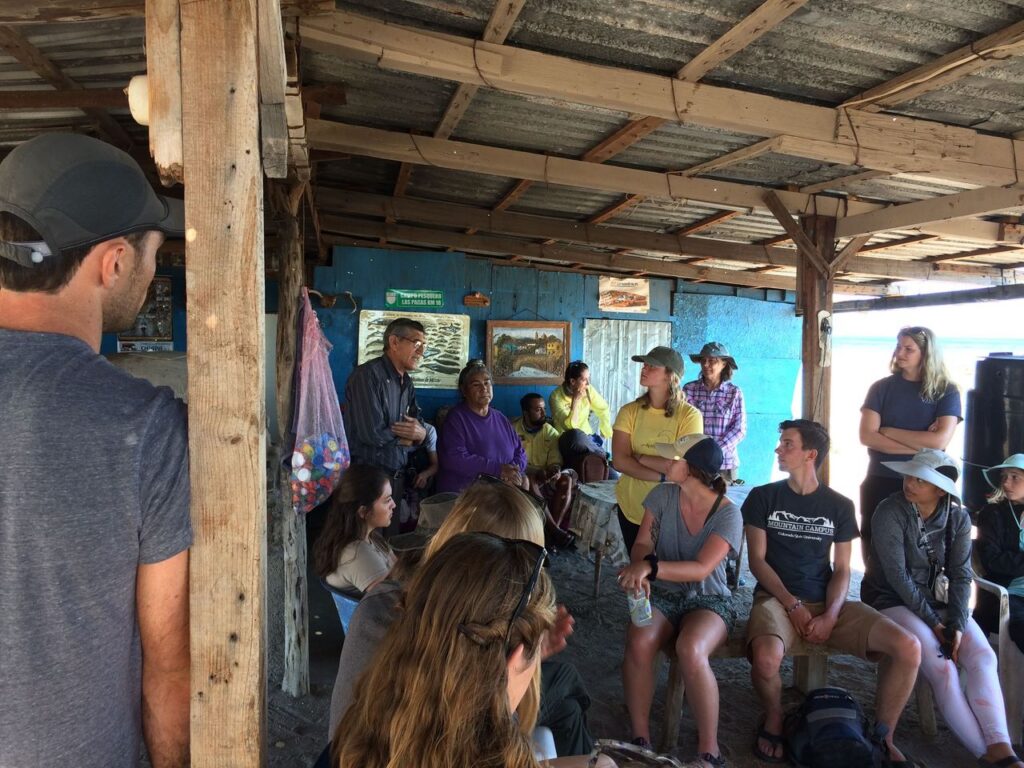
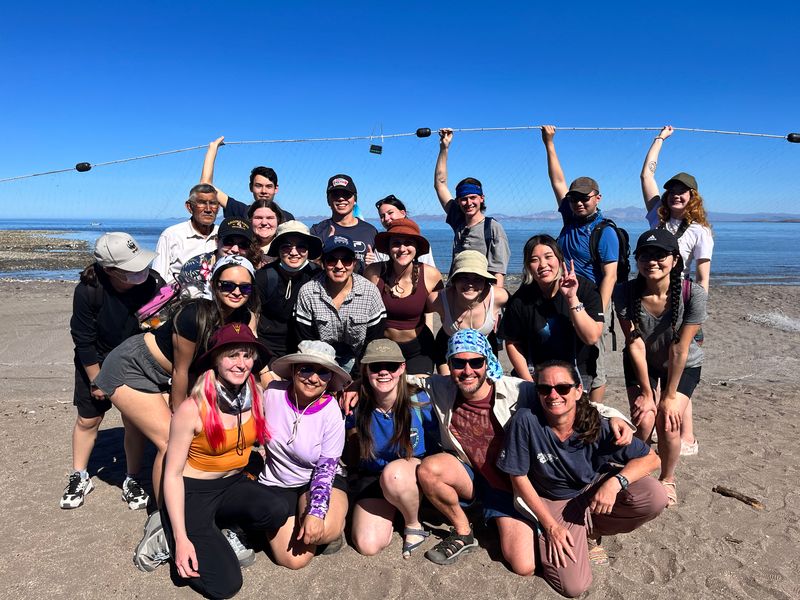 “Don Santiago and Doña Matilda have been hosting my ASU study abroad class, “Sea turtles, sharks, and fisheries of Baja California”, at Las Pacas over the past 2 years,” says Jesse. “During their time at Las Pacas, ASU students learn in detail from Don Santiago about how his community fishes, what gear they use, and how they are working to advance responsible fisheries.” Las Pacas and its inhabitants are a living classroom, where students from Baja, Arizona, Colorado, California and elsewhere learn what it means to radically change your way of life, to save your way of life. “We are fishermen of excellence” says Santiago. “Our neighbors wonder why we are spending time with all these ‘green people’. It’s simple. I want my children and grandchildren to have the same opportunity I had to make a living from the ocean. I am therefore dedicating my time to science and to the students. This will be my testimonial.”
This article is based on interviews with Santiago, Matilda, Ana, Stephanie and Jesse, as well as the Arizona State University News 2020 article, ASU scientist Jesse Senko’s solar-powered lights are rescuing more than sea turtles from fishing nets — they’re helping to transform the future of sustainable fishing.
by Sonya Bradley | Blog
45 Men and a Flag: William Walker’s Invasion of Baja California
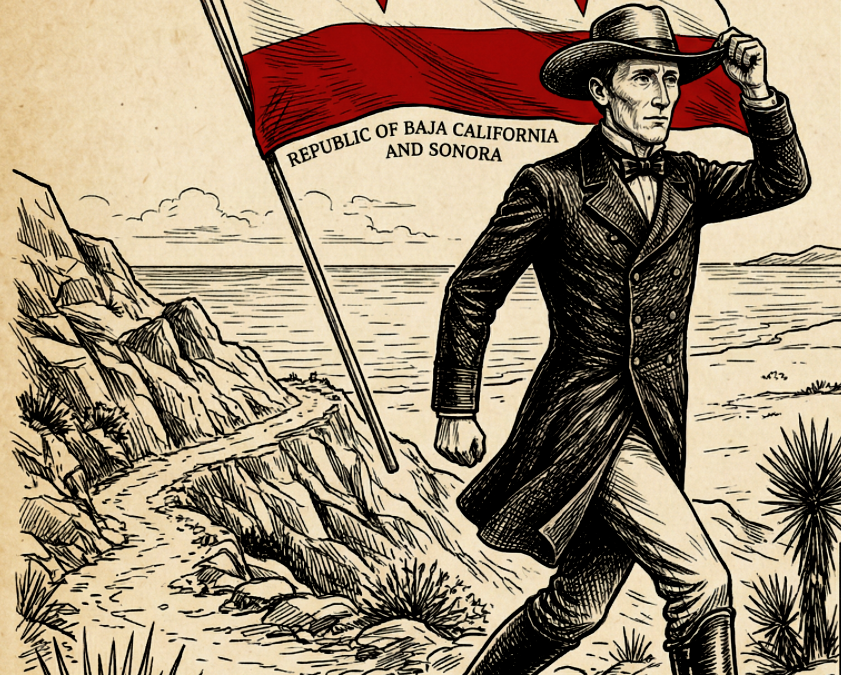
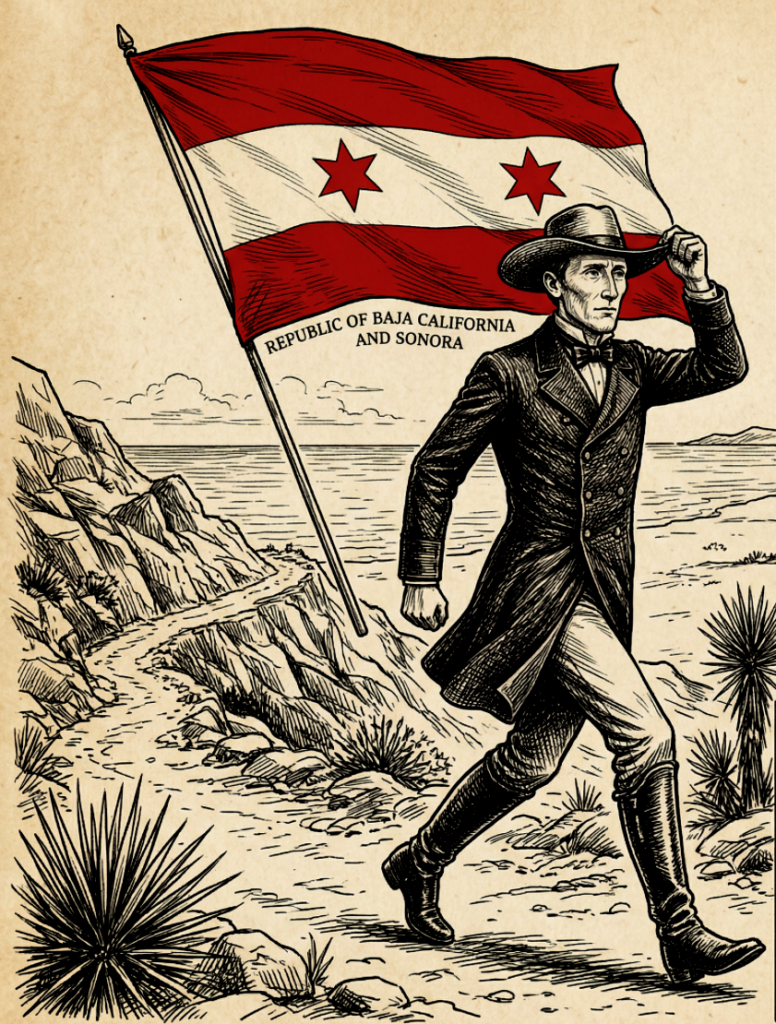
On the night of October 16, 1853, a 29-year-old American lawyer named William Walker slipped out of San Francisco harbor under cover of darkness on the schooner Caroline. He had 45 men with him. He had no maps of the territory he was about to invade. He had neglected to bring sufficient food. He had no military experience. He did have, however, an extraordinary sense of personal destiny and a flag he’d designed himself for the country he was about to create. The country was Baja, or Lower California. Never mind that Baja California was part of Mexico, the plan was to conquer it, declare it an independent republic governed by the laws of Louisiana – which meant slavery was legal – and eventually petition for annexation by the United States. The plan was insane. It nearly worked.
William Walker is one of the most remarkable yet most forgotten figures in American history, a testimony to the stories we choose to forget. He was born in Tennessee in 1824, the son of a non-slave owning family, and grew up to become a physician, then a lawyer, then a newspaper editor, graduating from all three professions with the particular confidence of a man who has been told repeatedly that he is brilliant. He stood five feet, two inches tall. He had pale gray eyes described by contemporaries as unsettling, the kind of eyes that don’t blink quite often enough. He had been shot in at least two duels and survived both. He had, somewhere in the course of all this doctoring and lawyering and newspaper editing, become absolutely convinced that the destiny of the United States required the expansion of white, slaveholder civilization into Latin America. He was not alone in this belief. The 1850s were the high noon of what Americans called Manifest Destiny, the quasi-religious conviction that the United States was ordained by God to expand across the continent and perhaps beyond it. The Mexican-American War had just ended in 1848, delivering to the U.S. more than half of Mexico’s territory: Texas, California, Arizona, New Mexico, Nevada, Utah, Colorado. The appetite had not been satisfied. Men like Walker – called “filibusters” after the Spanish filibustero, or pirate – raised their own private armies and invaded sovereign nations, not on behalf of the U.S. government but in the spirit of it, testing boundaries, claiming territory, daring Mexico to fight back. Walker decided to start with Baja California and Sonora. He had actually traveled to Guaymas in the summer of 1853 to ask the Mexican government for a land grant in Sonora. Mexico said no.
He went back to San Francisco, recruited 45 men – many of them Gold Rush veterans who had missed the fortune they came for and were looking for the next opportunity – and stole a second ship when the U.S. Army seized the first one. Walker’s schooner, the Caroline, arrived at Cabo San Lucas on October 28, 1853, paused for water, then sailed up the Gulf to La Paz. He arrived on November 3 flying the Mexican flag, a deception that gave him the element of surprise in a town of approximately 1,000 people who had no reason to expect an American invasion before breakfast. It took thirty minutes. Walker’s men captured the governor, Colonel Rafael Espinosa, at gunpoint. They hauled down the Mexican flag and ran up Walker’s own: three horizontal stripes, red and white, with a single star. Walker stepped off the boat, looked around the small, sun-bleached capital of one of Mexico’s most remote territories, and declared himself president. “The Republic of Lower California” he announced in a proclamation immediately dispatched to California newspapers, “is hereby declared Free, Sovereign, and Independent, and all allegiance to the Republic of Mexico is forever renounced.” He decreed free trade with the world. He decreed that the laws of the state of Louisiana would govern his new nation. Louisiana’s laws included slavery. Walker had just introduced the institution to a country that had abolished it 25 years earlier.
In San Francisco, the news landed like a firework. A local paper hailed the filibusters for “releasing Lower California from the tyrannous yoke of declining Mexico.” A recruiting office opened; within hours, hundreds of men had signed up. The era of Manifest Destiny was such that a private citizen could invade a foreign country with 45 men, declare himself its president, and be celebrated as a patriot in the American press. Walker’s problem was not public relations. His problem was logistics. Walker had no maps and no food, and Baja California in 1853 had no roads and very few people willing to help him. Within three days of his glorious proclamation, he abandoned La Paz – partly from fear of Mexican counterattack, partly because there was nothing useful there – and retreated to Cabo San Lucas. Three weeks later he moved again to Ensenada, 1,600 kilometers to the north, dragging prisoners with him in a wagon across terrain he did not understand toward a border he could barely locate. The promised supply ships from California were late. When reinforcements finally arrived – around 230 additional volunteers – they brought almost no provisions and less knowledge of how to survive the Baja desert. Walker’s men were living off livestock seized from local ranches, for which Walker issued IOUs that no one would ever collect.
On January 10, 1854, apparently feeling that conquering one non-existent country was insufficient, Walker issued a new decree: Baja California was now annexed to the Republic of Sonora. He had not set foot on the Mexican mainland, but he was now president of two countries. He began marching north toward the border, hoping to find a passage east into Sonora. His men were deserting in substantial numbers. Those who stayed were dying of dysentery and dehydration. The local population – the rancheros and farmers and fishermen of the Baja peninsula – were actively hostile, refusing to sell him food and in several cases taking
up arms against him under a Mexican officer named Antonio Meléndrez, who harassed Walker’s retreating column relentlessly through the thorny, waterless mountains of northern Baja.
By May of 1854, Walker had fewer than 35 men left. He tried to reach San Vicente – the administrative seat of Baja California about 90 miles south of the US border – but found Mexican troops had taken it. He tried to cross into the United States but found Mexican soldiers blocking his path and American soldiers waiting on the other side. In the end, the Mexican fighters stepped aside and let him cross and he surrendered on May 8, 1854. His invasion of Baja California and Sonora had lasted eight months, cost the lives of unknown numbers of men on both sides, and accomplished absolutely nothing. Back in San Francisco, Walker was tried for violating the Neutrality Act, which prohibited American citizens from waging private war against nations at peace with the United States. The jury deliberated for eight minutes and acquitted him. The era of Manifest Destiny was such that it only took eight minutes for twelve people to conclude that invading Mexico was fine. Walker, characteristically, took the acquittal as an endorsement. He immediately began planning his next invasion. In 1855 he went to Nicaragua with 60 men, exploited a civil war to seize control of the country, declared himself president, reinstated slavery (which Nicaragua had abolished), and made English an official language. U.S. President Franklin Pierce formally recognized his government. Walker ruled Nicaragua for almost a year. A coalition of Central American armies drove him out in 1857. He tried twice more to return. In 1860, the British Navy captured him in Honduras and handed him to local authorities. He was executed by firing squad on September 12, 1860, at age 36. He died, witnesses reported, without flinching.
Walker’s adventure had consequences for Baja California that echoed for decades. The invasion accelerated Mexican determination to populate and militarize the peninsula. Over a third of Baja’s already sparse population reportedly left the territory during and after the invasion, fleeing the chaos. The Mexican government responded by pushing settlers in from the mainland and establishing garrisons at key points along the peninsula. The modern effort to make Baja actually Mexican, rather than just technically Mexican, began in part as a direct response to Walker. In Mexico, Walker appears in third-grade history primers. In the United States, he is largely forgotten, a minor footnote in the history of Manifest Destiny, which itself has been largely laundered out of the national memory. William Walker, president of two republics that never existed, is dust.

by Sonya Bradley | Wildlife Encounters
Camp Cecil de la Bahia: Humpbacks, Fishing, Birding and Kayaking
Baja doesn’t get more wild, more alive, or more beautiful than this!
Nestled on the edge of one of the most biologically rich bays on the planet, Camp Cecil de la Bahía is your dreamy, wild, and utterly remote base camp for four unforgettable days and three magical nights immersed in the spectacular wildlife and untamed beauty of Magdalena Bay. The tents of Camp Cecil de la Bahia are beautifully appointed walk-in safari-style tents with gorgeous beds, seating areas, rugs, chandeliers, and ensuite bathrooms. The camp chef prepares three beautiful meals a day and daily happy hour.
In December and January, you can witness humpback whales lunging and breaching in the cobalt-blue waters at the mouth of the bay. Watch in wonder as these gentle giants roll and spy-hop, putting on a show that no screen can prepare you for. Cruise alongside playful pods of bottlenose dolphins as they race your bow. Share the water with California sea lions that seem to delight in your company as much as you delight in theirs.
From the camp you can take your kayak and glide silently through a cathedral of ancient mangroves—great blue herons, ospreys, pelicans and frigatebirds keeping watch as you paddle deeper into one of Baja’s most treasured coastal ecosystems. Your expert naturalist guide brings it all to life with the stories of plants, birds, and creatures that depend on these critical nursery waters.
And for those who want to test their luck against Magdalena Bay’s legendary fishing grounds—grab a rod and head out with our knowledgeable local fishing captains. Yellowtail, grouper, snapper, and occasional roosterfish are all in play.
Humpback, Fishing and Kayaking Season at Camp Cecil de la Bahia is mid-December to late January.
Price Includes
- Transportation to/from Todos Santos or La Paz
- Accommodation for 3 nights in a luxury tent with real beds, lovely linens, rugs, chandeliers and ensuite toilets
- Beautiful, chef-prepared meals from welcome lunch on Day 1 through breakfast on final day
- Daily happy hour and drinks with dinner
- Whale watching excursions, fishing, birding and mangrove exploration
- Bilingual naturalist guide(s) who is a certified Wilderness First Responder, NOM-9 Graduate and Leave No Trace certified
- Entrance fee and permits
Excludes:
- International airfare
- Gratuities
- Travel insurance
- Any activities, meals or drinks not explicitly identified in the itinerary
2026-2027 Dates
- Dec 13-16, 2026
- Dec 16-19, 2026
- Dec 19-22, 2026
- Dec 23-26, 2026
- De 26-29, 2026
- Dec 29, 2026-Jan 1, 2027
- Jan 2-5, 2027
- Jan 5-8, 2027
- Jan 8-11, 2027
- Jan 11-14, 2027
- Jan 14-17, 2027
Price USD
- Please enquire for pricing
- A 16% IVA tax will be added to all prices
Price MXN
- Please enquire for pricing
- A 16% IVA tax will be added to all prices