Don Santiago, Doña Matilda and Baja’s Rad Scientific Fishers
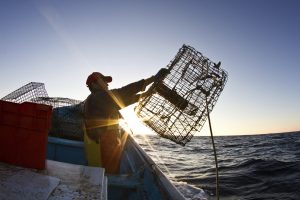
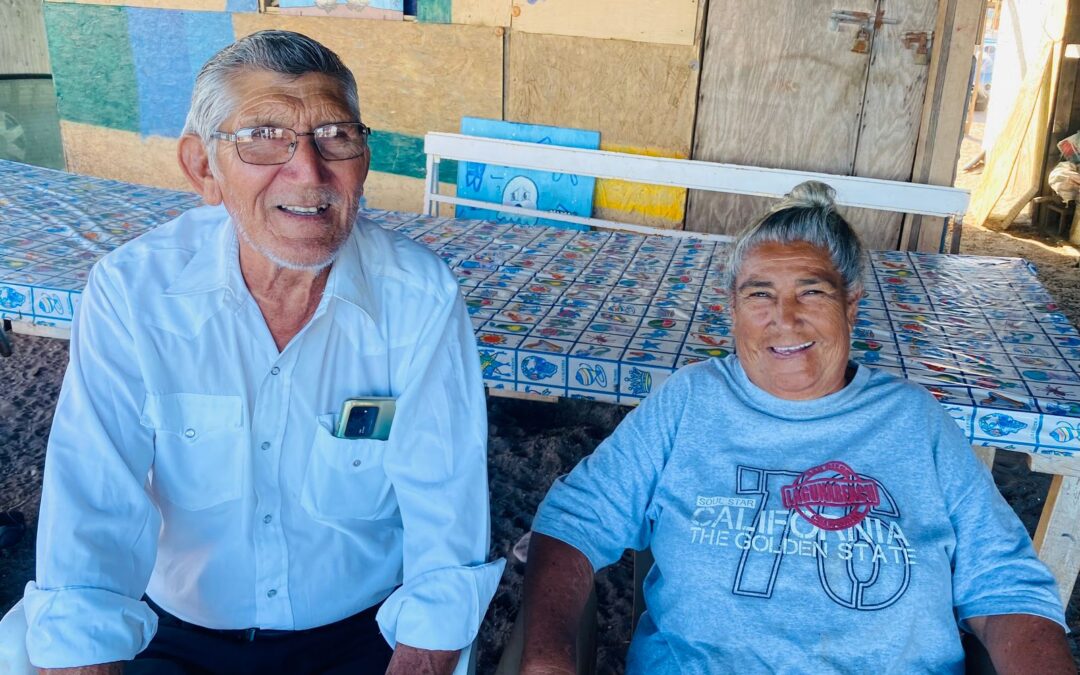
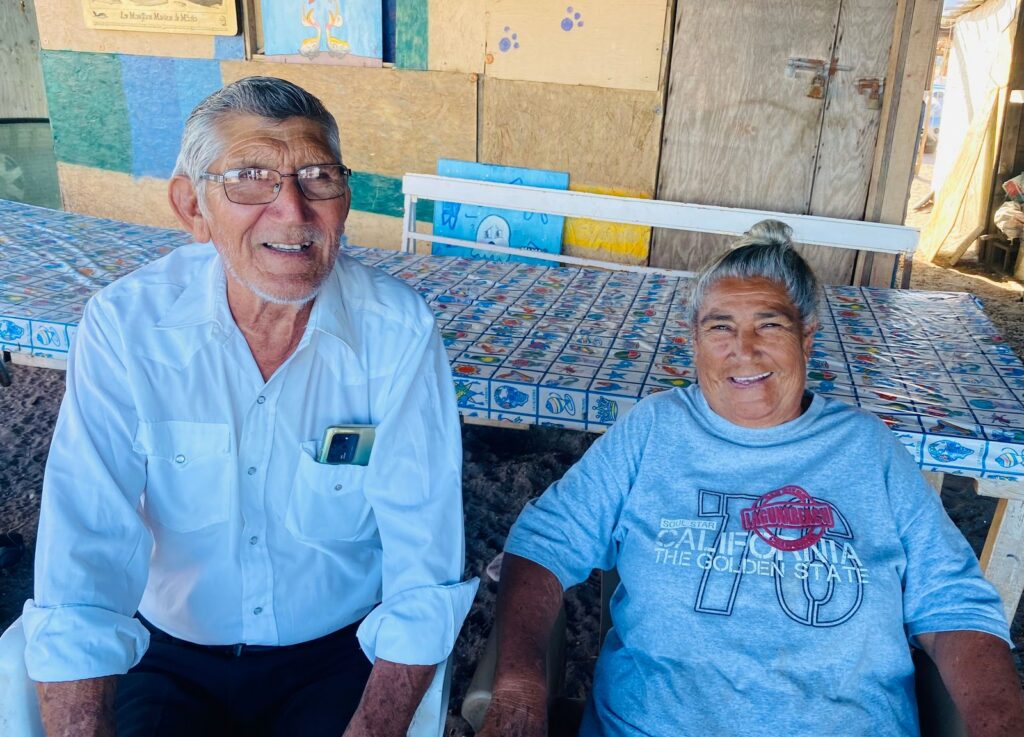
When you first meet Don Santiago and his sister Doña Matilda at their home in the Las Pacas fishing cooperative outside of La Paz, there is nothing to suggest that they are radical agents of change. Las Pacas looks like a place that time forgot, and Santiago, age 67 and Matilda, age 72, seem as eternal and constant as the mountains that backstop their home and the ocean that fronts it. Their great grandparents, grandparents, and parents were all fishermen. Together Santiago and Matilda still fish 3 times a week. To save their way of life, they are prepared to turn it on its ear.
“Santiago is a fisherman who doesn’t think like one” says Ana Karina, a professor of Alternative Tourism at the Autonomous University of Baja California Sur (UABCS) in La Paz. “in fact, all the other fishermen think Santiago is crazy.” The fishermen may suspect Santiago’s sanity because he is on a mission to change attitudes towards fishing reinforced across the generations. Says Santiago, “I don’t want my children to say that I was just a predator. It is now time for all of us fishers to give back to the ocean what the ocean has given to us. Life. From this point on I want to dedicate all my time to the students and to the ocean. I don’t want to fish anymore, I just want to do science.”
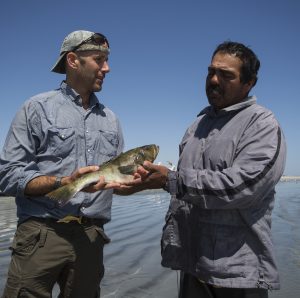
The students and science Santiago mentions come from many different places including Arizona State University’s School for the Future of Innovation in Society. Dr. Jesse Senko is the marine biologist and conservation scientist who heads that program. Jesse has a focus on the health of sea turtles, which he sees as tightly tied to sustainable fisheries and resilient coastal communities. Jesse explains the root of his work with Santiago and Matilda. “Fishing gear is the greatest threat to sea turtles worldwide. Sea turtles are vital for the health of the world’s oceans. They perform fundamental roles in ocean ecosystems, many of which are not fulfilled by other species. And humans need healthy oceans to survive and thrive.”
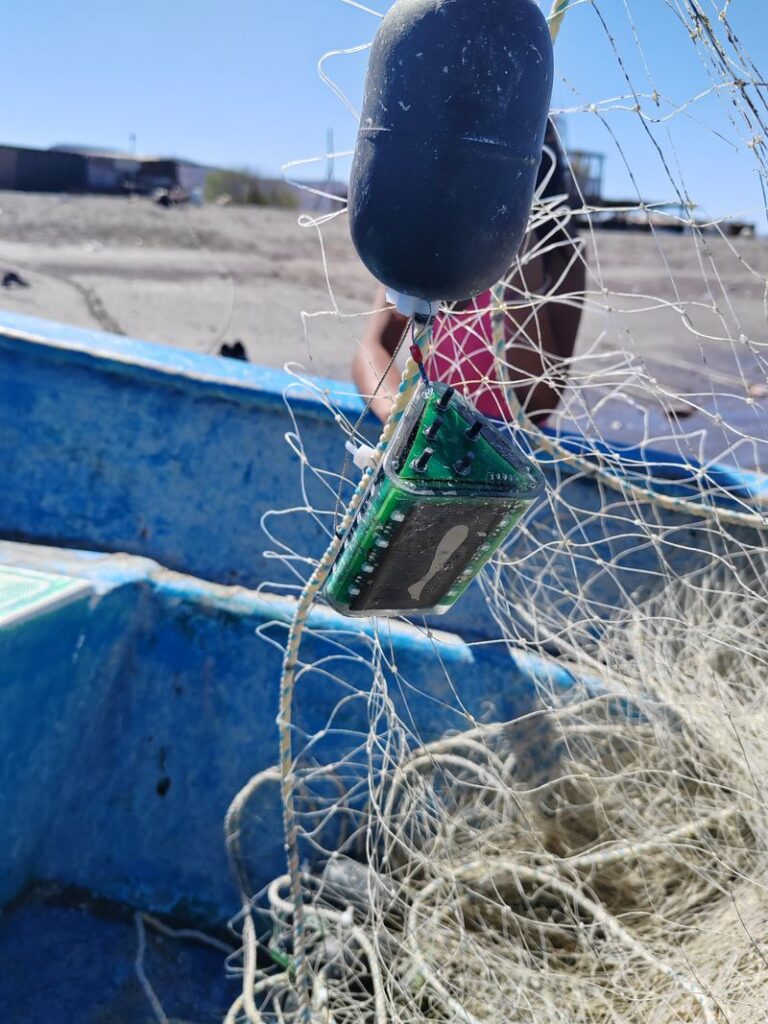
Fishermen in Baja commonly put lights on gill nets to attract fish. While doing research in Baja Jesse noticed that sharks and turtles could see the lights on the nets and turned away from them. To increase the turtle and shark chance of net-avoidance success, Jesse put battery-powered lights on the nets, and quickly saw a 50% reduction in turtle bycatch and 95% reduction in shark bycatch. “The turtles would swim right up to the nets and turn around” he notes. Jesse realized that the battery-powered lights, while effective, were not a sustainable solution; he thought solar-powered fishing lights might be. His engineering colleagues at ASU agreed and created the solar-powered solution he envisioned. Jesse began testing the nets with the Cuevas brothers at El Pardito (see JDP Holiday 2020-2021 edition #46) and was strongly encouraged by the results; the nets work. They now have the potential to be a radical game changer in the global fight to reduce bycatch, and it was his quest to expand his research that led Jesse to Santiago and Matilda’s door.
Stephanie Rousso is a Ph.D. candidate at CICIMAR in La Paz who has dedicated her career to the study and care of sea turtles. She has been working in sea turtle conservation and sustainable fisheries in Baja California Sur for over a decade, and met Santiago and Matilda through her work in reducing turtle bycatch. Santiago and Matilda began calling Stephanie whenever they saw a stranded sea turtle or caught one in their nets, and Stephanie taught them how to capture data about the turtles and safely release them back to the ocean. They now handle these tasks efficiently and effectively on their own, all while providing important data for Stephanie’s research to aid the turtles. When Jesse approached Stephanie about fishers he could work with, Stephanie didn’t hesitate. “Santiago and Matilda are amazing citizen scientists. They are all about the science now” she states.
Jesse could not be more pleased with the collaboration in which he is testing his lighted gill nets for global solutions using different colors, wavelengths, depths and even sound. “My team and I are working with Don Santiago and Doña Matilda to reduce bycatch while improving fisheries sustainability. We are still in the preliminary stages of research, but we believe that Las Pacas will be one of our most globally important study sites.”
Another of Santiago’s dreams is to create a fish refuge in his area. To this end he has already worked with the government to create an artificial reef using special technology donated by Japan, and he is hoping to get 10 hectares declared a fish refuge in which only local fishermen can catch commercial-size fish using handlines. The rest of the fish will be left alone to mature and repopulate the area. “Fish refuges often don’t work because the local fishermen aren’t well informed about them,” notes Santiago. “I want to change that. All along the Baja peninsula coastal communities are dying. There are only old people like me and Matilda left. I want to continue to connect with students and scientists so that our young people can carry on with this life in a way that is sustainable and revitalizes coastal life.”
Says Jesse, “Don Santiago is a visionary. He is not only interested in improving the sustainability of his own fisheries, but he is interested in developing solutions that coastal communities throughout the region can adopt. Through their partnership with our research program, they are helping pave the way for the next generation of scientific fishers. Their work will not only help advance sustainable fisheries in Baja California Sur, but their community can serve as a global model for responsible fisheries.”
Santiago is all about getting students invested in a vision for a more vibrant future of Baja’s coastal areas. Ana Karina is the UABCS professor of Alternative Tourism who brings many of her students to learn from and work with Santiago and Matilda. “Santiago is the kind of person who says, ‘If I knew that the world was going to end tomorrow, I would still plant a tree today.’ He works with the students on ideas for regenerative tourism that can reduce the impact on our fragile local ecosystems.”
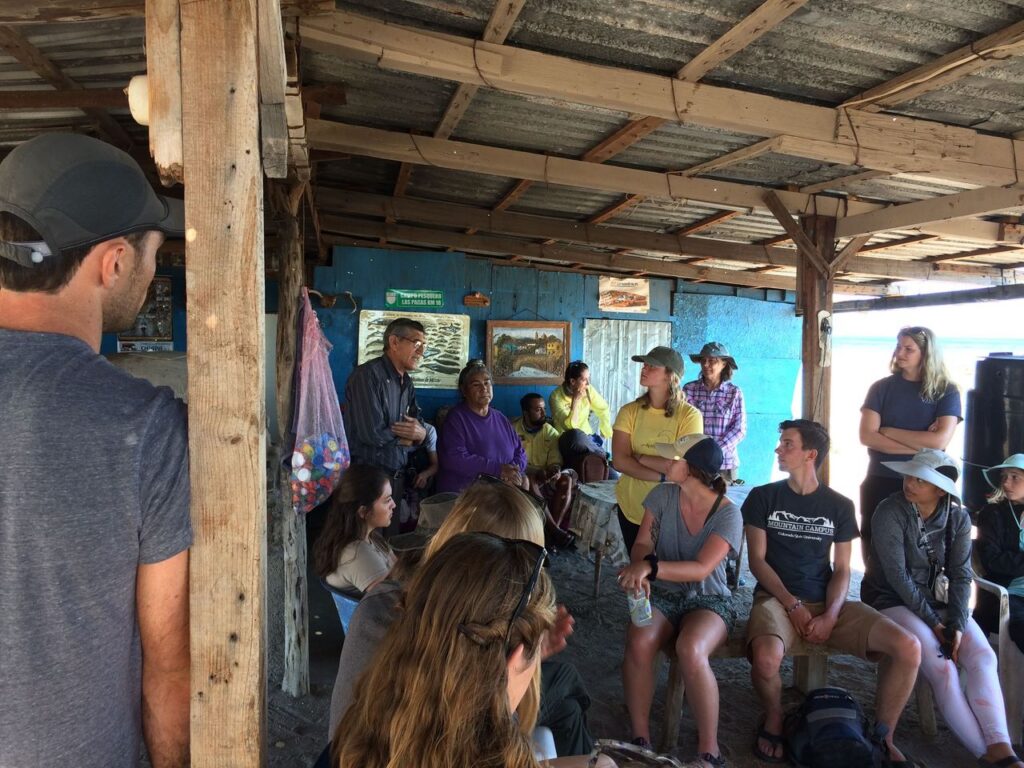
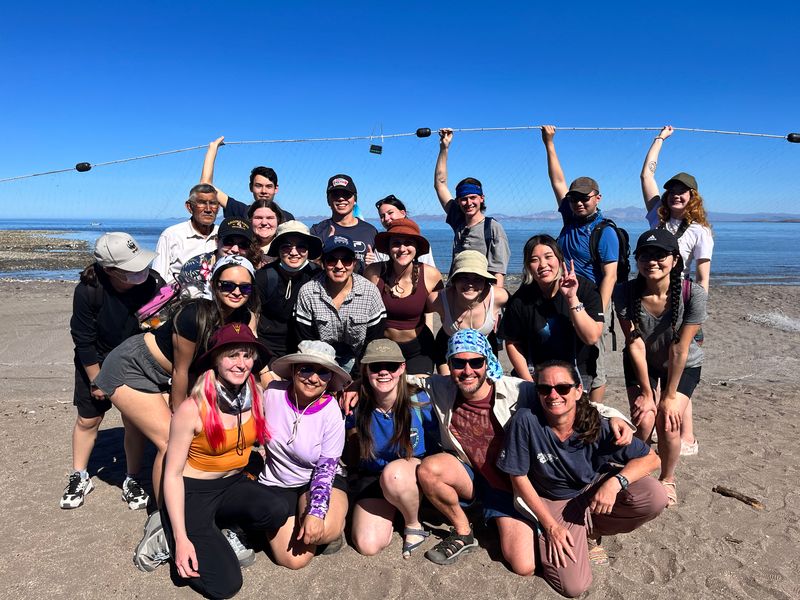
“Don Santiago and Doña Matilda have been hosting my ASU study abroad class, “Sea turtles, sharks, and fisheries of Baja California”, at Las Pacas over the past 2 years,” says Jesse. “During their time at Las Pacas, ASU students learn in detail from Don Santiago about how his community fishes, what gear they use, and how they are working to advance responsible fisheries.” Las Pacas and its inhabitants are a living classroom, where students from Baja, Arizona, Colorado, California and elsewhere learn what it means to radically change your way of life, to save your way of life. “We are fishermen of excellence” says Santiago. “Our neighbors wonder why we are spending time with all these ‘green people’. It’s simple. I want my children and grandchildren to have the same opportunity I had to make a living from the ocean. I am therefore dedicating my time to science and to the students. This will be my testimonial.”
This article is based on interviews with Santiago, Matilda, Ana, Stephanie and Jesse, as well as the Arizona State University News 2020 article, ASU scientist Jesse Senko’s solar-powered lights are rescuing more than sea turtles from fishing nets — they’re helping to transform the future of sustainable fishing.
45 Men and a Flag: William Walker’s Invasion of Baja California
On the night of October 16, 1853, a 29-year-old American lawyer named William Walker slipped out of San Francisco harbor under cover of darkness on the schooner Caroline. He had 45 men with him. He had no maps of the territory he was about to invade. He had neglected to bring sufficient food. He had no military experience. He did have, however, an extraordinary sense of personal destiny and a flag he’d designed himself for the country he was about to create. The country was Baja, or Lower California. Never mind that Baja California was part of Mexico, the plan was to conquer it, declare it an independent republic governed by the laws of Louisiana – which meant slavery was legal – and eventually petition for annexation by the United States. The plan was insane. It nearly worked.
William Walker is one of the most remarkable yet most forgotten figures in American history, a testimony to the stories we choose to forget. He was born in Tennessee in 1824, the son of a non-slave owning family, and grew up to become a physician, then a lawyer, then a newspaper editor, graduating from all three professions with the particular confidence of a man who has been told repeatedly that he is brilliant. He stood five feet, two inches tall. He had pale gray eyes described by contemporaries as unsettling, the kind of eyes that don’t blink quite often enough. He had been shot in at least two duels and survived both. He had, somewhere in the course of all this doctoring and lawyering and newspaper editing, become absolutely convinced that the destiny of the United States required the expansion of white, slaveholder civilization into Latin America. He was not alone in this belief. The 1850s were the high noon of what Americans called Manifest Destiny, the quasi-religious conviction that the United States was ordained by God to expand across the continent and perhaps beyond it. The Mexican-American War had just ended in 1848, delivering to the U.S. more than half of Mexico’s territory: Texas, California, Arizona, New Mexico, Nevada, Utah, Colorado. The appetite had not been satisfied. Men like Walker – called “filibusters” after the Spanish filibustero, or pirate – raised their own private armies and invaded sovereign nations, not on behalf of the U.S. government but in the spirit of it, testing boundaries, claiming territory, daring Mexico to fight back. Walker decided to start with Baja California and Sonora. He had actually traveled to Guaymas in the summer of 1853 to ask the Mexican government for a land grant in Sonora. Mexico said no.
He went back to San Francisco, recruited 45 men – many of them Gold Rush veterans who had missed the fortune they came for and were looking for the next opportunity – and stole a second ship when the U.S. Army seized the first one. Walker’s schooner, the Caroline, arrived at Cabo San Lucas on October 28, 1853, paused for water, then sailed up the Gulf to La Paz. He arrived on November 3 flying the Mexican flag, a deception that gave him the element of surprise in a town of approximately 1,000 people who had no reason to expect an American invasion before breakfast. It took thirty minutes. Walker’s men captured the governor, Colonel Rafael Espinosa, at gunpoint. They hauled down the Mexican flag and ran up Walker’s own: three horizontal stripes, red and white, with a single star. Walker stepped off the boat, looked around the small, sun-bleached capital of one of Mexico’s most remote territories, and declared himself president. “The Republic of Lower California” he announced in a proclamation immediately dispatched to California newspapers, “is hereby declared Free, Sovereign, and Independent, and all allegiance to the Republic of Mexico is forever renounced.” He decreed free trade with the world. He decreed that the laws of the state of Louisiana would govern his new nation. Louisiana’s laws included slavery. Walker had just introduced the institution to a country that had abolished it 25 years earlier.
In San Francisco, the news landed like a firework. A local paper hailed the filibusters for “releasing Lower California from the tyrannous yoke of declining Mexico.” A recruiting office opened; within hours, hundreds of men had signed up. The era of Manifest Destiny was such that a private citizen could invade a foreign country with 45 men, declare himself its president, and be celebrated as a patriot in the American press. Walker’s problem was not public relations. His problem was logistics. Walker had no maps and no food, and Baja California in 1853 had no roads and very few people willing to help him. Within three days of his glorious proclamation, he abandoned La Paz – partly from fear of Mexican counterattack, partly because there was nothing useful there – and retreated to Cabo San Lucas. Three weeks later he moved again to Ensenada, 1,600 kilometers to the north, dragging prisoners with him in a wagon across terrain he did not understand toward a border he could barely locate. The promised supply ships from California were late. When reinforcements finally arrived – around 230 additional volunteers – they brought almost no provisions and less knowledge of how to survive the Baja desert. Walker’s men were living off livestock seized from local ranches, for which Walker issued IOUs that no one would ever collect.
On January 10, 1854, apparently feeling that conquering one non-existent country was insufficient, Walker issued a new decree: Baja California was now annexed to the Republic of Sonora. He had not set foot on the Mexican mainland, but he was now president of two countries. He began marching north toward the border, hoping to find a passage east into Sonora. His men were deserting in substantial numbers. Those who stayed were dying of dysentery and dehydration. The local population – the rancheros and farmers and fishermen of the Baja peninsula – were actively hostile, refusing to sell him food and in several cases taking
up arms against him under a Mexican officer named Antonio Meléndrez, who harassed Walker’s retreating column relentlessly through the thorny, waterless mountains of northern Baja.
By May of 1854, Walker had fewer than 35 men left. He tried to reach San Vicente – the administrative seat of Baja California about 90 miles south of the US border – but found Mexican troops had taken it. He tried to cross into the United States but found Mexican soldiers blocking his path and American soldiers waiting on the other side. In the end, the Mexican fighters stepped aside and let him cross and he surrendered on May 8, 1854. His invasion of Baja California and Sonora had lasted eight months, cost the lives of unknown numbers of men on both sides, and accomplished absolutely nothing. Back in San Francisco, Walker was tried for violating the Neutrality Act, which prohibited American citizens from waging private war against nations at peace with the United States. The jury deliberated for eight minutes and acquitted him. The era of Manifest Destiny was such that it only took eight minutes for twelve people to conclude that invading Mexico was fine. Walker, characteristically, took the acquittal as an endorsement. He immediately began planning his next invasion. In 1855 he went to Nicaragua with 60 men, exploited a civil war to seize control of the country, declared himself president, reinstated slavery (which Nicaragua had abolished), and made English an official language. U.S. President Franklin Pierce formally recognized his government. Walker ruled Nicaragua for almost a year. A coalition of Central American armies drove him out in 1857. He tried twice more to return. In 1860, the British Navy captured him in Honduras and handed him to local authorities. He was executed by firing squad on September 12, 1860, at age 36. He died, witnesses reported, without flinching.
Walker’s adventure had consequences for Baja California that echoed for decades. The invasion accelerated Mexican determination to populate and militarize the peninsula. Over a third of Baja’s already sparse population reportedly left the territory during and after the invasion, fleeing the chaos. The Mexican government responded by pushing settlers in from the mainland and establishing garrisons at key points along the peninsula. The modern effort to make Baja actually Mexican, rather than just technically Mexican, began in part as a direct response to Walker. In Mexico, Walker appears in third-grade history primers. In the United States, he is largely forgotten, a minor footnote in the history of Manifest Destiny, which itself has been largely laundered out of the national memory. William Walker, president of two republics that never existed, is dust.
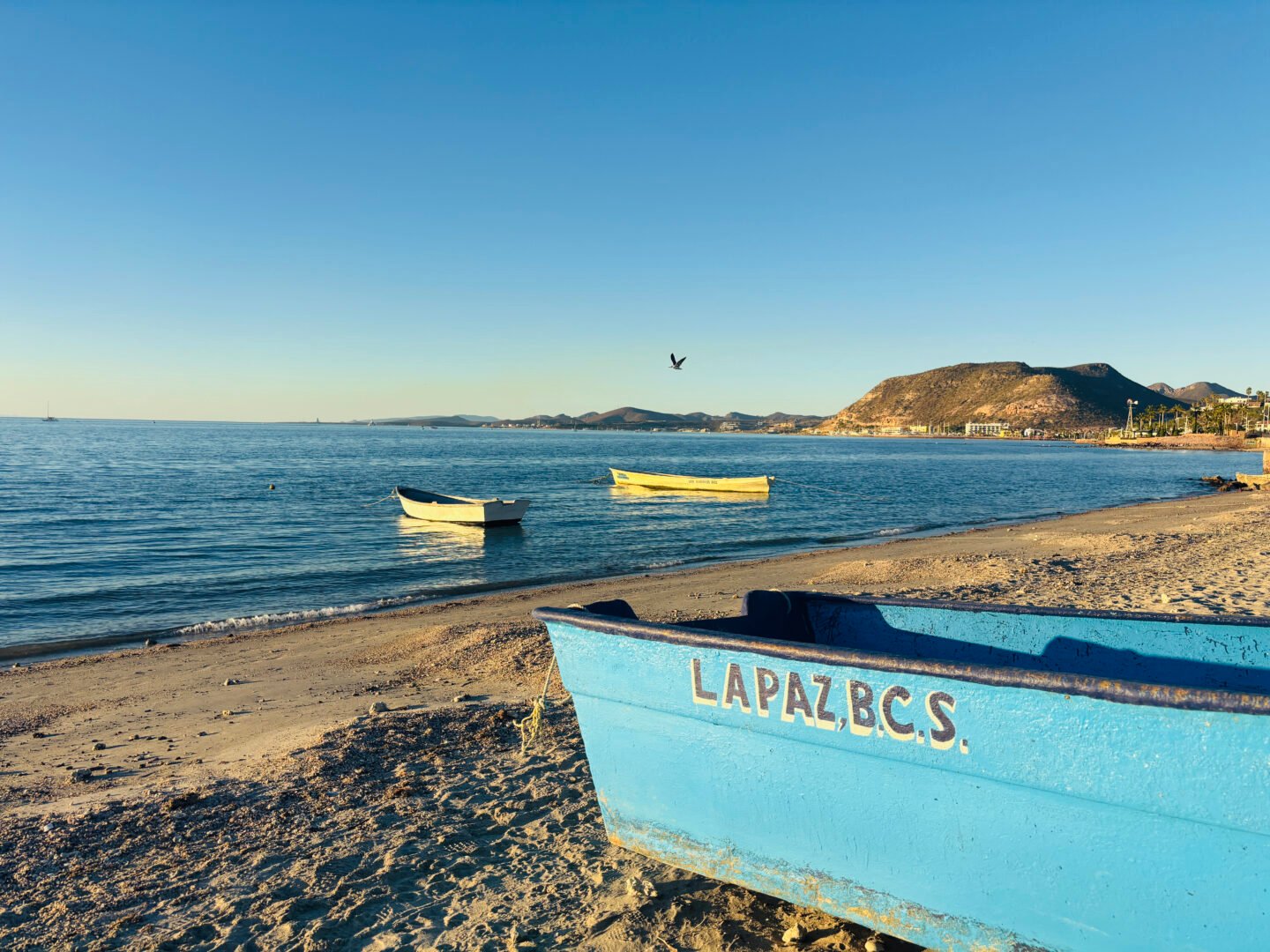
Fishing boats face the Bay of La Paz, where plankton blooms draw migrating whales and whale sharks annually from October to April. (Photo: Robin Esrock)
It took less than 24 hours for La Paz to become my favourite city in Mexico — a realization that came while savouring the glow of another reliable sunset on the Malecon.
A two-hour drive north from the spring break resort hotspot of Cabo San Lucas, we’d left mega resorts, chain stores and aggressive timeshare touts behind for a different experience of Baja California Sur.
Renting a bike to enjoy the sunset along the Malecón of La Paz. (Photo: Robin Esrock)
In La Paz, the state’s resurgent capital on the shores of the Sea of Cortez, the lifestyle sells itself. Cars stop for pedestrians crossing the five-kilometre-long seafront boulevard, lined with restaurants and stores, benches, gardens, marine-themed statues and dedicated running and biking lanes. A chilled margarita blend of locals, expats and tourists imparts a relaxing atmosphere you simply won’t find in the flop-n-drops of Cancun, Puerto Vallarta or Acapulco.
Luxury camping — aka “glamping” — has become a popular travel trend in recent years. But given the number of glamping experiences now on offer, Bryan Jauregui is unsure whether the catchphrase is still useful. Instead, the Louisiana transplant defines glamping as accommodation restricted by its terrain, with no permanent structures, no sewerage, and no access to the grid.
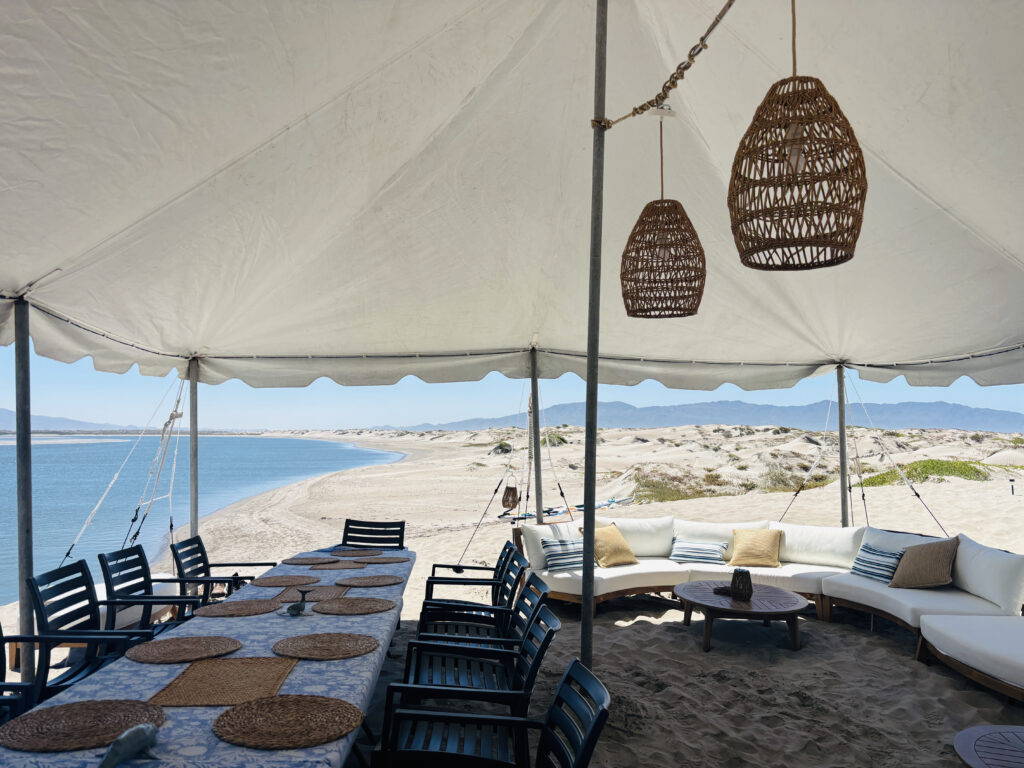
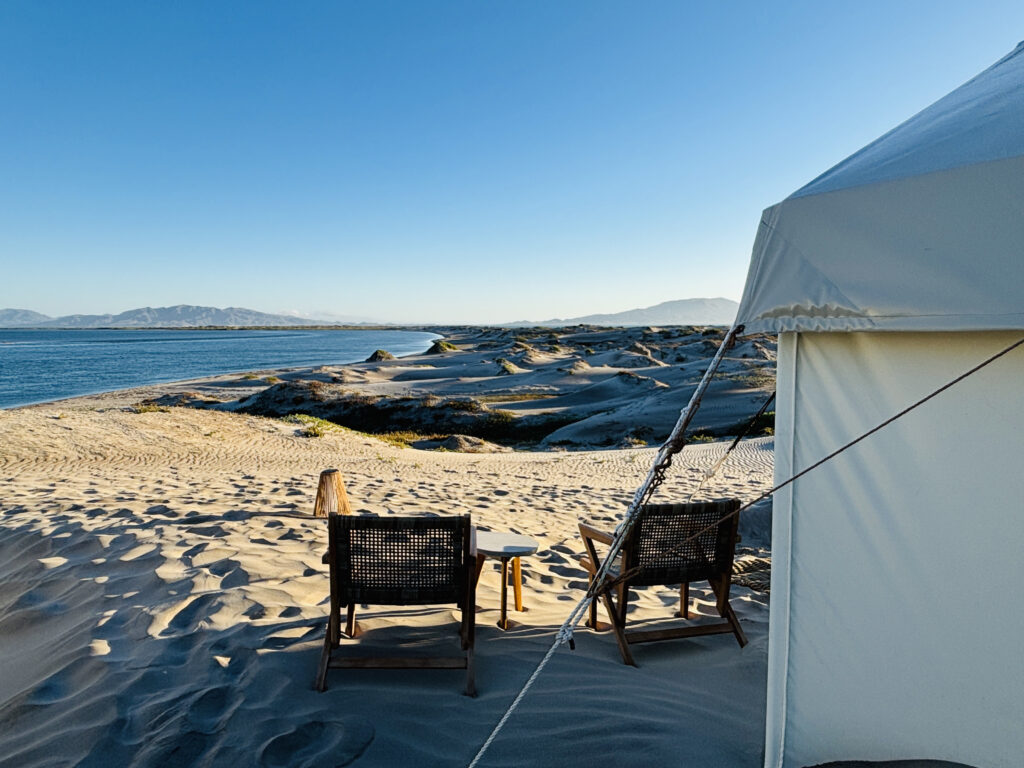
Together with her husband Sergio, Bryan co-founded Todos Santos Eco Adventures to pioneer outdoor adventure in Baja California Sur, curating a wide range of experiences, such as kayaking, hiking, birdwatching, coral gardening, sandboarding, cliff walking, surfing and whale watching, while upping the wow factor at three off-grid camps. This includes their latest endeavour, Camp Cecil de la Bahia, set on sprawling sand dunes overlooking the grey whale mecca of Magdalena Bay.
Elegant touches in the safari tents at Camp Cecil de la Bahia. (Photo: Robin Esrock)
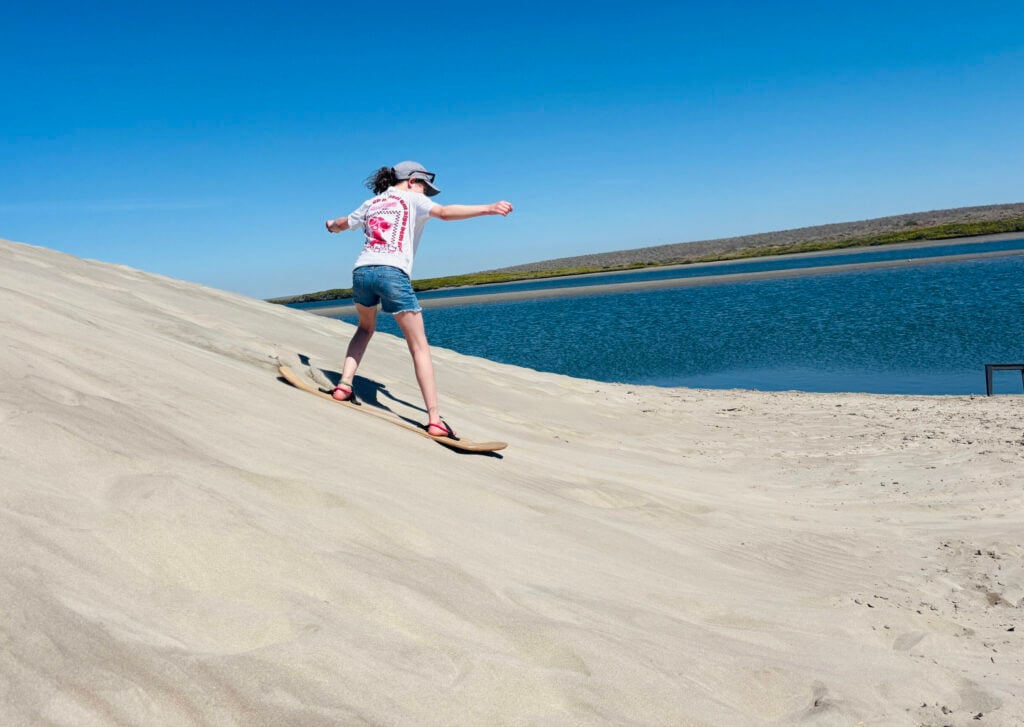
Sandboarding on the dunes at Camp Cecil de la Bahia. (Photo: Robin Esrock)
It’s a two-hour-plus drive north from La Paz on bullet-straight Highway 1 before we turn onto the bumpy dirt road to Cancún. Not the resort city of Cancún, 3,500 kilometres away in the Yucatán, but a tiny, namesake wood-shack fishing village primarily occupied by pelicans, cormorants, blue crabs and seagulls. Camp Cecil guests hop on a motorboat for a half-hour ferry to the dunes, where we are greeted by smiling staff, a cocktail, and large safari-style tents with a dazzling view.
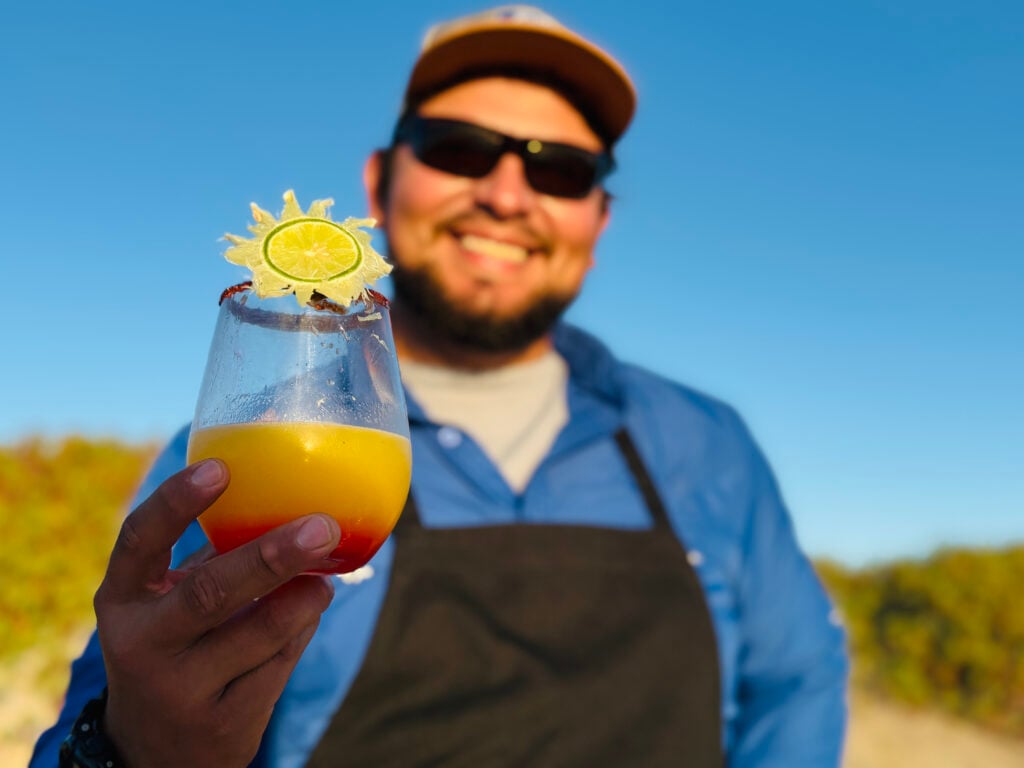
A sunset cocktail with smiles at Camp Cecil de la Bahia. (Photo: Robin Esrock)
“Luxury here has always been the nature,” says Bryan, visiting to assess the inaugural season’s success. “To be in a place this beautiful and remote, you typically have to rough it and have serious camping skills. But here, you can bring your kids or your parents, enjoy an experience perhaps just outside your comfort zone, but celebrate at the end of the day with great food and a comfortable bed.”
We’re shown to our gorgeous safari-style tent with thick duvets, plush carpets, elegant décor, and an ensuite bathroom with a foot-pump-operated sink and a compost latrine. Within minutes, my daughter wanders off, and I’m a little worried when I can’t find her. “I was just following coyote footprints to a massive beach beyond the dunes,” is her excuse, warming my heart to see an adventurous apple falling very close to her father’s tree.
Overlooking a lagoon, Camp Cecil de la Bahai is rebuilt on sand dunes from scratch for every season. (Photo: Robin Esrock)
Tents with a view at Camp Cecil de la Bahia. (Photo: Robin Esrock)
After an outstanding lunch of tuna sashimi tostadas and fresh guacamole, my daughter investigates bones and shells, triggers avalanches in the soft dunes, conquers the sandboards, and makes friends with a nine-year-old girl visiting with her family from Guadalajara. We paddle out in sea kayaks to explore nearby mangroves and sandbars, watching turtles breach as pelicans and osprey dive bomb for fish.
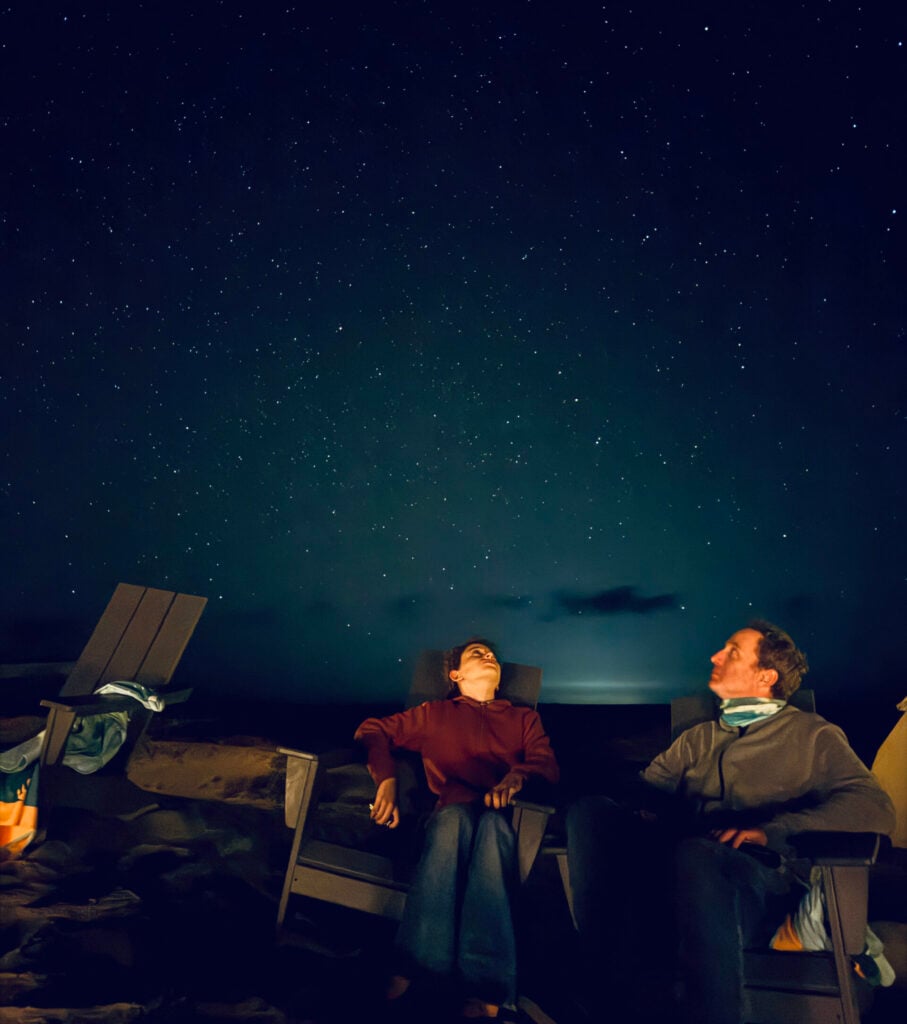
Epic stargazing on top of the dunes at Camp Cecil de la Bahia. (Photo courtesy Quetzalli Gallo Campos)
Returning to camp, we gather for cocktails on the beach and one of those epic sunsets that never sets in your memory. A locally caught lobster dinner, sourced from another fishing village, is followed by sensational stargazing, enthusiastically led by Sergio, who draws on his deep knowledge of myth and story. The girls dip their toes in the dark waters of the lagoon and gasp at shimmering bioluminescence mirroring the stars above. You remember days like this for a lifetime.
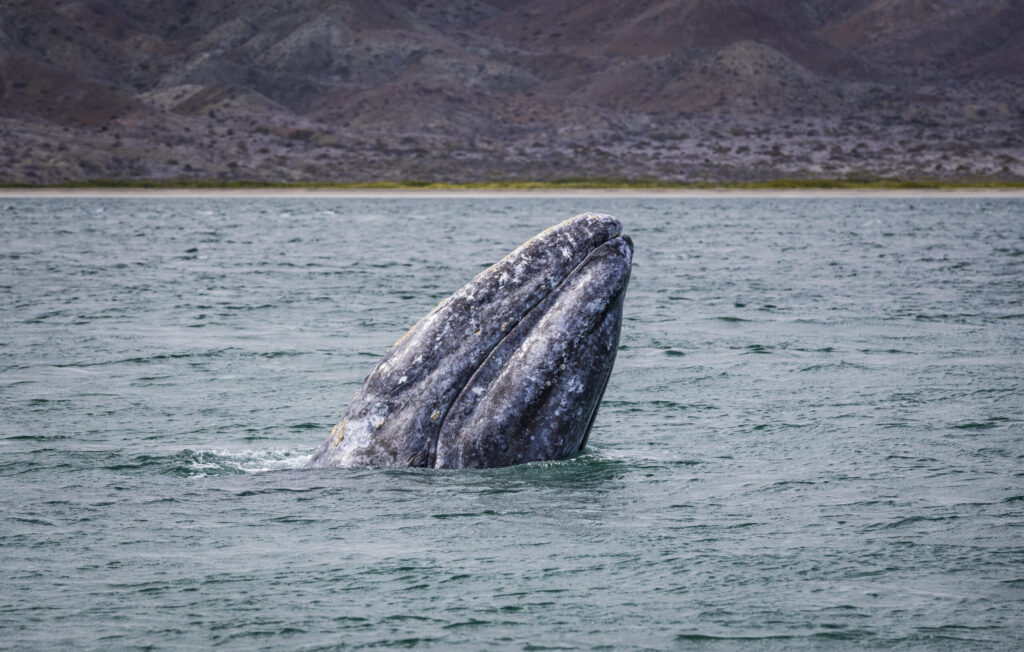
That Camp Cecil delights a nature lover’s imagination is no accident. The Cecil in question is Cecil Kramer, an Emmy Award-winning animation producer with credits that include Wallace & Gromit and Shrek. A close family friend of the Jaureguis, Cecil takes on each glamping site as a passion project, designing the interiors, layout, and ensuring an overall sense of wonder for all ages. Close encounters with a curious, spy-hopping grey whale in Magdalena Bay is the camp’s major draw, which is why the season runs January to March.
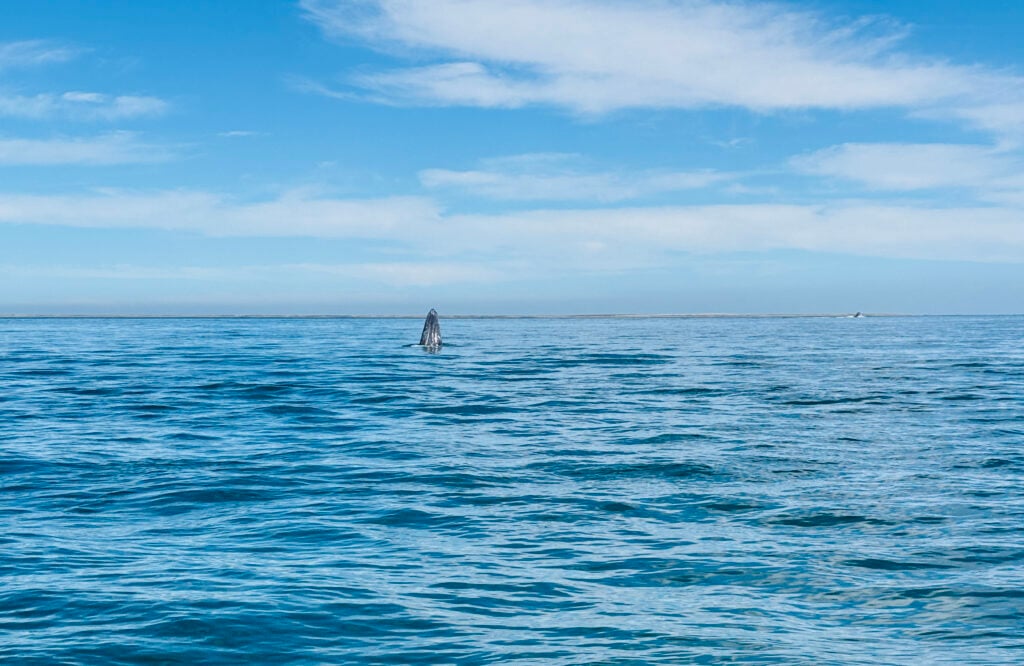
A spyhopping grey whale fattens up before the long migration north. (Photo: Robin Esrock)
We spot the last few grey whales in the bay before they begin their great migration to their northern feeding grounds, undertaking one of the longest migrations of any mammal on the planet. It will take a week or two for Bryan’s team to strike camp, after which all signs of its existence will dissipate like fine sand in the onshore breeze. At least until next season, when the shifting dunes will host a new version of Camp Cecil de la Bahia. I implore Bryan and Sergio to extend next year’s season for us Canadian spring breakers. Whales or no whales, being comfortably immersed in this kind of remote coastal beauty is one for the bucket list.
If SmartFish founder Hoyt Peckham has his way, diners in the high-end restaurants of Los Cabos will soon be guaranteed something that may have eluded them for some time–fish caught sustainably in the waters of Baja California Sur.
It seems hard to imagine that restaurants located on a spit of land between two vibrant oceans would have to import fish, but that is exactly what has been happening. Says Drew Deckman, founder and chef of restaurants in Los Cabos and Valle de Guadalupe, “It’s not that there aren’t fantastic fish in the local waters–some of the best seafood in the world is here. The issue is that some methods for catching and processing fish can destroy quality, so sometimes I have to go out with local fishermen myself to ensure that we’re providing our customers with the high quality, sustainably caught fish they deserve. It’s a shame.
Hoyt Peckham describes the problem faced by fishing cooperatives throughout the Baja peninsula. “Many of our local fishing cooperatives are caught in a vicious cycle. They are very good at fishing, but they don’t have the capital or the capacity to bring their fish to market, which puts them at the mercy of aggressive buyers. They end up receiving very poor prices for their fish, so every time they fish they have to make up for the low prices with higher quantities. For example, fishermen at Magdalena Bay sell some of their fish for between 5 and 8 pesos per kilo. By comparison, dirty plastic bottles fetch 9 or 10 pesos per kilo. This means that these fishermen are literally selling their fish for less than garbage, and to break even at that rate they need to catch and sell 800 kilos per day. To make money they need to do 1,000 kilos per day, and there is no way for a small boat to maintain quality at those volumes. This is the reverse alchemy that plagues Baja fishermen: they catch something that could be worth gold, but they’re selling it for less than garbage.”
The mission of SmartFish is to reverse that equation and the overfishing that it fuels. Fishing is at the heart of communities throughout Baja, and SmartFish aims to empower local fishermen and their families to rescue the value of their product, while avoiding the predicted extinction of key target species. Says Hoyt, “Here we are on one of the most pristine coasts in North America, fishing every day in the “Aquarium of the World,” but distinguishing customers are importing their fish. We have to reverse that trend.” Otherwise, fears Hoyt, these communities will continue to be marginalized, with a good swath of the social fabric of Baja destroyed in the process.
The current quality problems stem from three main factors: how the fish is caught, how it is stored, and how it is processed.
How it is caught: Many fishermen use gillnets or traps to catch the volumes they need. These processes produce stress in the fish, which leads to a dramatic increase in blood flow, as well as the excretion of hormones and enzymes. These factors lead to an accelerated degradation of the fish’s flesh when it dies, meaning a much poorer quality of fish reaches the shore. In addition, fish often suffocate in the traps and gillnets, which means they are dead by the time they are brought on board the boat; they have literally started to rot.
How it is stored: The small fishing pangas of some fishermen have no refrigeration to speak of, so these large volumes of fish are simply dumped in the bottom of the boat where they cook in the hot sun all day. Needless to say, this seriously degrades the quality of the meat. Further, when they reach the shore, in many cases these mounds of fish are just shoveled onto the ground where they continue to cook in the hot sun during processing.
How it is processed. In some places, the fishermen’s families process the fish at the beach on wooden tables in the sun, and with a large catch, processing can take quite a long while.
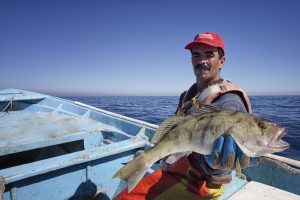
The SmartFish Difference. Hoyt and his team set out to address these problems by forming a social venture with five fishing cooperatives in Magdalena Bay. The fishermen quickly grasped Hoyt’s vision of higher profitability and sustainability, and Hoyt helped them gain access to funding for the equipment and training they needed to make the vision a reality. The fishermen successfully switched from their high volume, high bycatch gillnetting and trapping techniques to much smaller volume / no bycatch hook and line fishing and eco-traps that have escape hatches for smaller fish and barriers to larger fish. All fish are brought in alive by hand, quickly dispatched and bled, then immediately put into ice water, maintained below 4C.
“This process generates fish that is dramatically different in quality, and the high-end chefs have really been blown away.” Says Drew Deckman “Not only are we willing to pay a premium for the superb quality of fish coming out of SmartFish, we’re willing to pay a premium for the sustainability that is inherent to this process. This is a major win for both the fishermen and the restaurants they serve in Baja.” One of Smartfish’s first customers was El Bismarkcito, a much-loved seafood restaurant in La Paz. The owner, who has been selling seafood under the same trees along the Malecón for decades, at first refused to believe that the fish was one of the species she had bought for years. When finally convinced, the only question she had was, “Can you get me more?”
For SmartFish the challenge now is not demand but supply. The success of the pilot cooperatives is generating considerable interest, but not even all the boats in the those cooperatives have been converted; it takes at least one year to get a fleet up to the SmartFish standard. With a relatively small number of boats in the program, Hoyt currently can personally guarantee that the fish bought by El Bismarkcito or Drew has been caught responsibly. But soon that will change as the number of fisherman in the system increases. To address this issue SmartFish is launching a process of traceability using the technology and techniques of ShellCatch (www.shellcatch.com) in which consumers can track a fish from the fisherman’s hook to their own plates.
Hoyt characterizes all this as SmartFish’s “Value Rescue formula” and is excited that it is yielding “impressive triple-bottom-line outcomes”: 1. Economic
outcome: fishermen are realizing important price increases, usually exceeding 100%; 2. Power outcomes: Fishermen and their families are taking control of their economic destinies as price setters, and chefs and other retailers are able to offer sustainable and high quality seafood; and 3. Environmental outcomes: there is a 40-60% lower catch volume than the status quo for target species; there are minimum and in some cases maximum size limits; there is decreased fish bycatch and zero megafauna bycatch (no turtles, dolphins etc. killed in gillnets); and a switch to more resilient target populations, i.e. away from grouper and shark towards sand bass and yellowtail.
Drew Deckman is sold. “I’m the governor of Slow Food for the entire Baja peninsula and the vertical integration that Hoyt is seeking in the fishing cooperatives is exactly what I look for in every new location in which I establish operations. Before I was a chef I was a commercial fisherman and a master diver, so for me the SmartFish solution is ideal; it is the logical conclusion of all my efforts. It’s fantastic to work with Hoyt and the cooperatives, and we’re all excited about the change this will bring to the lives of fishermen in Baja.” SmartFish, smart choice.
For more information on SmartFish you can visit their website at http://smartfish.mx/
It’s Not all Dire Straits in BCS
Todos Santos Fisherman Agustin Agundez
Of course not all fishing cooperatives in Baja are subject to the same forces Hoyt describes. Many receive good prices for their fish and have catching and processing techniques that deliver a high quality product to consumers. In Todos Santos, for example, fishermen Agustin Agundez reports that they receive 60 pesos per kilo for desirable fish like cabrilla and huachinango. While some Todos Santos fishermen do use gillnetting, they also fish with hook and line to ensure that local restaurants have the great quality fish for which they are rightfully famous. Chef Dany Lamote of Santo Vino has a great working relationship with the local fishermen. “The fishing cooperatives in Todos Santos know the quality that Santo Vino demands and we are very pleased with the fish we get here. We often buy the fish right off the boat and it is still very cool and very fresh.”


 The students and science Santiago mentions come from many different places including Arizona State University’s School for the Future of Innovation in Society. Dr. Jesse Senko is the marine biologist and conservation scientist who heads that program. Jesse has a focus on the health of sea turtles, which he sees as tightly tied to sustainable fisheries and resilient coastal communities. Jesse explains the root of his work with Santiago and Matilda. “Fishing gear is the greatest threat to sea turtles worldwide. Sea turtles are vital for the health of the world’s oceans. They perform fundamental roles in ocean ecosystems, many of which are not fulfilled by other species. And humans need healthy oceans to survive and thrive.”
 Another of Santiago’s dreams is to create a fish refuge in his area. To this end he has already worked with the government to create an artificial reef using special technology donated by Japan, and he is hoping to get 10 hectares declared a fish refuge in which only local fishermen can catch commercial-size fish using handlines. The rest of the fish will be left alone to mature and repopulate the area. “Fish refuges often don’t work because the local fishermen aren’t well informed about them,” notes Santiago. “I want to change that. All along the Baja peninsula coastal communities are dying. There are only old people like me and Matilda left. I want to continue to connect with students and scientists so that our young people can carry on with this life in a way that is sustainable and revitalizes coastal life.”
 “Don Santiago and Doña Matilda have been hosting my ASU study abroad class, “Sea turtles, sharks, and fisheries of Baja California”, at Las Pacas over the past 2 years,” says Jesse. “During their time at Las Pacas, ASU students learn in detail from Don Santiago about how his community fishes, what gear they use, and how they are working to advance responsible fisheries.” Las Pacas and its inhabitants are a living classroom, where students from Baja, Arizona, Colorado, California and elsewhere learn what it means to radically change your way of life, to save your way of life. “We are fishermen of excellence” says Santiago. “Our neighbors wonder why we are spending time with all these ‘green people’. It’s simple. I want my children and grandchildren to have the same opportunity I had to make a living from the ocean. I am therefore dedicating my time to science and to the students. This will be my testimonial.”