In the 17th and 18th centuries the Jesuits were on a global roll. In China, the emperor prized them for their knowledge of astronomy, western science and mathematics; the Jesuits were trusted advisors to the court. In France, Spain and Germany the kings prized them for their supreme education and administrative acuity; the Jesuits monopolized the role of royal confessor. In Baja California Sur (BCS), the native Pericue and Guaycura Indians couldn’t quite figure out what to prize the padres for. Often, it was mutual.
Spain’s Ambitions and the Jesuit Theocracy
The Jesuits who established the first successful mission in Baja California in Loreto in 1697 were the latest in a long line of Europeans who had attempted to subdue and convert the peoples of the land they called California for the Spanish crown, starting with Hernan Cortez in 1535. Why such great effort with respect to Baja? The modern Jesuit historian Ernest J. Burrus puts it this way, “The extraordinary interest derived not so much from what Baja California was – an extensive and unproductive peninsula, almost completely uninhabited and uninhabitable – as for what it was believed to be – a land rich in pearls and precious metals, bordering on the straights of Anian…linking the Atlantic with the Pacific, shortening by thousands of miles the distance between Europe and the New World as well as the Far East.”
The Anian Straits were, it turns out, a mythical boundary between North America and Asia, and Baja was a peninsula, not an island as cartographers of the day held. But Spain’s interests were quite real, and one of the crown’s key drivers with respect to Baja was the desire to protect its Manila Galleon, a trading ship that traveled between Acapulco and the Philippines, bringing luxury goods from China and other parts of the East to Spain. The galleons were threatened by English and Dutch ships that were plying the waters of the Baja peninsula, using the harbors and bays of the southern tip of the peninsula as a base from which to plunder the Spanish ships as they attempted to transverse the Pacific. Moreover, the return voyage from Manila to Acapulco took 6 to 7 months, too long to maintain stores of potable water and fresh food. By the time the Manila Galleon was sailing past Baja, most of the crew and passengers were in the last stages of scurvy and beriberi; Acapulco was simply too far. They needed a place to go ashore to eat fresh food and recuperate. A safe harbor on the Baja peninsula was the only way to stave off death – and keep Spain supplied with the luxurious items from the Orient it coveted.
But Spain had no money to send a military force to secure the peninsula, and the Jesuits, keen to convert the Indians of California to Catholicism, saw an opportunity. Lead by the Italians Juan
Todos Santos Mission
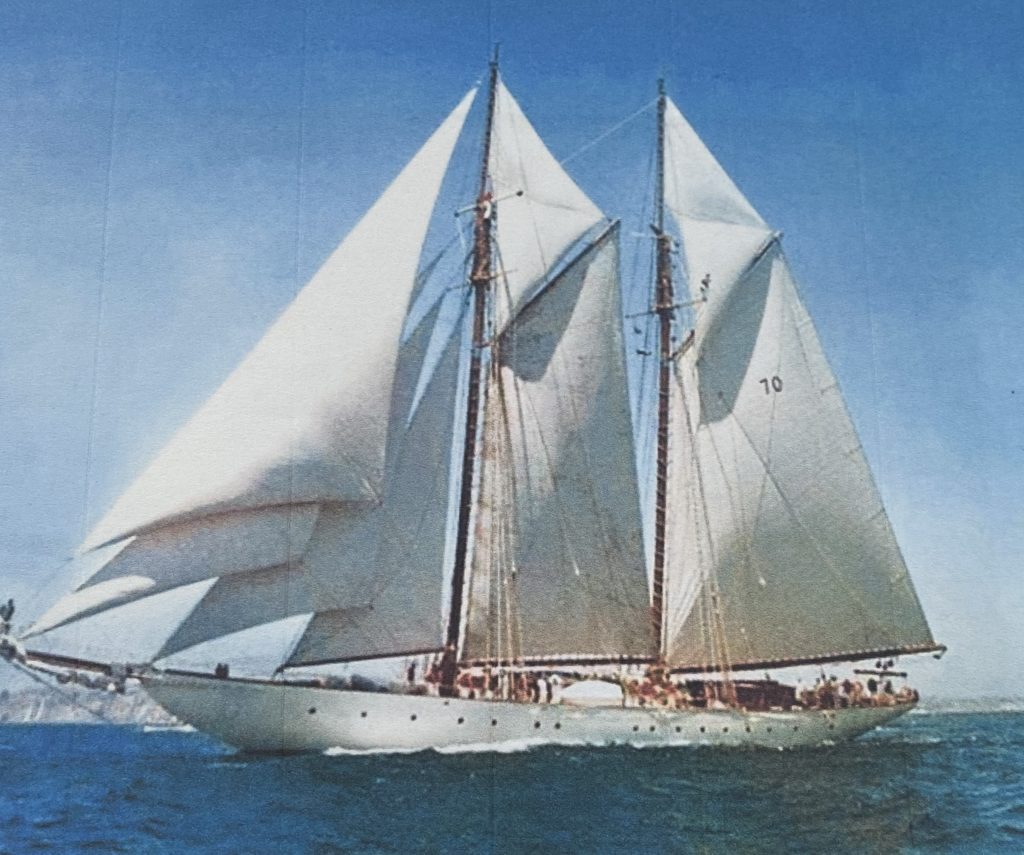
María de Salvatierra and Eusebio Francisco Kino, the Jesuits struck a bargain: if the crown would give the Jesuits permission to settle in the peninsula and convert the Indians, they would pay for the whole thing themselves. In return for funding the enterprise, the Jesuits would manage all aspects of local government themselves, religious, military, civil and economic. The crown agreed, with the result that the group that was finally able to secure the Baja peninsula for Spain was, as Crosby notes, “the least impressive of armies.” When the Jesuit galley the Santa Elvira anchored off the coast in the Gulf of California on October 19, 1697, the crew it landed to conquer the shore included an Italian missionary, a Spanish soldier, a Portuguese ranch foreman, a Sicilian seaman, a creole muleteer, a Maltese artilleryman, a Peruvian sailor, a Yaqui warrior, a Mayo herder and an Indian boy. And with that multicultural force, the history of California was changed forever.
The Geography of Hope
The Baja peninsula is a piece of continental crust that was torn from mainland Mexico by violent, sustained, tectonic forces six million years ago. As naturalist Exequiel Ezcurra explains in The Camino Real and the Baja California Peninsula, “The folds and crests that have formed as a result of this intense tectonic activity are the principal cases for the uneven topography of Baja California, causes which in turn drive the local climate.” The Jesuits, despite their advanced level of education, were “Misled by their ignorance of the peninsula’s natural environment and their inexperience with peninsular people,” says Crosby. It was a steep learning curve.
From their base in Loreto the padres set out to establish a series of missions from which they could save souls, and initially chose areas where the Indians appeared to congregate. Their experiences in mainland Mexico had led the padres to believe that the California Indians would have strong emotional ties to certain locations, and they completely failed to grasp that the terrain of Baja meant that the Indians practiced their semi-nomadic, seasonal hunting and gathering regimen over a wide geographical area, with no particular attachment to any one place. The Indians depended for their survival on a deep knowledge of tinajas, or bedrock cachements, that held rain for a substantial period of time after a rainfall. The Jesuits were unaccustomed to operating in a land with no rivers and no consistent annual rainfall. They gradually gained a better understanding of the land and its peoples, but, as Crosby notes, “The Jesuits initially failed to realize that supporting a mission’s people on irrigated agriculture required many times the volume of water that the same group used in their traditional lifestyle. Their education was expensive. Of nine missions founded in the first 24 years of the conquest, one was abandoned and 5 had to be moved to better sites.” It was not a stellar start.
The business of saving souls proved equally complex. In the northerly central areas around Loreto, they found the Cochimi Indians somewhat welcoming. But further south, the Guaycura and Pericue Indians were proving much tougher customers. In the early 1700s there were probably about 5,000 Guaycura in the area between Magdalena Bay and Todos Santos, and 3,000 Pericue in the area south of Todos Santos to the Cape. They were not friendly, even with each other. The Guaycura roamed their territory in small groups who spoke different dialects and constantly battled with each other, the Cochimi and the Pericue. For their part, the Pericue spoke a common language and battled less among themselves, but they were accustomed to a great deal of independence, a character trait which did not square well with the Jesuit desire to lure them into mission life. Indian distrust of the padres was likely fueled by the English and Dutch pirates who stalked the Manila Galleons from their bases in BCS, and who, as Crosby notes, “had reasons to instill in the local people their own fear of any representative of Spanish authority.” And the Jesuits had made the bargain to be the sole representative of that authority in all matters
El Camino Real
Poor welcome notwithstanding, the Jesuits pressed on with their plans to build and maintain a camino real. The term “Camino Real” or “Royal Road” has its roots in medieval Spain and referred to roads that were built and maintained at the behest of the king. In colonial Mexico, the phrase was used to refer to roads that connected major settlements, and in California, the phrase came to mean the system of communication that facilitated the constant flow of people and provisions that were required for the colonization of the Baja peninsula. Generally, there was very little that seemed royal about the roads that the padres built with the labor of their Spanish soldiers and neophyte Indians. In many cases road building meant simply moving large obstacles out of the existing Indian footpaths that provided the most direct route from one site to another. But they did succeed in building impressively straight roads over tough terrain, and El Camino Real eventually connected the mission in San Jose del Cabo to the mission in San Francisco, California, covering almost 1,400 miles and over 50 missions built by Jesuits, Dominicans and Franciscans. More than any other, it is the route the ties together the histories of the United States and Mexico.
But at no time in their 71 years in the Baja peninsula did the actual number of European Jesuit padres on the ground total more than 17 men. It proved to be a dangerously low number. In the first third of the 1700s the Jesuits remained a most unimpressive army, and as they built their roads and missions in the hostile south to secure a safe port for the Manila Galleon, the Spanish crown refused to pay for more soldiers to protect them. And the natives were definitely restless. Raging epidemics of measles and smallpox had decimated the Guaycura and Pericue populations, reducing their populations by half in a single generation. Years passed in which the Jesuits and their converts did little more than tend the sick, bury the dead and attempt to procure food from the mainland; years of drought and plagues of locusts had severely limited their ability to support a settled community through agriculture on mission lands.
Against this backdrop, in 1733 the Jesuits of the southern missions, led by Padre Nicolás Tamaral, began an effort to eradicate polygamy amongst the Pericue. With their missionary zeal and Eurocentric outlook, the Jesuits had been working for years to quell the ancestral customs of the Indians, but the attack on polygamy appears to have been the tipping point for the Pericue. As Crosby states, “The subject of women was particularly sensitive among the Pericue at that time. Diseases, most notably syphilis, were disproportionately reducing the female population. Neophytes in the south were deeply disturbed by a growing lack of mates.” Amongst all the Indians of the Baja peninsula, women were the chief procurers of food, so the more wives a man had the higher his status; important men like chiefs and shamans had several. In a pointed challenge to local leaders, Padre Tamaral made explicit efforts to attract young women as neophytes. It was missionary vs medicine man, and the unprotected missionaries were vulnerable while the traumatized Pericue were deadly focused; they were able to unite the warring factions of the southern Baja Indians against what they saw as an alien invader who had unleashed ravaging disease against their people and wanton destruction against their culture. The pirates likely fueled their rage.
On October 1, 1734 the body of Padre Nicolás Tamaral of the San Jose del Cabo mission was found clubbed, mutilated and burned. The same thing happened to padres and their servants at the missions in La Paz and Santiago. The revolt grew, the Pericue consolidated their hold on the tip of the peninsula, and when the Manila Galleon landed at the Cabo port established by the Jesuits in January 1735, the Pericue killed all 13 men in the longboat that had been sent ahead to seek help from the mission.
It was the beginning of the end for both the Jesuits and the Indians in BCS. Salvatierra and Kino’s dream of a theocracy was lost, as was California’s isolation as others came in to settle the land. By the time the Jesuits were expelled from California in 1768, the Guaycura and Pericue were linguistically and culturally extinct – perhaps their genes live on in the world and their souls reside in heaven. The Jesuits were suspected of harboring hordes of gold, silver and pearls that they were not sharing with the king, but when the inspector came from Spain after their expulsion, he was shocked at the poverty of the missions. The Jesuits had barely survived, and producing food to keep the missions and their neophytes alive in the harsh Baja landscape was almost all they had time for.
It was not an accident that the first people to come ashore with Padre Salvatierra at Loreto in 1697 included a ranch foreman, a muleteer, and a herder. These Jesuit recruits were chosen for their skills in building a community based around agriculture and ranching. When the Jesuits were expelled from California, many of these “soldiers” and their families stayed on and became the backbone of the vaquero, or cowboy culture that replaced that of the native Indians, a culture that – unshackled from the poorly chosen mission sites – still thrives in Baja to this day. In fact, this culture was exported north along El Camino Real, and the Baja vaqueros are now honored in the western USA as the cultural ancestors of the American cowboy. To celebrate El Camino Real and its role in the cultural connection of the peoples of the Baja peninsula and the US state of (Alta) California, several organizations are working to have the entire 1,400-mile corridor declared a UNESCO World Heritage Site.
What Ezcurra calls “the savage and seductive landscape of Baja California” has lured many to its shores, and changed the fates of all. The Pericue, who quite possibly sailed to Baja from Polynesia, survived on the peninsula for roughly 12,000 years. The Jesuits only 71. Human survival along El Camino Real can still prove tenuous, and it is perhaps for this reason that the writer and naturalist Wallace Stegner refers to the wild landscape of Baja as the “geography of hope.” Writes Ezcurra, “Baja California, more than any other place on earth, deserves this description: the peninsula is a vast corridor of hope, a world where untamed nature may still be able to survive in all its splendor. Or, as Octavio Paz wrote, it is a place where, “the world still has beaches, and a boat awaits you, always.” And that is a royal road indeed.
Sources: Interviews with Harry W. Crosby, David Richardson and Trudi Angell. Several books including Antigua California: Mission and Colony on the Peninsular Frontier, 1697-1768 by Harry W. Crosby; Jesuit Relations, Baja California 1716-1762 by Ernest J. Burrus, S.J.; The Camino Real and the Missions of the Baja California Peninsula/El Camino Real y Las Misiones de la Peninsula de Baja California by Miguel Leon-Portillo, California’s El Camino Real and its HistoricBells by Max Kurillo; and Californio Portraits: Baja California’s Vanishing Culture by Harry W. Crosby.
Ashes to ashes, dust to dust. That may be the fate of the mortal coil, but humans have never had much truck with letting flesh have the final word. “Rock, stone, mosaics, ceramics. These are the lasting materials of any civilization,” says Donna Billick, the founder of Billick Rock Art in Davis, California and Todos Artes in Todos Santos, Baja California Sur. “Rock art is the only uninterrupted communication throughout human history of who we are culturally. It is a statement of who we are in our time as well as the transmission of ourselves through time. When you look back across the ancient civilizations of Mesopotamia, Greece, Rome, China, Mesoamerica, you will find ceramics and mosaics embedded in the culture, still informing us today in vibrant and dynamic detail about those ancient lives lived.”
In fact, ceramics – clay hardened by heat – are so durable that NASA incorporates the material into present-day spacecraft engineering. The space agency actually has a page on its website devoted to “Superhero Ceramics!” noting that ceramics are “stronger than aluminum, fireproof and able to withstand meteoroids.” Among many other uses, the entire lower surface of a space shuttle orbiter is covered with ceramic tiles as part of the spacecraft’s thermal protection system. But there is another material that is equally compelling to NASA and that is “pound-for-pound more effective for shielding against cosmic radiation than aluminum.” Plastic. In fact, the same material used to make household trash bags, polyethylene, can be chemically modified into a material that has three times the tensile strength of aluminum and is 2.6 times lighter.
That type of durability is highly desirable for space travel, particularly for any humans interested in traveling to Mars who would have to endure high levels of radiation for up to 30 months. But the very durability that makes your plastic trash bag seem like Superman’s cape in space, makes it a more of a Lex Luther-grade menace when it simply envelopes your trash in a landfill on earth. It can take up to 1,000 years to decompose, and in the process it can release toxic pollutants into the air, ground and water that threaten our very existence on the planet. It is probably safe to say that we would all rather have our first trip to Mars be by personal choice then by mandated evacuation order.
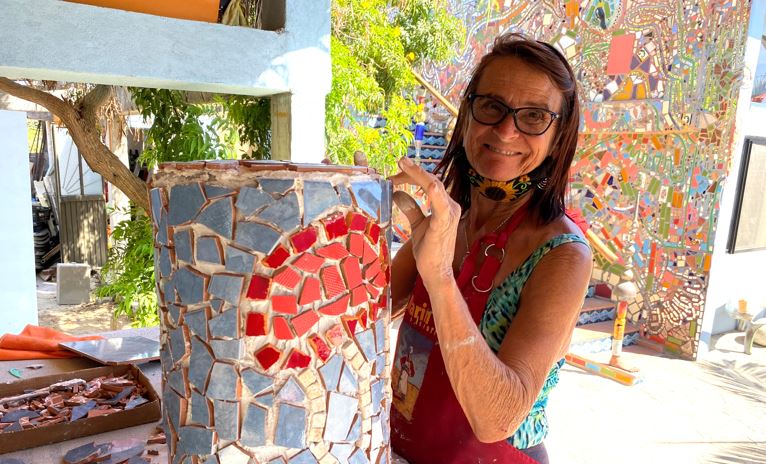
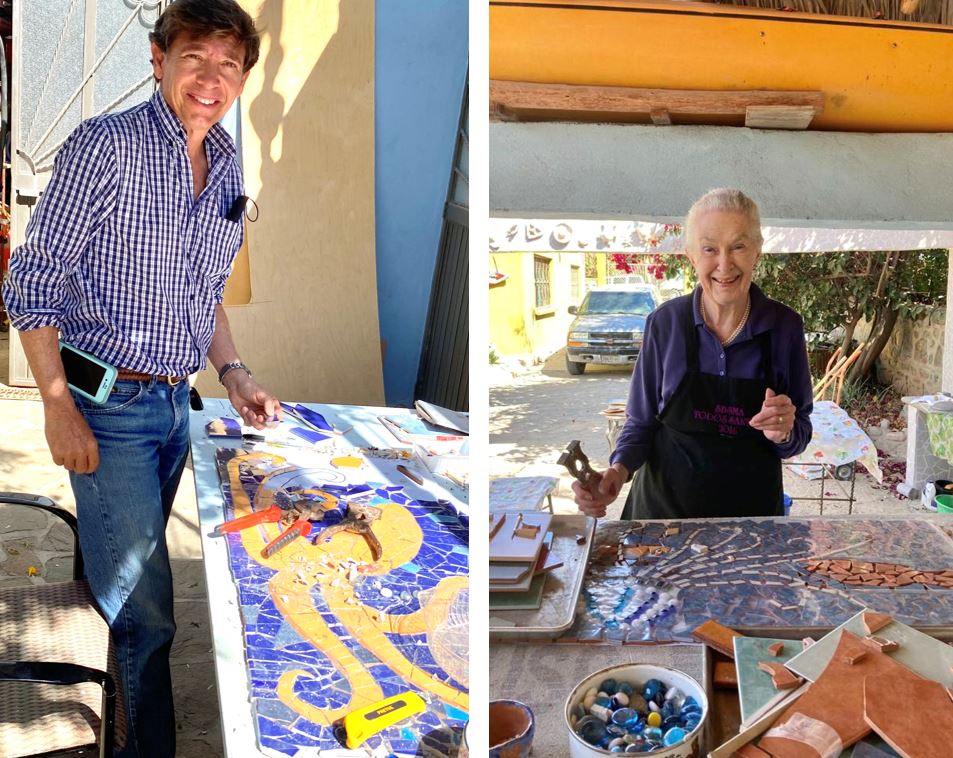
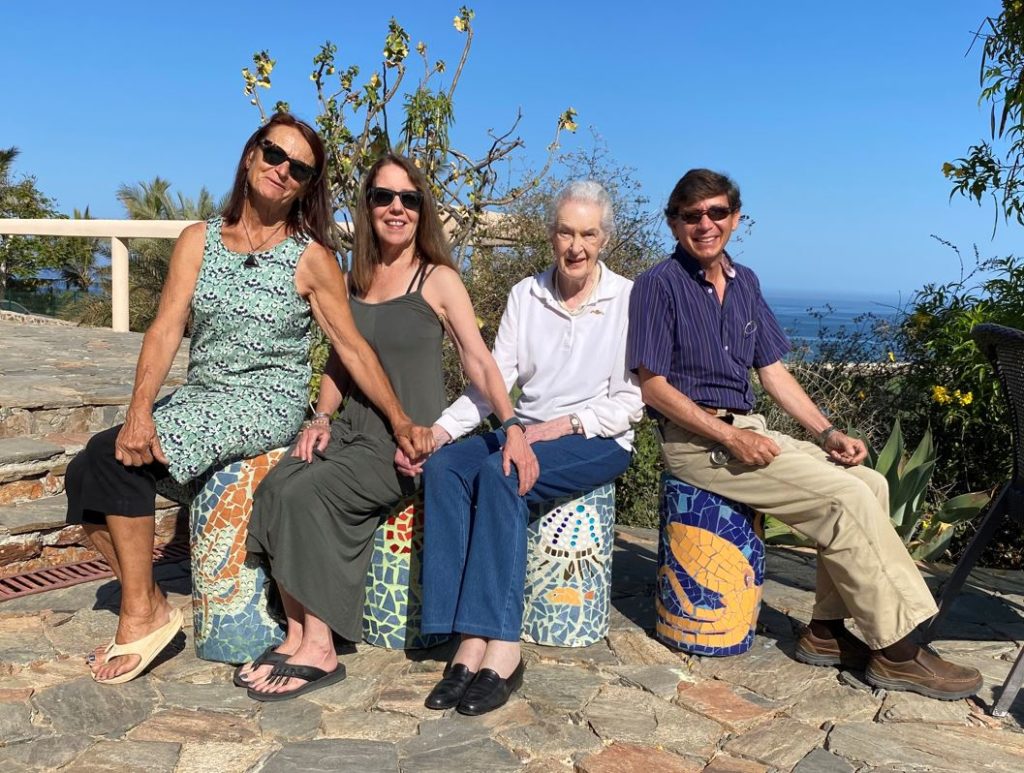
Donna, who has a degree in genetics in addition to art, started the Art & Science Fusion Program during her tenure as a professor at the University of California Davis. It is therefore not surprising that she and her Todos Artes “quaranteam” of artists, surfers and environmentalists Isabel “Issy” Von Zastrow and Will Worden, saw their two worlds happily collide around the durable properties of ceramics and plastic. It all started with the ecobrick. Explains Will, “An ecobrick is a plastic container like a Coke bottle or a garafon (large water container) stuffed to the brim with non-biodegradable plastic waste. This makes a very strong, reusable and long-lasting building material that can be used to make many things including furniture, garden walls, and sculptures. Issy and I were working on ecobricks for our new home, when we happened to observe Donna giving a ceramic mosaic workshop. The lightbulb kind of collectively went off for all of us, and we all saw a great way to mitigate the extremely negative impact of plastic waste’s durability, with the culturally positive impact of ceramic’s durability. When we take the ecobricks and encase them in concrete and ceramic mosaics, it makes a beautiful and enduring piece of art. From the basic building block of an ecobrick, you can make lamps, tables, chairs, really all kinds of beautiful, functional pieces.”
When Donna got out of graduate school in the mid-1970s, the governor of California at the time, Jerry Brown, mandated that 2% of the budget for all public buildings be devoted to art. For Donna, this was the answer to her father’s daily question during her childhood, “so what is your big idea?”, and she’s spent the last 42 years producing large scale art for public spaces. But having her art enjoyed by everyone, not just a few private collectors or gallery owners, is only part of Donna’s Big Idea. “Community build is really where it’s at. Jerry Brown saw public art as a key component of an enlightened, vibrant and thriving society. And when the community itself participates in making a piece of art, it creates a sense of collective ownership and pride in the art that is simply not possible any other way.” Donna, a founding member of the Community Built Association, brought community build to Todos Santos through Todos Artes and her annual Heaven on Earth workshop. Two of her ceramic mosaic pieces built by Todos Santos community members, the Aztec Calendar just off the Todos Santos town plaza, and the Los Todos Santeños wall along the well-traveled route of lower Topete, are now some of the most-photographed, most-loved, and iconic images of the town.
Issy outlines how the ecobricks can fit into a long-term community build program for our tourism-driven area. “There is a difference between impact and influence. One way that the communities of Baja California Sur can influence the impact of tourism on our towns is to invite all travelers to contribute to the ecobricks. Each hotel, restaurant and Airbnb rental can have an old garafon in a central area and invite travelers to stuff it with their plastic waste. When the garafon is full, either we at Todos Artes will come pick it up to turn it into functional art, or we can share with the proprietors how to do it themselves. We invite visitors into our communities to experience the area’s great natural beauty, and this is a great way for them to help ensure that the place will be just as beautiful the next time they visit. They can influence the impact they have on the community in a lasting, beautiful way.”
There is a group called The Long Now Foundation that is in the process of building the 10,000 Year Clock – a clock it expects to keep time for 10,000 years – with the help of ceramic bearings of course. The clock is a monument to long-term thinking and Alexander Rose, the executive director of the project notes, “It is not the engineering [of the clock] but the civilization around it which we hope to shape as one that cares for both the present and the future. We hope that by building such things…they challenge us to become better ancestors.” The Todos Artes team sees ecobricks in much the same light. Says Donna, “The ecobricks are a great way to increase the environmental literacy of our community, to engage the current generation in a completely fun way in the preservation of the stunning nature all around us for future generations.”
Perhaps when the 10,000 Year Clock strikes its last hour all those centuries into the future, and the archaeologists are writing their books on the ancient artifacts of the 2020s in Baja California Sur, they’ll be struck by the care that society took to turn one of its most enduring problems – plastic waste – into some of its most enduring works of art. Rock, stone, mosaics, ceramics. With ecobricks we’ll be transmitting who we were culturally to all the generations to come. We’ll be proving ourselves good ancestors. And, if all goes according to plan, those receiving the message will still have the option to live on a vibrant, thriving and enlightened Earth.
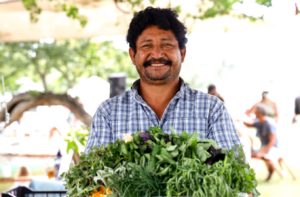
Mahi mahi straight from Agustin’s boat, strawberries with crème freche right out of Agricole, Nasturtium-adorned salads fresh from Jan’s farm, zillions of mangos, right from your own tree. This is the type of food security enjoyed by many residents of Baja California Sur (BCS). All fresh, all delicious, all healthy – and always obtainable in season.
BCS is the fastest growing state in Mexico, with vast sums of tourism-driven dollars flooding the state. This growth, rapid and seldom interrupted over the last few decades, has acted as a beacon to people across Mexico, drawing thousands of immigrants seeking economic opportunity. The Ministry of Economy reported a population increase in BCS of over 25% between 2010 and 2015, a rate which does not appear to have slackened. Yet BCS does not have the infrastructure or resources to adequately feed and house all the new arrivals, a fact that has given rise to a slew of informal settlements across the lower part of state, many without even the most basic of public services. Not coincidentally, the government agency CONEVEL states that in 2020 roughly 29% of the population in BCS was living in extreme poverty, with almost 35% of the population suffering from social deprivation, including deprivation of food access. In this land of plenty, accessing fresh, nutritious food is an extreme challenge for many.
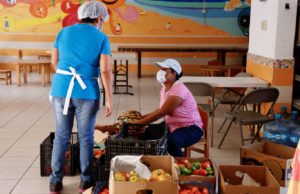
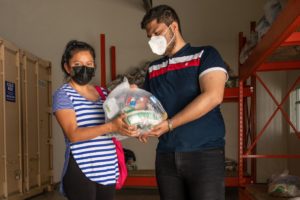
“The International Community Foundation (ICF) founded the Alianza Para la Seguridad Alimentaria (ASA, or BCS Food Security Alliance) in 2014 as an alliance of nonprofits, business owners, government agencies and individuals committed to addressing food insecurity in southern BCS” notes McKenzie Campbell, a program officer with the ICF. “When the pandemic slammed into Mexico in March 2020, BCS was one of the hardest hit states because of its heavy reliance on tourism. Food assistance groups exploded across the state, and by December 2020 many of these groups were serving more than twice their pre-pandemic population.” Because BCS did not have a state foodbank, these groups were spending precious time and resources sourcing ingredients. ASA mobilized to effectively become a mobile food bank for these groups, supporting their efforts with the distribution of despensas (packages of donated food and hygiene essentials) to the informal communities. Continues McKenzie, “It was when we were actively distributing despensas that we realized that without a formal government safety net or a reliable food supply, these communities would be in a constant state of crisis. The pandemic really showed that we needed a permanent solution to addressing food security in BCS.”
Luis Garduño, the director of ASA who was in charge of distributing despensas during the pandemic, says that the ICF doubled down on its commitment to food security during the pandemic. ASA had been formalized as an independent Mexican nonprofit in 2019, so it was the perfect platform from which to accelerate food security efforts in the region. Says Luis, “The first thing we did was conduct a series of diagnostic studies looking at all facets of the food system in BCS from producers, to distribution points, to consumers. Based on what we learned through these studies, ASA is focusing its efforts in three main areas: creating a Sudcaliforniano food bank, fostering community health and resilience, and piloting local foodsheds.”
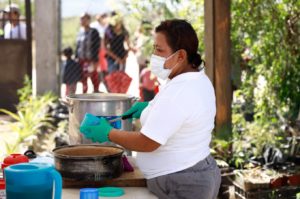
The food bank program is a remarkable testimony to ASA’s focus. Says Luis, “We are really excited about the progress that’s been made with the Sudcaliforniano food bank, and we expect it to be fully functioning with a presence in La Paz and Los Cabos by the end of 2022. We have secured warehouse space in both locations, and we’re working hard to source necessary items like trucks and cold storage.” The core of the food bank program is food recovery and redistribution, salvaging food that is deemed unsellable or unusable by producers and getting it to vulnerable populations. Notes McKenzie, “Around the world 40% of all food produced in the world is wasted and all those inputs lost. In Mexico, 20 million tons of food are wasted every year, enough to feed 70% of the population living in poverty. One of ASA’s first efforts was to assess food waste hot spots in BCS, then implement recovery, redistribution and prevention strategies.” Continues Luis, “In 2021 ASA provided 34 tons of recovered food to 5,800 individuals. Our goal is to be providing recovered food to 12,000 people on a regular basis by the end of 2022.” The Sudcaliforniano food bank is now affiliated with BAMX, Mexico’s national food bank program, and partners with its prepared food donation program, Al Rescate. It also receives and distributes regular donations from several Walmart-affiliated stores, Carl’s Junior and Earth Ocean Farms.
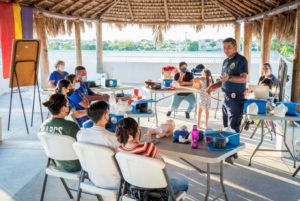
“Another thing we found when distributing despensas to the informal communities during the pandemic was that women were taking leadership roles and doing what needed to be done to protect not just their own families, but also the most vulnerable in their communities” recalls McKenzie. ASA’s second key initiative, community health and resilience, is designed to amplify that leadership, and give these women the tools they need to be even more effective. Continues Luis, “This program is multifaceted. Not only do we work with these women on leadership skills like decision-making, negotiating, effective communication and teamwork, but also on personal finance skills and small business administration skills. We help develop their skills to determine what is the most nutritious food they can buy for their families with the money that they have.” The program also teaches hurricane and emergency preparedness and response, including basic first aid, fire management, hurricane alert and preparedness systems and control centers for emergency response.
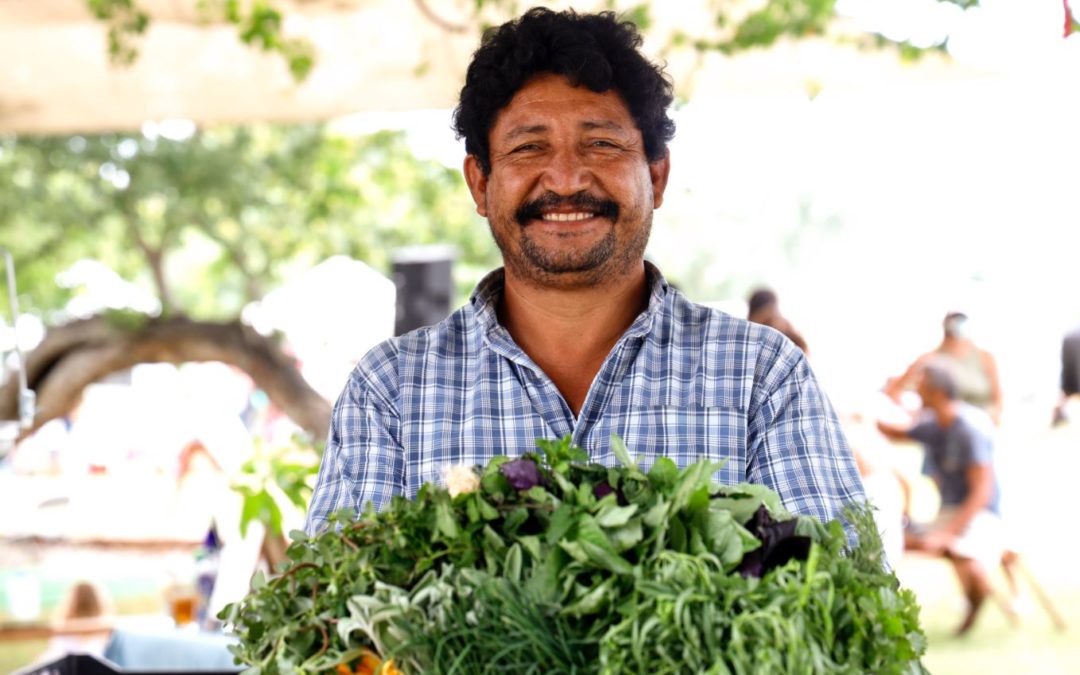
One of the key focus areas of the community health and resilience platform is nutrition and healthy cooking. Local groups like SINADES in Pescadero are at the forefront of this effort. Under the leadership of founder Inés Melchor Pantoja, with assistance from her husband, Julio César Rivas García, SINADES has been working with women in the community for almost two decades on a Conscious Cooking program, making healthy foods affordable, desirable and an integral part of family life. So that they could procure organic produce at a reasonable price, SINADES and the 18 women of the Conscious Cooking program started building greenhouses at their homes a decade ago. The greenhouses have given these women and their families much greater food sovereignty and economic stability, and 3 of them are now expanding into raising chickens. They are currently looking to formalize a point of sale for their chickens, eggs and chicks, and to expand the program to other women in town. SINADES is attacking food insecurity at its source.
Raíz de Fondo is another community force based in La Paz. Founded by Erika Goetz 12 years ago as a community garden in a dirty, abandoned lot in downtown La Paz, Raíz de Fondo is now a driving force for nutrition, food security and sustainable living across the city. The group provides workshops to schools and communities on how start their own gardens, providing garden kits as well as on-going instruction on composting and nutrition. The program has been so successful that when the Secretary of Education (SEP) decided to launch a nutrition and wellness curriculum in elementary and preschools, Raíz de Fondo was tapped to train the teachers in their school garden program to deliver the curriculum.
Another key Raíz de Fondo program is “Cocianado para la Colonia”. Based at the outdoor kitchen of one of their community gardens, Jardin Guamuchil, chefs prepare meals made with ingredients from the garden, as well as rescued food, to support community kitchens with limited resources. Erika says they plan to support 3 groups this year with a total of 3,000 meals. The team is further using this platform to teach healthy recipes to cooks from participating institutional kitchens. To support these programs, Raíz de Fondo has created a network of vegetable farmers who often have perfectly edible food that they cannot sell. They are thrilled to have Raíz de Fondo redistribute this food to those in need, and even get a tax deduction for their donation. Because of their extensive experience with local producers, Raiz de Fondo is a key partner in ASA’s food recovery and distribution program in La Paz.
The third pilar of ASA’s food security platform in BCS is creating thriving local foodsheds by boosting the capacity of small and mid-sized farmers to produce healthy food for the local market. In June 2021 ASA started an “Agroecological Learning Collective” focused on the transition to a regenerative production model, employing farming techniques that improve soil quality. Currently 7 producers from 3 farms are participating in the pilot collective and have received 60 hours of technical assistance and 30 hours of regenerative management consulting. There is a great deal of excitement around this project, and local businesses like Sueno Tropical, Rancho Cacachiles and Baja Regenerative Farms are all pitching in with invaluable advice on production planning, crop selection and marketing. ASA’s Food Hub goal is to be the currently missing link of aggregation, distribution and marketing between local small and mid-sized producers and regional buyers and consumers.
How can you help ASA implement this comprehensive approach to food security in Baja California Sur? Connect with these programs and lend your time, money, expertise, and enthusiasm:
Like many of the best things in life, Mar Libre was born over drinks by friends kvetching about the state of things. “When you get biologists together, the conversation invariably veers to how bad things are in the natural world” says Pablo Ahuja, one of the founders of Mar Libre. “On this particular night we were all complaining about how we couldn’t enjoy diving at San Rafaelito in the Sea of Cortez anymore because every time we went, we’d have to spend all of our time and air picking fishing line off the coral. This is painstaking work that must be done very carefully so the coral doesn’t get damaged.” Pablo continues, “Right then and there we decided that instead of cleaning up areas incidentally when we were out diving, we’d start diving with the purposeful intent of cleaning these natural areas.”
Pablo and his friends decided to set a date right then and there. “On the night of July 3, 2015 we posted on Facebook about a clean-up dive for July 21, 2015, and by the next morning we had over 20 divers and dive companies saying they wanted to participate. By the time July 21 rolled around, there were 8 boats and 70 people volunteering to help. That day we cleaned the reef not only San Rafaelito, but La Gaviota as well.” That was a little over 6 years ago and Mar Libre has done a monthly reef or mangrove clean up dive every month since then. Says Pablo, “There are so many rents that we pay on a monthly basis like housing, electricity, and telephone, so we decided that we would also pay our monthly rent to Mother Nature.”
The Mar Libre crew understood from the beginning that conservation without education is not productive or sustainable, so in October 2015 they started going into the schools to educate students and staff on the issues, using the photos and data they had from the July, August, and September clean up dives. Pablo, a marine biologist with a background in science education, lead the charge. “The school directors in Baja California Sur have been great to work with. They will give us 45 minutes per classroom to discuss the problems and the solutions. Very often after a visit an entire school will go on a cleanup. Cleaning a mangrove or reef really changes their views. They simply cannot believe the amount of trash that there is, and they realize that only they can really be the agents of change. So far we’ve engaged with over 24,000 students in BCS.”
Just how much trash is there? Recalls Pablo, “We did a cleanup at El Magote in La Paz in March 2021 with 200 volunteers and 8 boats. We took that trash to the La Paz dump which has a scale. That is how we learned that we had collected 8.4 tons of trash on just that one day. We estimate that we’ve cleaned over 140 tons of trash from the reefs and mangroves since we started the project in 2015.” Some of the things that they find in a mangrove that has never been cleaned might seem surprising to the uninitiated. Recounts Pablo, “We’ve found fax machines, washing machines, electrodes, 50 year-old mason jars. We pulled 4 porcelain toilets out of one mangrove. We figured folks had gone camping and were just looking for a little privacy. It’s fun to date stuff that comes out of the cleanups. There is a brand of beer called Carta Blanca that used to make its bottles with a little indentation on the side. The idea was to use one bottle to take the cap off the next. They stopped making those bottles in 1970 so when we find them we know that trash is at least 50 years fold.”
Pablo takes the long view on his quest to clean the reefs and mangroves of Baja California Sur. “When we go to a new spot, literally no one in human history has ever cleaned that place before. It can seem overwhelming at the first cleaning, but subsequent visits are encouraging. Pargo Villa Reef near Isla Ceralvo is a good example. In September 2015 we cleaned that reef for the first time and took out 100 kilos of fishing line alone. In September of 2016 we cleaned again and took out 10 kilos of fishing line, and we think this was mainly because we didn’t get it all the first time. In September 2017 we cleaned again and there was only one kilo of fishing line. And with education, 100 kilos of fishing line will never build up in this spot again.”
Mar Libre exists only in the hearts and minds of the kayakers, surfers, divers, sailors, biologists, students and other ocean lovers who volunteer their time, energy and resources to cleaning our local reefs and mangroves. There is no office, no staff, no NGO status, no budget, no funds. Pablo’s goal is to wipe out even that reality. “We want to clean and educate ourselves out of existence.” But that moment is not yet at hand and much work remains to be done. Everyone is invited to join the Mar Libre movement and participate in the monthly reef and mangrove cleanups. Invite your friends, your family, your school group, your office mates to join you!
A tumultuous, exhilarating, infuriating and irrevocable shift of population, outlook, culture and vision is sweeping the lower part of the Baja peninsula. Some residents who have been here for a time are eagerly embracing the evolution, spreading the new concepts one joyous Instagram post after another. Others remain faithful to the old days and ways, testily resisting the transformers one grumpy Todos Santos Newsfeed post after another. Who is really a Todos Santeño? Paraphrasing Colson Whitehead’s beautiful tribute to New York, “No matter how long you have been here, you are a Todos Santeño the first time you say, ”That used to be Café Santa Fe” or ”That used to be Santana’s.” … You are a Todos Santeño when what was there before is more real and solid than what is here now….You start building your own private Todos Santos the first time you lay eyes on it.”
For Greg Schredder the first time he laid eyes on Todos Santos was in 1961 from the sea, but he’d been driving down the Baja peninsula for a couple of years by then. “A bunch of us southern California surfers started coming to Baja in 1959” recalls Greg. “Because there was barely a road and certainly no gas stations at that time, we retrofitted our old truck with a custom-built 55-gallon gas tank and brought what we called our Tijuana credit card, a one-inch tube that we’d use for siphoning the gas we bought at the ranches. The ranchers were always incredibly welcoming and ready to help us with gas and anything else we needed. Of course, we didn’t always find them in time and we were often stranded for days. We didn’t care, we were just always looking for waves.”
The fishermen were equally welcoming. “We would travel with 10-pack cartons of unfiltered, Delegado cigarettes, and one carton would get us up to 50 pounds of lobster. Everything was so abundant then. We’d actually get tired of eating lobster and so we’d use it as bait to go fishing. It was not uncommon to see 600-pound groupers in the Pacific lagoons in those days, and the fishermen would actually catch these giants with their hand lines. We loved staying in the fishing villages on these trips. We would surf, dive, fish, and learn incredible stories of these people living in the most remote locations. You could hear your heartbeat for a quarter mile it was so quiet and still. We would always bring baseballs, gloves and Playboy magazines, and we made friends and had a great time everywhere we went.”
Greg’s introduction to Todos Santos was rooted in much more glamorous transportation than the type that required a Tijuana credit card. “In the 1950s and 60s, most of us surfer kids in Newport, California worked on the yachts of famous people like André Previn, Julie Andrews, and Humphrey Bogart to make money, and they really treated us like family. In 1965 I came to Cabo on Ralph Larrabee’s yacht, Goodwill, and stayed for about a month. At that time Cabo was really just a small village with no electricity. Larrabee’s friends like Donald Douglas (of Douglas Aircraft fame) and John Wayne would fly in to spend a few days partying and fishing, then fly back home. It was during these downtimes that I first explored the Pacific Coast between Cabo and Todos Santos. It was a surfer’s paradise.”
Greg’s friendship with the likes of Douglas and Wayne ended up lasting decades and inspired many of his business ventures across Mexico and Costa Rica. “I would often travel with them over the years, and they are the ones who motivated me to get a real job. As a surfer and diver I decided to set up factories in La Paz and Tijuana to make rubber products related to those activities. We expanded that business into setting up factories for many Fortune 500 companies who needed inexpensive, repetitive labor. We were the largest employer in La Paz and Ensenada for over 20 years. Of course, before the highway came in, it could take up to 2 days to drive to Todos Santos for some surfing.”
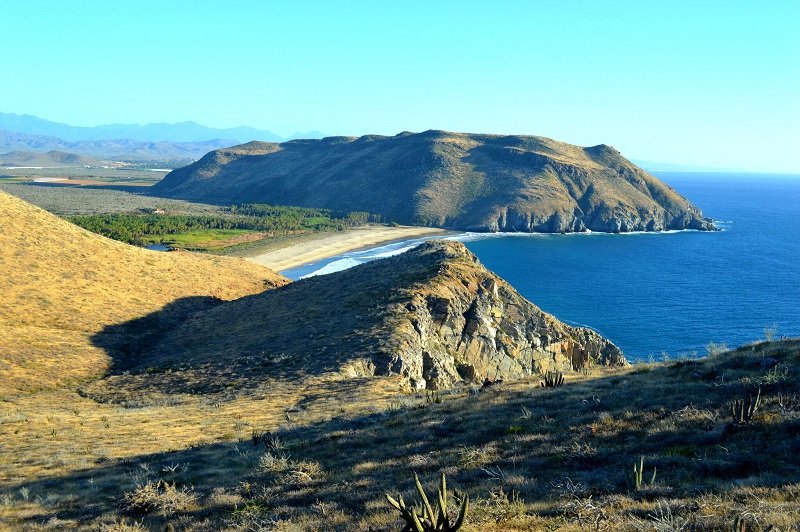
“I have always loved the Pacific side of Baja, and in 1979 I bought Rancho Gaspareño, 50 acres of remote land along a quarter mile of the Pacific coastline, not too far from Todos Santos. One of the people who drew me to the area was Carmen Salgado Agramont. She had a little cantina with a hitching post out front for horses where she’d serve up warm beer and hot food. She was quite savvy, and bought the first gas refrigerator in the area. She almost couldn’t keep up with ranchero demand for cold beer after that, and there were always dozens of horses around her cantina. I loved that place, and it was Carmen’s son who set me on the path to buying the ranch, which actually has the name and signature of Benito Juarez on the original land grand title. Since then I’ve been growing coco palms on the ranch, and have also been experimenting with growing plants from Hawaii like breadfruit that have excellent potential in Mexico.”
Greg loves the history of the area. “Rancho Gaspareño was named after a Spanish galleon that went aground on the point, the Gaspareño. It was one of the so-called Manila galleons, Spanish ships that sailed between the Philippines and Acapulco for 250 years, bringing spices, silks and other luxuries from the far east to New Spain. All these galleons sailed the Pacific coast of Baja on their way to Acapulco, so naturally enough the area became riddled with pirates, many of them English and Dutch. There are many tales of buried pirate treasure in the area, and local school groups still come to explore the cave at Rancho Gaspareño each year to tap into the lore. Treasure hunters have reason for optimism; in 1974 when the road from La Paz to the ferry terminal at Pichilingue was being built, a pirate chest of plundered loot was discovered by road workers.”
“I think of this part of the Baja coastline as the forgotten area” continues Greg. “People drive past Rancho Gaspareño going a hundred miles an hour on the new 4-lane highway and have no idea of the history of the area.” The Guaycura and Pericue Indians were the original inhabitants before the Jesuit’s arrival in 1697, and they were essentially wiped out by the time the Jesuits left in 1768. The Jesuits built their theocracy based on a promise to the King of Spain to get rid of the pirates who were plundering his ships, and the pirates faded away with the demise of the Manila galleons in 1815. Dominican Padre Gabriel González had a ranch near Gaspareño from 1825 to 1850, and the tobacco, rum, sugar, corn, and livestock he produced there made him the richest man in Baja California. From his ranch the padre engaged in espionage and guerilla warfare during the Mexican-American war of 1846-1848, and – thanks in part to the Padre – Mexico won a major victory near Gaspareño (but lost the war). By 1855 the Padre had lost his political backing and left Baja for good. For the next one hundred years entrepreneurs made fortunes in the sugar cane industry with fields in areas like Gaspareño, but in the 1950s a severe drought and price drop lead to the demise of the industry; the last sugar processing plant closed in 1974. In that same year the trans peninsular highway made its way to Todos Santos, bringing new life to the town, and in 1985 renowned artist Charles Stewart arrived from Taos, planting the seed for Todos Santos’ current incarnation as an artists’ colony. It remains an agricultural center and surfing hotspot, only now it is firmly on the radar of major developers.
62 years after his first trip down the Baja peninsula, Greg is ready to carve out a little hacienda for himself and his art collection, but let someone else take over the bulk of the land that is Rancho Gaspareño. He has kept his 50 acres wild and free, but would love to see someone with vision and passion create a place of beauty that celebrates the area’s thrilling past, and embraces an artistic, sustainable future. Someone who started building their own private Todos Santos the first time they laid eyes on it.
Of course, letting go of a big piece of the ranch is bittersweet for Greg. Paraphrasing Colson Whitehead’s tribute to New York once more, “We can never make proper goodbyes… Maybe we become Todos Santeños the day we realize that Todos Santos will go on without us. …. Naturally we will cast a wary eye toward those new kids on the block, but let’s be patient and not judge too quickly. We were new here, too, once.” Yes indeed. A tumultuous, exhilarating, infuriating and irrevocable shift of population, outlook, culture and vision is sweeping the lower part of the Baja peninsula. It always has.
It’s the time of year when droves of homo sapiens inhabiting the upper section of the North American continent give themselves over to the irrepressible urge (what scientists might call a life-preserving instinct) to seek out the warm sand and cool vibes of Baja California Sur. Following the great highway routes mapped out by their ancestors, they migrate south in their Volkswagen campers, Airstreams, and Harleys, the miles made short and their dreams made large by the great beach music of their elders. When they arrive there is much feasting and celebrating (in a greatly reduced version of their native garb) as they share stories of their great migrations, some of which are over 4,000 miles long!
The neighbors are unimpressed. Take the North Pacific loggerhead sea turtle (Caretta caretta) for example. These loggerheads begin life on the shores of Japan, and many appear content to spend the balance of their days foraging for crab, jellyfish and other delicacies in the central Pacific. But just as with our homo sapiens, there are some outliers among the loggerheads who feel the irresistible pull of Baja California Sur, and swim 9,000 miles (14,500 km) to the waters of Baja in nothing more than the shell they were born in. Being cold-blooded, loggerheads need warm water to survive, yet this epic journey requires them to pass through 6,000 kilometers of water between Pacific basins that is so cold that Charles Darwin himself pronounced it “impassable” for the likes of sea turtles. Many species, like coral, are unable to cross this divide, yet a small group of loggerheads regularly makes the trip.
For years this feat remained a mystery, with scientists simply unable to account for the Japanese-born loggerheads showing up in the abundant feeding grounds of Baja. Then they got focused, and between 1997 and 2013 researchers in Japan and the US tagged hundreds of adolescent loggerheads and published their findings in April 2021. It turns out that the young loggerheads migrate in the years when the ocean surface temperature is much warmer than usual due to natural phenomena such as marine heat waves and El Niño. These conditions create a thermal corridor that allows the young turtles to keep swimming in warm water all the way to Baja. Mystery solved!
But what prompted the scientists to get focused? Adelita of course. Adelita was a loggerhead turtle who was captured off the coast of Baja as a juvenile and raised in captivity. She was released in 1996 with a satellite tag attached to her back, and proceeded to amaze the world by traveling over 14,000 kilometers across the Pacific Ocean, becoming the first animal to cross an ocean basin while being tracked. It was Adelita who confirmed to scientists that the loggerheads seen in Japan, the central Pacific and Baja all belong to the same distinct population. It was Adelita who led to the knowledge that this population nests exclusively in Japan then spreads out across the Pacific to forage for food. It was Adelita whose journey prompted insight into the bold loggerheads who spend their youth in the blissfully warm, food-rich waters of Baja, then return to Japan at 20-30 years of age to continue the species. It was Adelita who transformed loggerheads into the stuff of migration legend.
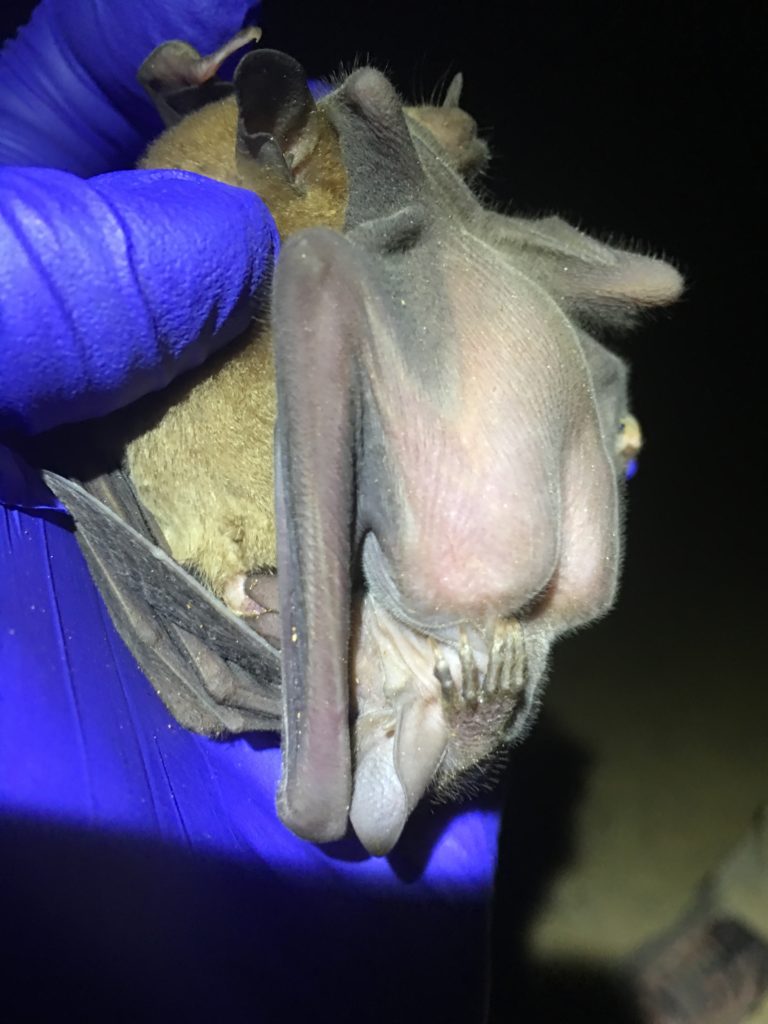
For its part, the lesser long-nosed bat (Leptonycteris yerbabuenae) may migrate only a few hundred miles each year from south-central Mexico to Baja California Sur, but the females of the species up the ante by doing it while heavily pregnant. According to Dr. Winifred Frick who has studied the bats of Baja for almost two decades, “In late March and early April the females follow the nectar corridor north from southern-central Mexico up along the Sinaloan coast, and we think they likely fly over the Sea of Cortez to the Baja peninsula. The lesser long-nosed bats are in the last stages of pregnancy when they make these spring migrations. Their feat is made all the more incredible when you realize that bat pups are roughly a third of the mother’s weight at birth – an enormous amount of extra baggage to carry on the migration route. The females then all give birth at the same time in mid-April in what is known as a synchronous birth pulse.” (It is generally acknowledged as a blessing that the migratory homo sapiens do not follow suit.) The babies nurse for 4-8 weeks, during which time it is not unusual for the mothers to fly 60 miles in each direction, each night, to their feeding grounds to obtain the nutrition needed for both mother and pup. Dr. Frick puts this feat into human terms. “It would be like leaving your newborn at home, jogging 60 miles to find a pop-up grocery store, eating all your meals at once, then jogging 60 miles home to your newborn.” In the process of feeding, the lesser long-nosed bats act as major pollinators for Baja California’s agaves and columnar cacti. When the cacti are pollinated and the babies are weaned, the cloud of bats then migrates back to the Mexican mainland. A very satisfactory migration job completed!
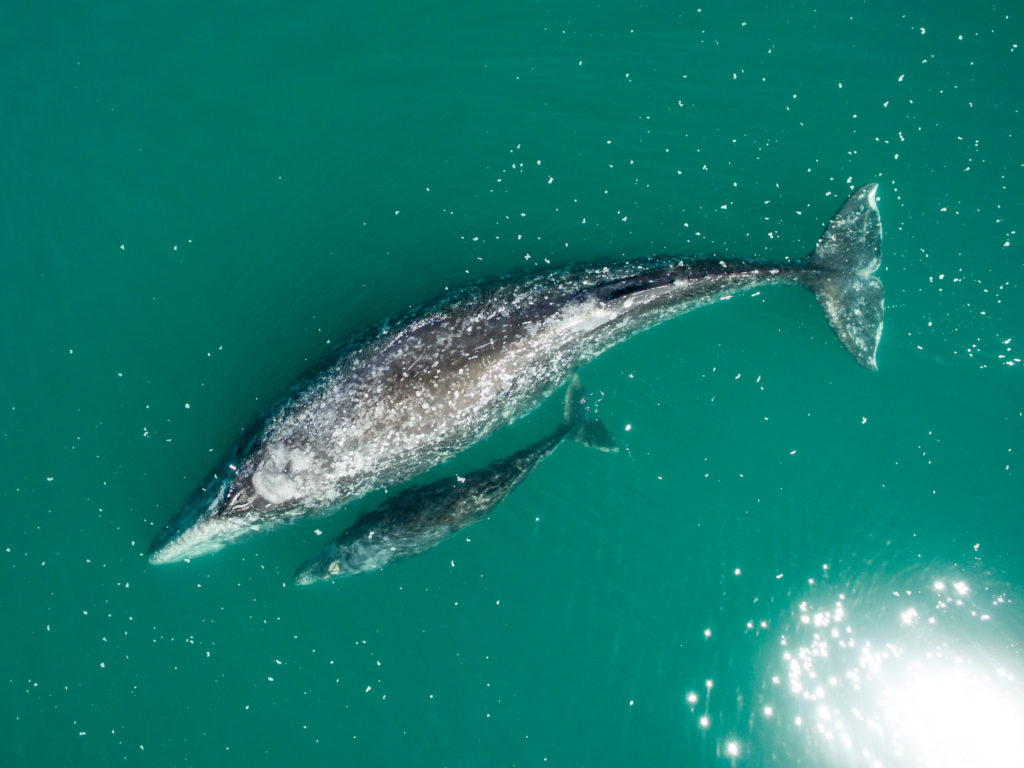
Given their enormous size and intelligence, it may not seem fair to bring gray whales (Eschrichtius robustus) into the Baja migration discussion. After all, over the average gray whale’s lifetime of annually migrating the roughly 12,000 miles roundtrip between the feeding grounds of the Arctic and the breeding grounds of Baja, they will have traveled the equivalent of a return trip to the moon. But the gray whales aren’t resting on their migratory laurels. In 2010 a gray whale showed up off the coast of Israel, then moved on to Spain before dropping off the scientific radar. Three years later a different gray whale swam the longest distance ever recorded in a marine vertebrate, more than 16,700 miles, lingering off the coast of Namibia for a bit before vanishing to parts unknown. (A leatherback turtle had previously held the world record of 12,774 miles across the Pacific. She couldn’t be reached for comment for this article.) National Geographic reports that scientists were so discombobulated by seeing gray whales on the wrong side of the world – they had never seen one outside of the Pacific Ocean before – that one compared the feeling to walking down a street in California and seeing a giraffe.
But these two whales just might just be the vanguard in a new migratory pattern for gray whales. Or, more precisely, the dusting off of an old one. Research suggests that millions of years ago gray whales lived in both the Atlantic and Pacific. The planet later cooled and an impenetrable Arctic barrier formed between the two populations, which then may have evolved into two distinct species. If so, then it is likely that the Atlantic gray whales are what naturalists of the 18th century called “scrag whales” and that they were decimated by the whaling industry while the Pacific whales survived. DNA and carbon isotopes from the bones of Atlantic whales proved to scientists that the Pacific and Atlantic gray whale populations are still closely related. In fact, it shows that the Pacific gray whale was responsible for colonizing the Atlantic Ocean, not just in a one-off, fluke event, but several times across the ages. As National Geographic puts it, the data proves that “Pacific gray whales have periodically swum across the Arctic Ocean and into the Atlantic and established populations that survived for millennia. The scientists can identify several waves of immigration. One took place about 79,000 years ago, and then three others happened more recently, between about 10,000 and 5,000 years ago.”
The loggerheads know how they did it: warm water, at least relatively speaking. 70,000 to 135,000 years ago the climate was so warm that the Arctic Ocean was open all year round, allowing the Pacific gray whales to freely migrate to the Atlantic. A new ice age cut off the Arctic once again, but when it ended 60,000 years later the Pacific gray whales renewed their Arctic passages to the Atlantic. A later cooling again closed the route, but now that the migrating homo sapiens are warming up the Arctic in record time, perhaps more gray whales will follow the lead of their friends spotted in Israel and Namibia, and strike out across the ice-free Arctic Ocean, looking to colonize the Atlantic once again.
Migrations long and short are a theme of life in Baja. In March and June thousands of mobula rays congregate to mate in the Sea of Cortez bays around La Paz and La Ventana, then migrate over 300 miles to the Pacific side of the peninsula. In spring and autumn each year the small Red Knot bird (Calidris canutus roselaari) follows the Pacific Flyway 9,300 miles from the Arctic to Tierra del Fuego – then back again – bulking up on nutritious grunion eggs along the Sea of Cortez each way. No matter the species or their origin, the migrators are part of the magic pull and thrill of Baja as we marvel at and celebrate their victories over incredible obstacles to reach the peninsula’s life-giving shores. As Thoreau may have mused, the homo sapiens who migrate to Baja may find that it is not the margarita they sought but the tonic of wildness they found of which they can never have enough. And that is as life-affirming a reason for migration as ever there was.
Notes:
Thanks to Jose Sanchez of PureBajaTravels.com for inspiration on gray whale travels through the Arctic.
Details on the scientific research related to gray whale migrations across the Arctic came from Carl Zimmer’s article in National Geographic, Whales on the Wrong Side of the World.
The Stanford study on loggerhead turtle migrations was originally published in Frontiers of Marine Science.
Todos Santos Eco Adventures (TOSEA) is the leading eco adventure company in Baja California Sur. TOSEA invites you to join them in the following initiatives to help preserve the habitats of Baja California that both our native and migratory species depend on:
Carbon Capture with Tomorrow’s Air. TOSEA is a carbon capture education partner with Tomorrow’s Air, and to date has supported the removal of one ton of carbon dioxide from the air. All homo sapiens who migrate to Baja are invited to join TOSEA in supporting this incredible project that was awarded Newsweek’s 2021 Future of Travel Award in the Visionary category
– it is not carbon offset, it is actually removing CO2 from the air and storing it deep underground. www.tomorrowsair.com.
Zero Waste Alliance of Todos Santos and Pescadero (ZWA). TOSEA is a proud supporter of the ZWA which is actively working to reduce the amount of waste that goes to the local landfill and build circular economies around that waste. All homo sapiens, both native and migratory, are invited to join the movement! www.facebook.com/alianzacerobasuratodossantos




 time for.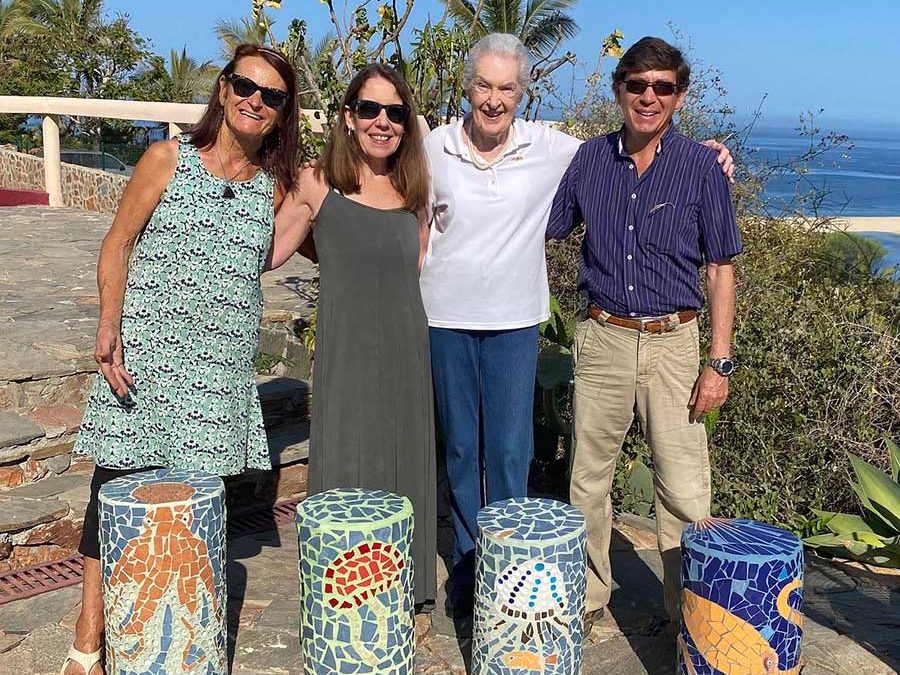
 “The International Community Foundation (ICF) founded the Alianza Para la Seguridad Alimentaria (ASA, or BCS Food Security Alliance) in 2014 as an alliance of nonprofits, business owners, government agencies and individuals committed to addressing food insecurity in southern BCS” notes McKenzie Campbell, a program officer with the ICF. “When the pandemic slammed into Mexico in March 2020, BCS was one of the hardest hit states because of its heavy reliance on tourism. Food assistance groups exploded across the state, and by December 2020 many of these groups were serving more than twice their pre-pandemic population.” Because BCS did not have a state foodbank, these groups were spending precious time and resources sourcing ingredients. ASA mobilized to effectively become a mobile food bank for these groups, supporting their efforts with the distribution of despensas (packages of donated food and hygiene essentials) to the informal communities. Continues McKenzie, “It was when we were actively distributing despensas that we realized that without a formal government safety net or a reliable food supply, these communities would be in a constant state of crisis. The pandemic really showed that we needed a permanent solution to addressing food security in BCS.”
 The food bank program is a remarkable testimony to ASA’s focus. Says Luis, “We are really excited about the progress that’s been made with the Sudcaliforniano food bank, and we expect it to be fully functioning with a presence in La Paz and Los Cabos by the end of 2022. We have secured warehouse space in both locations, and we’re working hard to source necessary items like trucks and cold storage.” The core of the food bank program is food recovery and redistribution, salvaging food that is deemed unsellable or unusable by producers and getting it to vulnerable populations. Notes McKenzie, “Around the world 40% of all food produced in the world is wasted and all those inputs lost. In Mexico, 20 million tons of food are wasted every year, enough to feed 70% of the population living in poverty. One of ASA’s first efforts was to assess food waste hot spots in BCS, then implement recovery, redistribution and prevention strategies.” Continues Luis, “In 2021 ASA provided 34 tons of recovered food to 5,800 individuals. Our goal is to be providing recovered food to 12,000 people on a regular basis by the end of 2022.” The Sudcaliforniano food bank is now affiliated with BAMX, Mexico’s national food bank program, and partners with its prepared food donation program, Al Rescate. It also receives and distributes regular donations from several Walmart-affiliated stores, Carl’s Junior and Earth Ocean Farms.
 “Another thing we found when distributing despensas to the informal communities during the pandemic was that women were taking leadership roles and doing what needed to be done to protect not just their own families, but also the most vulnerable in their communities” recalls McKenzie. ASA’s second key initiative, community health and resilience, is designed to amplify that leadership, and give these women the tools they need to be even more effective. Continues Luis, “This program is multifaceted. Not only do we work with these women on leadership skills like decision-making, negotiating, effective communication and teamwork, but also on personal finance skills and small business administration skills. We help develop their skills to determine what is the most nutritious food they can buy for their families with the money that they have.” The program also teaches hurricane and emergency preparedness and response, including basic first aid, fire management, hurricane alert and preparedness systems and control centers for emergency response.
 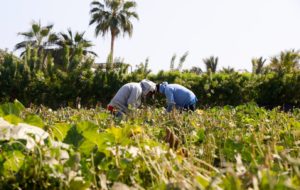 Raíz de Fondo is another community force based in La Paz. Founded by Erika Goetz 12 years ago as a community garden in a dirty, abandoned lot in downtown La Paz, Raíz de Fondo is now a driving force for nutrition, food security and sustainable living across the city. The group provides workshops to schools and communities on how start their own gardens, providing garden kits as well as on-going instruction on composting and nutrition. The program has been so successful that when the Secretary of Education (SEP) decided to launch a nutrition and wellness curriculum in elementary and preschools, Raíz de Fondo was tapped to train the teachers in their school garden program to deliver the curriculum.
 The third pilar of ASA’s food security platform in BCS is creating thriving local foodsheds by boosting the capacity of small and mid-sized farmers to produce healthy food for the local market. In June 2021 ASA started an “Agroecological Learning Collective” focused on the transition to a regenerative production model, employing farming techniques that improve soil quality. Currently 7 producers from 3 farms are participating in the pilot collective and have received 60 hours of technical assistance and 30 hours of regenerative management consulting. There is a great deal of excitement around this project, and local businesses like Sueno Tropical, Rancho Cacachiles and Baja Regenerative Farms are all pitching in with invaluable advice on production planning, crop selection and marketing. ASA’s Food Hub goal is to be the currently missing link of aggregation, distribution and marketing between local small and mid-sized producers and regional buyers and consumers.
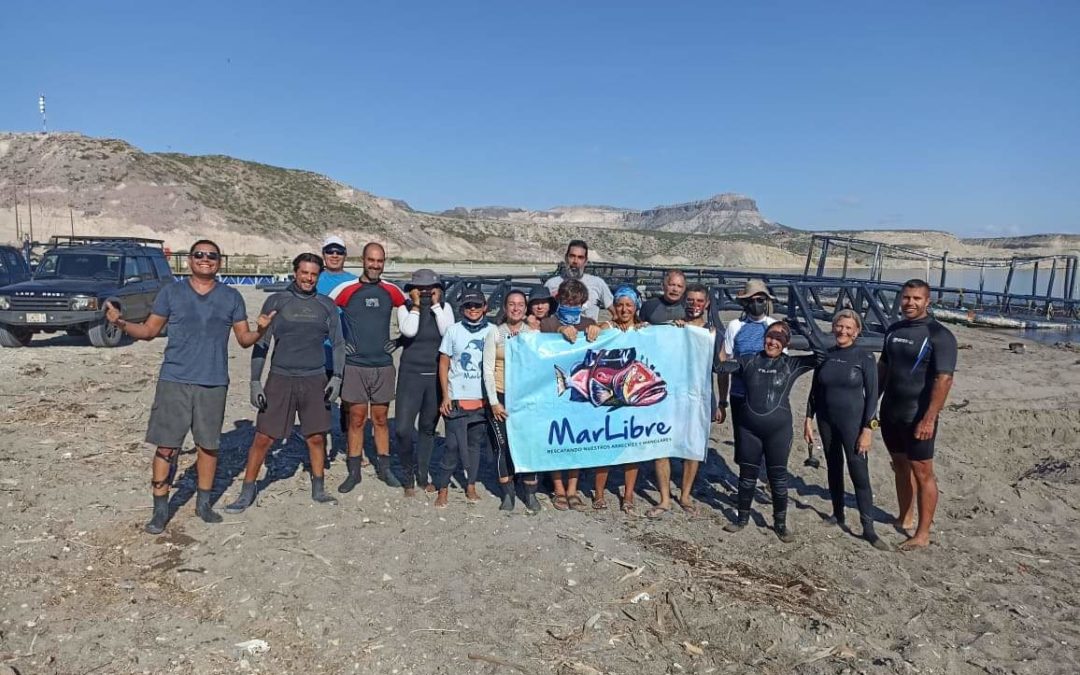
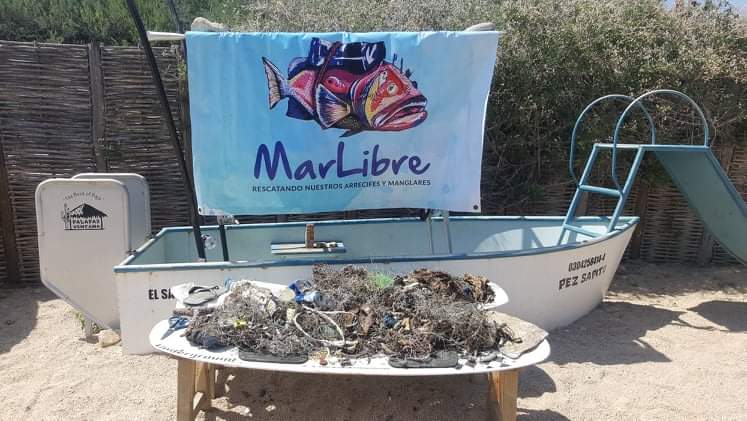 Like many of the best things in life, Mar Libre was born over drinks by friends kvetching about the state of things. “When you get biologists together, the conversation invariably veers to how bad things are in the natural world” says Pablo Ahuja, one of the founders of Mar Libre. “On this particular night we were all complaining about how we couldn’t enjoy diving at San Rafaelito in the Sea of Cortez anymore because every time we went, we’d have to spend all of our time and air picking fishing line off the coral. This is painstaking work that must be done very carefully so the coral doesn’t get damaged.” Pablo continues, “Right then and there we decided that instead of cleaning up areas incidentally when we were out diving, we’d start diving with the purposeful intent of cleaning these natural areas.”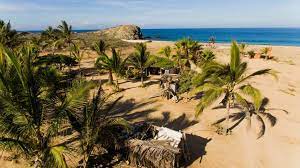


 For its part, the lesser long-nosed bat (Leptonycteris yerbabuenae) may migrate only a few hundred miles each year from south-central Mexico to Baja California Sur, but the females of the species up the ante by doing it while heavily pregnant. According to Dr. Winifred Frick who has studied the bats of Baja for almost two decades, “In late March and early April the females follow the nectar corridor north from southern-central Mexico up along the Sinaloan coast, and we think they likely fly over the Sea of Cortez to the Baja peninsula. The lesser long-nosed bats are in the last stages of pregnancy when they make these spring migrations. Their feat is made all the more incredible when you realize that bat pups are roughly a third of the mother’s weight at birth – an enormous amount of extra baggage to carry on the migration route. The females then all give birth at the same time in mid-April in what is known as a synchronous birth pulse.” (It is generally acknowledged as a blessing that the migratory homo sapiens do not follow suit.) The babies nurse for 4-8 weeks, during which time it is not unusual for the mothers to fly 60 miles in each direction, each night, to their feeding grounds to obtain the nutrition needed for both mother and pup. Dr. Frick puts this feat into human terms. “It would be like leaving your newborn at home, jogging 60 miles to find a pop-up grocery store, eating all your meals at once, then jogging 60 miles home to your newborn.” In the process of feeding, the lesser long-nosed bats act as major pollinators for Baja California’s agaves and columnar cacti. When the cacti are pollinated and the babies are weaned, the cloud of bats then migrates back to the Mexican mainland. A very satisfactory migration job completed!